BIFMA Certified Office Furniture: What Malaysian Buyers Must Know
BIFMA certified office furniture separates chairs that survive a decade from chairs that fail within three years. Most procurement officers in Malaysia spot the BIFMA label on product sheets. Then they skip past it, treating it as another acronym.
That’s a costly oversight. BIFMA compliance means the product passed independent mechanical tests. Those tests simulate over 10 years of commercial use. For businesses furnishing 50 or more workstations, it’s the most reliable signal your investment won’t become a replacement expense.
This guide covers what BIFMA tests, why it connects to Malaysian workplace safety, and how to write it into your procurement specs.
Key Takeaways
- BIFMA compliance means office furniture has passed independent durability, safety, and stability tests simulating more than a decade of daily commercial use.
- The standard is voluntary worldwide, but Malaysia’s DOSH seating guidelines and expanded OSHA 1994 create employer obligations that BIFMA-compliant furniture helps satisfy.
- A 102 kg drop test repeated 100,000 times is one of 20 tests under ANSI/BIFMA X5.1 for office chairs.
- Always request a BIFMA test report from the supplier, not just a marketing claim, and check the BIFMA Compliant registry for independent verification.
- BIFMA-compliant furniture typically lasts 10 or more years in single-shift use, reducing total procurement cost by avoiding early replacements.
What BIFMA Testing Puts Your Office Chair Through
What does BIFMA stand for and what does it test?
BIFMA stands for the Business and Institutional Furniture Manufacturers Association. It’s a non-profit organisation founded in 1973. It develops voluntary safety, performance, and sustainability standards for commercial furniture alongside ANSI.
Here’s what catches most buyers off guard. BIFMA doesn’t “certify” furniture the way ISO certifies management systems. Products are tested against BIFMA standards by independent labs. Those that pass are described as “BIFMA compliant.” The distinction matters for procurement specs.
According to BIFMA’s standards overview, the organisation maintains standards for chairs, desks, tables, lounge seating, and more. Each standard defines mechanical tests with pass/fail criteria. Labs like SGS, Intertek, and Bureau Veritas administer them.
The tests aren’t gentle. They compress years of real-world abuse into weeks of lab punishment. And they’re the closest thing the furniture industry has to a crash-test rating.
Furniture that survives BIFMA testing has proven it can handle the worst your office throws at it, day after day, for a decade.
How does ANSI/BIFMA X5.1 test office chairs?
ANSI/BIFMA X5.1 is the standard you’ll encounter most often. It covers general-purpose office chairs with 20 individual tests. These tests are designed for users weighing up to 125 kg. They simulate more than 10 years of single-shift daily use.
Here’s what a chair must survive before it earns approval:
| Test category | What happens | Cycles or load |
|---|---|---|
| Seat drop impact | A 102 kg bag drops onto the seat from 30 mm height | 100,000 cycles |
| Tilt mechanism durability | The tilt system is cycled under full load | 300,000 cycles |
| Back strength (static) | 68 kg of force pushes against the backrest | Single application, no failure allowed |
| Caster and base durability | Loaded chair rolls over a threshold strip repeatedly | 200,000 cycles |
| Swivel test | The seat rotates under load | 100,000 cycles |
| Stability (tip-over) | Loaded chair is tested for tipping in all directions | Must not tip |
| Arm strength | Downward and outward force applied to each armrest | 100,000 cycles each direction |
That seat drop test alone means a 102 kg weight crashes into the seat 100,000 times. Picture someone sitting down hard, every few seconds, for weeks straight. A chair that passes this isn’t just durable. It’s built for conditions far harsher than your office will ever produce.
BIFMA also publishes ANSI/BIFMA X5.5 for desk and table products, covering structural load, stability, and durability for work surfaces. If you’re furnishing complete workstations, both standards apply.
Chairs designed for heavy-duty environments face even tougher protocols. The tilt durability test runs 300,000 cycles for good reason. Understanding how tilt mechanisms affect daily chair performance shows why that number matters for commercial seating.
What is the difference between BIFMA compliance and BIFMA certification?
This distinction trips up procurement teams regularly, and getting it wrong weakens your tender specifications.
BIFMA does not certify individual products. It publishes performance standards. When a manufacturer says their chair is “BIFMA certified,” they typically mean something different. The product was tested by an independent lab and found to comply with BIFMA standards. That’s compliance, not certification.
Two levels of verification exist. Self-declaration means the manufacturer states compliance based on their own testing or a hired lab’s results. The BIFMA Compliant registry, launched in 2021, goes further. Products listed on this registry have undergone independent third-party verification and are publicly searchable.
When writing procurement specs, ask for a test report from an accredited lab. A marketing brochure that says “meets BIFMA standards” is not the same as a test certificate from SGS or Intertek.
Low-emission materials add another layer. Manufacturers pairing BIFMA structural testing with Greenguard Gold certification for healthier indoor air quality cover both mechanical and chemical safety.
A marketing brochure claiming “meets BIFMA standards” carries zero verification weight without an independent lab test report to back it up.
Why Malaysian Businesses Should Require BIFMA Compliance
Is BIFMA compliance mandatory for office furniture in Malaysia?
BIFMA standards are voluntary worldwide. No Malaysian law requires office furniture to carry BIFMA compliance. But the practical answer is more complex than the legal one.
Malaysia’s OSHA 1994 was expanded by the 2022 Amendment Act. Effective June 2024, it now applies to all workplaces. Employers must conduct risk assessments and ensure employee safety. Penalties for non-compliance reach RM500,000.
DOSH’s ergonomic compliance framework covers four updated guidelines, mandatory risk assessment, and adjustability criteria beyond what BIFMA certification addresses.
DOSH (Department of Occupational Safety and Health) published updated Guidelines on Occupational Safety and Health for Seating at Work in 2024. These guidelines require employers to provide appropriate seating, conduct ergonomic risk assessments, and implement proper seating management systems.
BIFMA compliance doesn’t satisfy DOSH requirements by itself. But it provides documented evidence that your furniture meets internationally recognised safety and durability benchmarks. When DOSH asks how you assessed your office seating risk, a BIFMA test report is a concrete answer. A furniture invoice is not.
BIFMA compliance won’t replace a DOSH risk assessment, but it gives your assessment documented evidence instead of guesswork.
How does BIFMA connect to DOSH workplace seating guidelines?
The 2024 DOSH seating guidelines address musculoskeletal disorders linked to prolonged sitting. The numbers are alarming. A study in Applied Ergonomics found that 92.8% of Malaysian office workers reported musculoskeletal discomfort over six months. Physical demands at the workstation drove 61% of that risk.
DOSH requires employers to evaluate seating arrangements whenever new furniture is introduced or employees report discomfort. The guidelines recommend documented evidence that seating meets ergonomic standards.
BIFMA’s G1 ergonomic guideline goes beyond structural testing. It specifies seat height ranges, depth adjustability, and backrest dimensions. These dimensions are calibrated from the 5th percentile female to the 95th percentile male. Furniture tested to these specs directly addresses the risk factors DOSH targets.
HR managers evaluating seating for employee wellbeing will find that choosing the right ergonomic chair in Malaysia bridges the gap between BIFMA compliance and daily comfort.
What does BIFMA-compliant furniture save over 10 years?
The real cost of office furniture isn’t the purchase price. It’s what you spend over a decade of use.
Merryfair has manufactured office furniture since 1974. Five decades of supplying corporate clients reveals a pattern. Non-compliant furniture generates 3 to 5 times more replacement costs within five years.
Here’s a simplified total cost of ownership comparison for a 100-seat Malaysian office:
| Cost factor | Non-compliant chairs | BIFMA-compliant chairs |
|---|---|---|
| Unit price (avg) | RM400-600 | RM800-1,500 |
| Initial outlay (100 units) | RM40,000-60,000 | RM80,000-150,000 |
| Replacement rate (years 1-5) | 30-40% of units | Under 5% of units |
| Replacement cost (5 years) | RM12,000-24,000 | RM4,000-7,500 |
| Warranty coverage | 1-2 years | 5-10 years |
| Estimated lifespan | 3-5 years | 10-15 years |
| Total cost per chair over 10 years | RM800-1,400 | RM800-1,500 |
[REFRESH NOTE: pricing ranges should be verified against current market data every 12 months]
The upfront difference shrinks fast. By year five, total spend converges. By year eight, compliant furniture costs less. And that calculation skips reduced sick days. A systematic review in PMC connects better ergonomic support to musculoskeletal disorder prevention.
By year eight, BIFMA-compliant chairs cost less per seat than cheap alternatives that needed replacing twice.
Comparing ergonomic chairs across every budget tier reveals how sharply the cost-per-year drops as build quality and compliance improve.
How to Specify BIFMA Compliance in Your Procurement Process
What should a BIFMA procurement specification include?
Most procurement documents mention BIFMA as a checkbox. That’s not enough. A proper specification protects your organisation from suppliers who claim compliance without evidence.
Merryfair’s procurement team recommends the BIFMA Procurement Readiness Checklist. It’s a four-step verification process for corporate buyers:
- State the exact standard. Write “Must comply with ANSI/BIFMA X5.1-2017 (R2022) for office chairs.” Vague phrases like “meets industry standards” give suppliers an out.
- Require a test report from an accredited lab. Specify labs with ANSI accreditation or ISO 17025. SGS, Intertek, TUV, and Bureau Veritas are solid choices. Self-declared compliance isn’t equivalent.
- Check the BIFMA Compliant registry. Products listed at bifma.org have passed independent verification. Ask suppliers for their listing or a reason it’s absent.
- Pair BIFMA with complementary standards. Specify ISO 9001, Greenguard Gold, and the relevant BIFMA standard together. This triple stack covers the product, factory, and air quality.
Writing “meets industry standards” in a tender document gives every supplier an escape route. Name the exact BIFMA standard and demand the lab report.
The guide on sourcing BIFMA certified furniture for corporate fit-outs covers the full 5-Point Supplier Fit Test for Malaysian buyers.
How do you verify if a supplier’s furniture is BIFMA compliant?
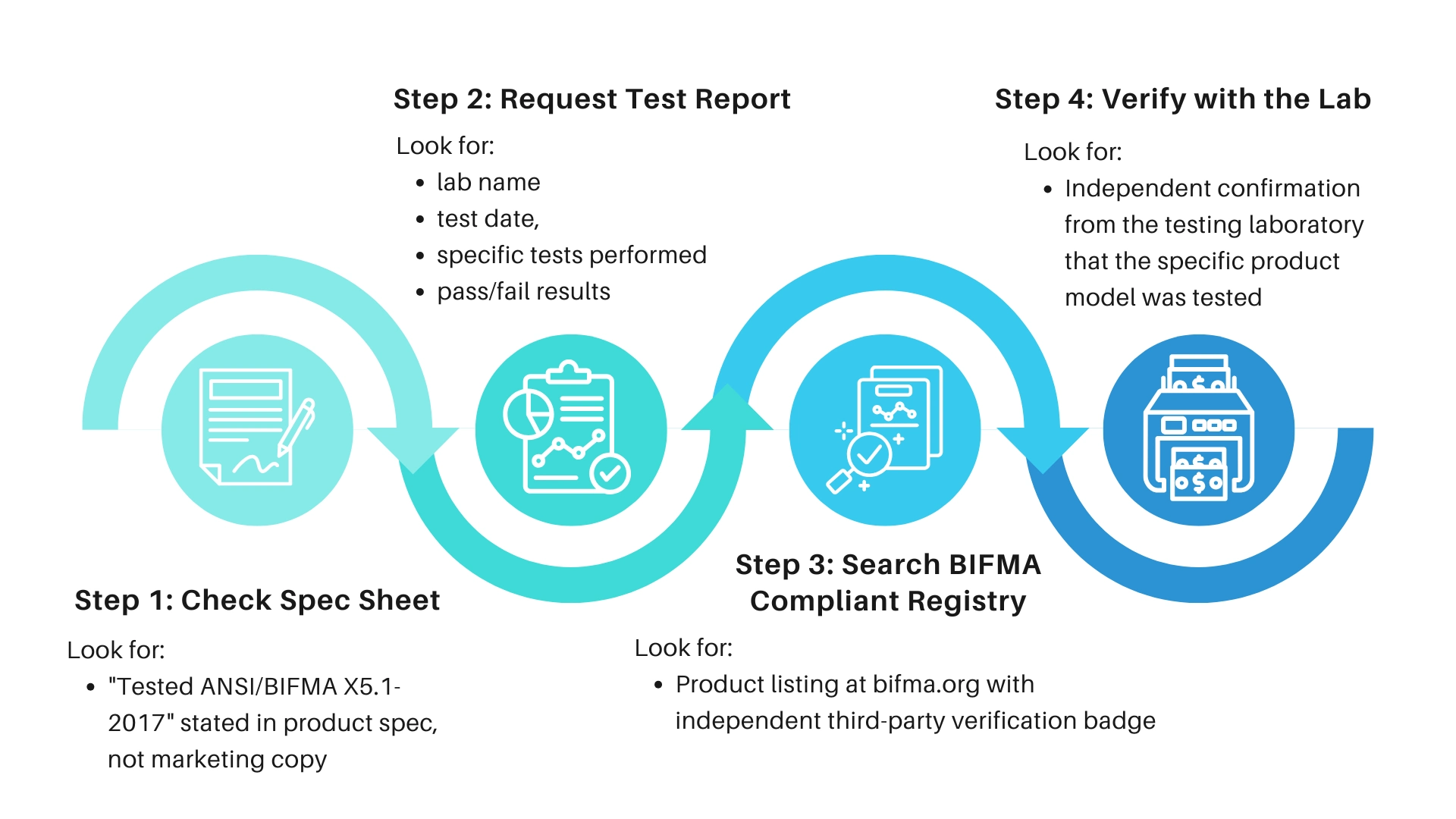
Four verification methods, ranked from easiest to most thorough:
Check the product specification sheet first. Manufacturers proud of their testing state the exact standard on the spec page, not buried in marketing copy. Look for language like “Tested to ANSI/BIFMA X5.1-2017.”
Request the test report directly. A reputable supplier shares the full report, including the lab name, date of testing, specific tests performed, and results. If they hesitate, that tells you something.
Search the BIFMA Compliant registry online. This public database lists products that have passed independent verification. Not all compliant products are listed (it’s voluntary), but those that are have the strongest documentation.
Ask which lab conducted the testing. Accredited labs maintain their own records. You can verify independently that the testing actually occurred.
If a supplier can’t produce a test report within 48 hours, their BIFMA claim deserves scrutiny.
Your Next Office Furniture Decision Starts with One Question
Before your next furniture purchase order, ask one thing. Can the supplier prove their products meet ANSI/BIFMA standards?
That question separates commercial-grade furniture from consumer-grade products sold at commercial prices. It protects your budget from early replacements. It gives your DOSH risk assessments documented backing. And it ensures every employee sits in a chair engineered to last.
Use the BIFMA Procurement Readiness Checklist. Name the standard. Demand the lab report. Check the registry.
There are many factors to consider when you are trying to select the best office furniture supplier in Malaysia for your specific business type, and BIFMA should be in the procurement team’s list.
At Merryfair, we manufacture BIFMA-compliant office chairs, system furniture, and desking solutions from our 65,000 sqm facility in Klang. Every seating product carries independent BIFMA test reports, ISO 9001 quality management certification, and Greenguard Gold low-emission certification. Explore our complete range of
BIFMA-compliant seating products or contact our project team for a corporate consultation.
One question separates a furniture investment from a furniture expense: can the supplier prove BIFMA compliance with an independent test report?
Frequently Asked Questions
What does BIFMA certification mean for office furniture?
BIFMA compliance means office furniture has been independently tested for safety, durability, and structural integrity. These standards are set by the Business and Institutional Furniture Manufacturers Association. Tests simulate over 10 years of daily commercial use. Products that pass are described as “BIFMA compliant.”
Is BIFMA compliance the same as ISO 9001?
No. BIFMA tests the product itself for durability, safety, and structural performance. ISO 9001 certifies the manufacturer’s quality management system across design, production, and delivery processes. BIFMA confirms the chair works. ISO confirms the factory follows documented quality procedures. Both matter for corporate procurement.
Can small businesses in Malaysia benefit from BIFMA-compliant furniture?
Yes. BIFMA compliance applies regardless of company size. A chair tested to withstand 100,000 seat drops protects a 5-person startup and a 500-person corporation equally. For SMEs, the longer lifespan and lower replacement rate often justify the premium within two to three years.
What is the difference between BIFMA and EN 1335?
BIFMA is a North American standard focused on durability, safety, and structural integrity through mechanical stress testing. EN 1335 is a European standard focused on ergonomic dimensions, adjustability, and posture support. They complement each other. BIFMA proves the chair won’t break. EN 1335 proves the chair fits the human body correctly.
How long does BIFMA-compliant office furniture typically last?
BIFMA testing simulates more than 10 years of single-shift commercial use. In practice, well-maintained BIFMA-compliant chairs typically last 10 to 15 years in standard office environments. The actual lifespan depends on usage intensity, maintenance, and environmental conditions. Non-compliant alternatives often require replacement within 3 to 5 years.
MORE BLOGS
Standard Desk Height: Is 29 Inches Right for Your Body?
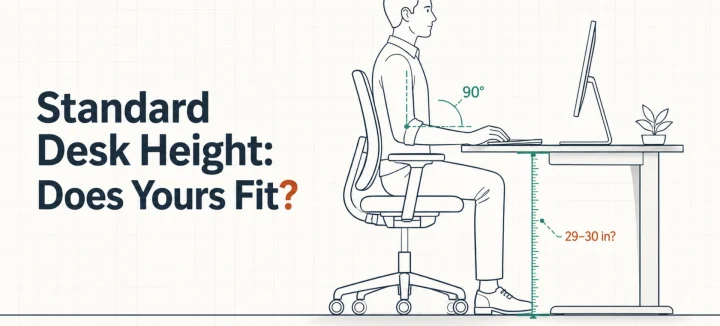
Standard desk height is 29 to 30 inches (73 to 76 cm). That number fits far fewer people than you’d think. A desktop that tall matches the seated elbow height of someone around 6’2″. The average American man stands 5’9″, and the average woman 5’3.5″. So this guide does two jobs. It shows you how […]
Read More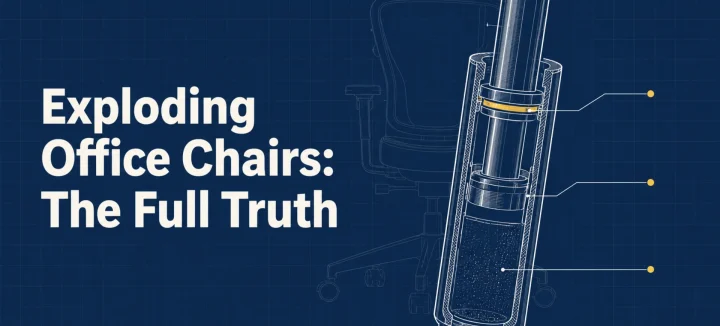
Exploding Office Chairs: The Full Truth From a Chair Maker
The exploding office chair story resurfaces every few years, same grainy photos attached. So can a chair really burst? A handful have, and every documented case involved an uncertified gas cylinder (the pressurized tube that raises and lowers your seat). Chairs built to recognized safety standards fail differently: seals leak, the seat sinks, nothing bursts. […]
Read More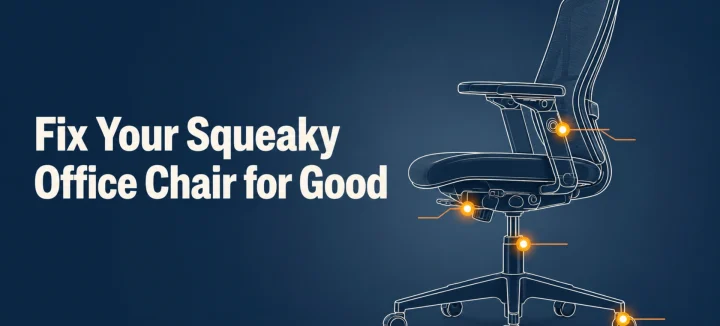
How to Fix a Squeaky Office Chair by Sound and Location
A squeaky office chair makes four different noises, and each one points to a different part. To silence it for good, find the source first: the tilt mechanism, gas cylinder, casters, or armrests. Then tighten what’s loose and lubricate with the right product for that joint. This guide matches each sound to its fix, and […]
Read More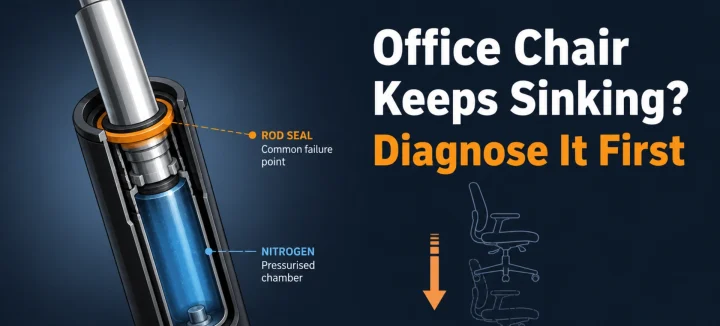
Office Chair Keeps Sinking? Diagnose and Fix It for Good
An office chair that keeps sinking or won’t stay up has one main cause: the gas cylinder under the seat is losing pressure. Worn seals let the nitrogen escape, so the piston stops holding your weight. A hose clamp or PVC pipe locks the height today; a new cylinder fixes it properly in 15 minutes. […]
Read More