How to Source Office Furniture for Corporate Fit-Outs in Malaysia
Choosing the right office furniture supplier in Malaysia can reshape the total cost of your fit-out project. Yet most procurement officers shortlist vendors on price alone.
They skip the evaluation steps that separate a smooth rollout from years of replacements. At Merryfair, we’ve supplied furniture for government offices, banking headquarters, and multinational workspaces since 1974. The pattern is consistent: failed projects trace back to supplier selection, not the furniture.
Sourcing for a corporate fit-out requires evaluating suppliers on five criteria. Those criteria are manufacturing control, certification stack, project track record, service radius, and scalability. Get these five right, and the furniture becomes the easiest part of the project.
This guide walks you through supplier assessment, the three sourcing models in Malaysia, and procurement timelines that keep fit-outs on track.
Key Takeaways
- Evaluate every office furniture supplier against five measurable criteria before requesting quotes.
- Manufacturer-direct sourcing can lower unit costs by 15-30% and gives you direct control over customisation.
- BIFMA compliance and Greenguard Gold certification confirm furniture built for 9+ hours of commercial use daily.
- Start furniture procurement 12-16 weeks before move-in to account for production, shipping, and installation.
- System furniture costs more upfront but reduces long-term renovation expenses through modular reconfiguration.
Why Corporate Furniture Procurement Fails Before It Starts
Most corporate fit-outs in Malaysia budget between RM90 and RM250 per square foot. Interior design firms across the Klang Valley consistently cite this range for projects spanning basic to premium specifications, according to KHD Interior Design. Furniture takes a large share of that spend.
And here’s where things go wrong.
Procurement teams treat furniture as a line item instead of a system. They request quotes, compare prices, and pick the lowest number. Six months later, chairs start failing and workstations can’t be reconfigured.
The problem isn’t the furniture. It’s the selection process.
What makes corporate furniture sourcing different from retail buying?
Corporate furniture sourcing differs from retail purchasing in four ways: volume commitments, compliance requirements, installation complexity, and lifespan expectations. A retail buyer picks a chair and has it delivered. A procurement officer coordinates 200 chairs across three floors with fire safety ratings and warranty terms.
Scale changes everything. At corporate volumes, you negotiate production runs, not browse catalogs. Lead times stretch from days to weeks.
Delivery involves coordinating with contractors, building management, and your operations team.
The stakes are different too. A study in Applied Ergonomics found that 92.8% of Malaysian office workers reported musculoskeletal discomfort over six months. Physical demands at the workstation drove 61% of that risk.
The furniture you choose isn’t just an expense. It’s a health decision for every person sitting in it.
Corporate buyers who understand correct sitting posture and office chair setup already know this. Cheap chairs cost more in sick days than they save at purchase.
A single poorly designed chair won’t make headlines. Two hundred of them will drain your workforce’s energy for years.
The 5-Point Supplier Fit Test for Corporate Buyers
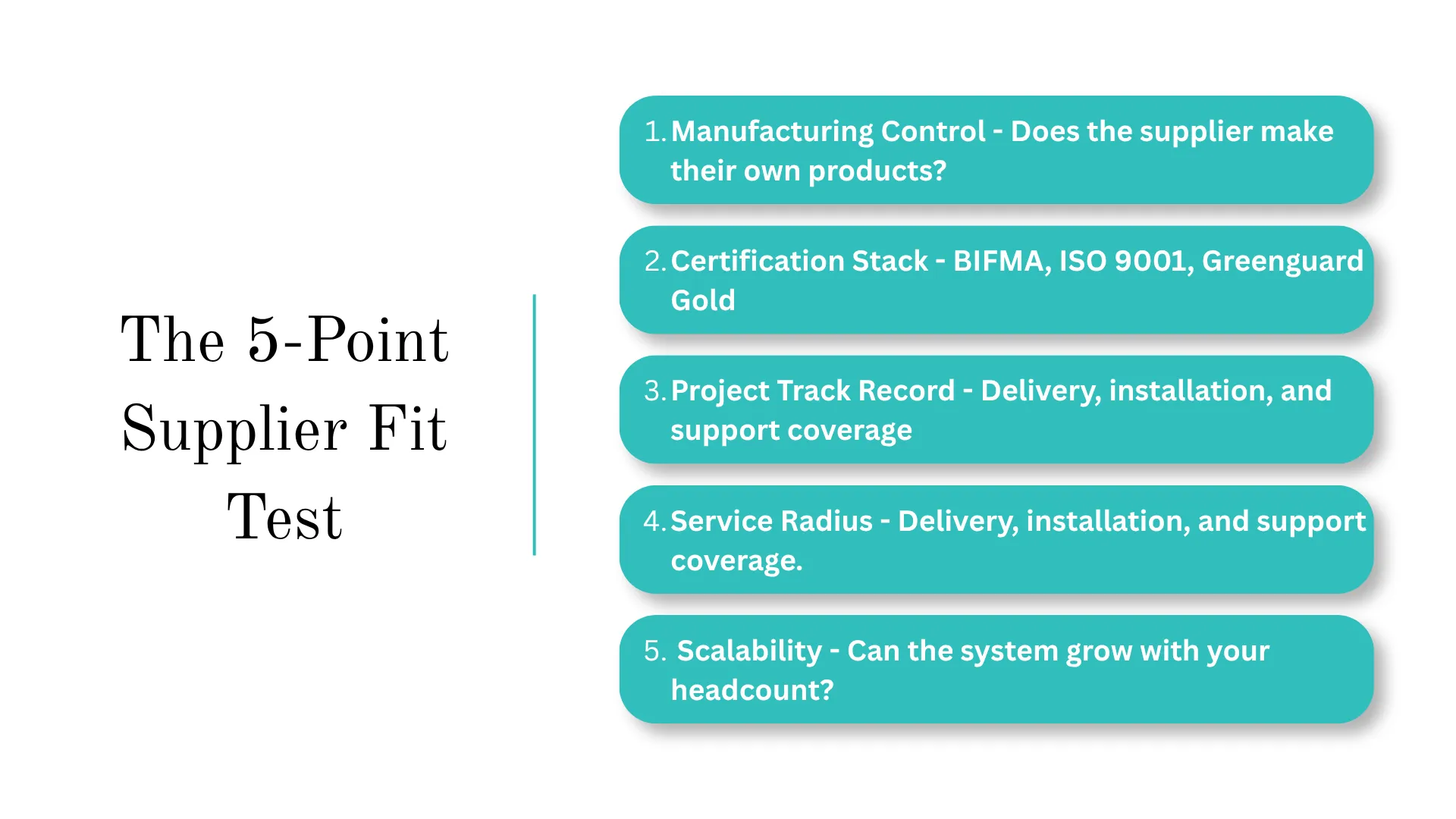
Over five decades of supplying corporate clients, we’ve identified five dimensions that separate reliable suppliers from risky ones. We call it the 5-Point Supplier Fit Test.
- Manufacturing Control. Does the supplier make their own products or resell someone else’s? In-house production means tighter quality control and faster issue resolution.
- Certification Stack. Does the product line carry BIFMA compliance, ISO 9001, or Greenguard Gold? These aren’t vanity badges. They’re third-party proof of commercial-grade durability.
- Project Track Record. Has the supplier completed fit-outs at your scale? Ask for case studies, not testimonials.
- Service Radius. Can they deliver, install, and support your location? For multi-site rollouts, ask about coverage beyond the Klang Valley.
- Scalability. If your company grows from 100 to 300 employees, can the same supplier extend your system without starting over?
Score every shortlisted supplier against these five. The highest total usually predicts three-year satisfaction better than the lowest quote.
A supplier who scores five out of five on the Fit Test will cost you less over ten years than one who wins on price alone.
Manufacturer, Dealer, or Retailer: Which Sourcing Model Fits Your Fit-Out
Before you compare suppliers, understand the supply chain you’re buying into. Three sourcing models operate side by side in Malaysia. Each comes with trade-offs your procurement team should weigh.
What’s the real cost difference between manufacturer-direct and dealer pricing?
Buying directly from a manufacturer bypasses the dealer margin. That margin typically adds 15-30% to the end price. But cost isn’t the only variable.
Here’s how the three models compare across the criteria that matter for corporate fit-outs:
| Criteria | Manufacturer-Direct | Authorised Dealer | Online Retailer |
|---|---|---|---|
| Unit pricing | Lowest (no middleman) | Mid-range (dealer margin) | Varies (promotions) |
| Customisation | Full (colours, sizes, branding) | Limited to manufacturer’s options | None or minimal |
| Lead time | 6-12 weeks (production cycle) | 4-8 weeks (from stock or order) | 1-2 weeks (ready stock) |
| Quality assurance | Direct factory QC | Depends on dealer’s process | Minimal to none |
| After-sales support | Direct from maker | Through dealer (variable) | Limited or DIY |
| Best for | 100+ unit orders, custom specs | Mid-scale offices, mixed brands | Quick small purchases |
For fit-outs furnishing 50 or more workstations, manufacturer-direct sourcing delivers better value. You pay for the product, not the distribution chain.
We operate from a 65,000 sqm facility in Klang that handles steel fabrication, plastic injection moulding, and final assembly under one roof. That vertical integration lets us offer customisation at standard lead times and resolve quality issues without routing them through a third party.
Comparing ergonomic chairs across every budget tier reveals how much the sourcing model affects what you get per ringgit.
The cheapest quote on paper is rarely the cheapest total cost over five years.
When does buying from a dealer make more sense than going direct?
Dealers earn their margin in two situations. First, when you need a multi-brand solution. No single manufacturer covers every furniture category. A dealer can combine chairs from one maker and desks from another.
Second, when speed matters more than customisation. Dealers often carry ready stock that ships in days. If your timeline is compressed (and you’re flexible on colour), a dealer fills the gap.
But there’s a caveat. Dealer-sourced furniture makes warranty claims harder to resolve. You add a layer between yourself and the factory. For a 5-year or 10-year warranty, that layer matters.
How to Evaluate an Office Furniture Supplier in Malaysia
You’ve chosen a sourcing model. Now you need to evaluate specific suppliers. This section turns the 5-Point Supplier Fit Test into actionable steps.
What certifications should corporate office furniture have?
Three certifications matter most for corporate procurement in Malaysia.
BIFMA compliance tests furniture for structural integrity, durability, stability, and ergonomic performance. According to BIFMA’s standards overview, their protocols simulate years of intensive use. A BIFMA-compliant chair handles 9+ hours of daily use without structural failure.
ISO 9001 confirms the manufacturer follows a quality management system across design, production, and delivery. It tells you the factory runs on documented processes.
Greenguard Gold certification tests for chemical emissions. Office furniture releases volatile organic compounds from adhesives, foams, and finishes. Greenguard Gold sets the strictest emission limits for enclosed environments.
If a supplier can’t point to at least two of these, ask why. We hold all three: BIFMA compliance, ISO 9001, and Greenguard Gold (certified since 2019). That combination means the product is tested for durability, the factory follows quality systems, and the finished furniture won’t off-gas into your office.
If you’re selecting eco-friendly ergonomic chairs for a sustainable office, Greenguard Gold should be non-negotiable.
Certification isn’t a marketing badge. It’s the only third-party proof that your furniture will survive real office conditions.
How do you verify a supplier’s project track record?
Ask for three things. First, a list of completed corporate projects at similar scale to yours. Names, locations, and scope. Second, at least two client references you can call directly.
Third, photos of completed installations, not product shots from a studio.
Red flags to watch for: suppliers who only cite government tenders, those who can’t name specific addresses, and anyone who dodges questions about difficult projects. Every experienced supplier has had a challenging installation. The honest ones tell you how they resolved it.
Does the supplier cover delivery and installation nationwide?
For Klang Valley projects, almost every supplier offers delivery and basic installation. The real test comes with multi-site rollouts.
Ask specifically: Do you install in Penang, Johor, and East Malaysia? Do you use your own team or subcontract? What happens if items arrive damaged?
Suppliers with their own logistics fleet resolve problems faster. Subcontracted installers mean your supplier coordinates through a middleman during the most time-sensitive phase.
Managing the Procurement Timeline Inside a Fit-Out Project
Furniture procurement is one phase within a larger fit-out project. Get the timing wrong, and contractors build around missing furniture while your team works from folding tables.
How long does corporate office furniture delivery take in Malaysia?
For manufacturer-direct orders with customisation, expect this timeline:
- Weeks 1-2: Finalise specifications, colours, and quantities with the supplier.
- Weeks 3-4: Supplier confirms production schedule and issues a formal quotation.
- Weeks 5-10: Production. Custom orders need 6-8 weeks depending on complexity and volume.
- Weeks 11-12: Quality inspection, packing, and dispatch to site.
- Weeks 13-14: Delivery, unloading, and installation across your floors.
- Weeks 15-16: Punch list walkthrough to replace or adjust items that miss spec.
That’s 12-16 weeks minimum. Start furniture procurement the moment your floor plan is approved.
When we supplied workstations and chairs across multiple Kedai Tenaga branches for TNB, the production schedule ran parallel to construction. Multi-site rollouts only stay on track when procurement starts early enough for the manufacturer to batch production.
Procurement officers who wait until the fit-out is “almost done” before ordering furniture add 8-12 weeks of delay the entire project absorbs.
JLL’s 2025 Asia Pacific Fit-Out Cost Guide reports that the average office fit-out cost across APAC is roughly USD 1,524 per square metre. Malaysia sits below this regional average, but rising material costs are pushing numbers higher. Early procurement locks in pricing before adjustments.
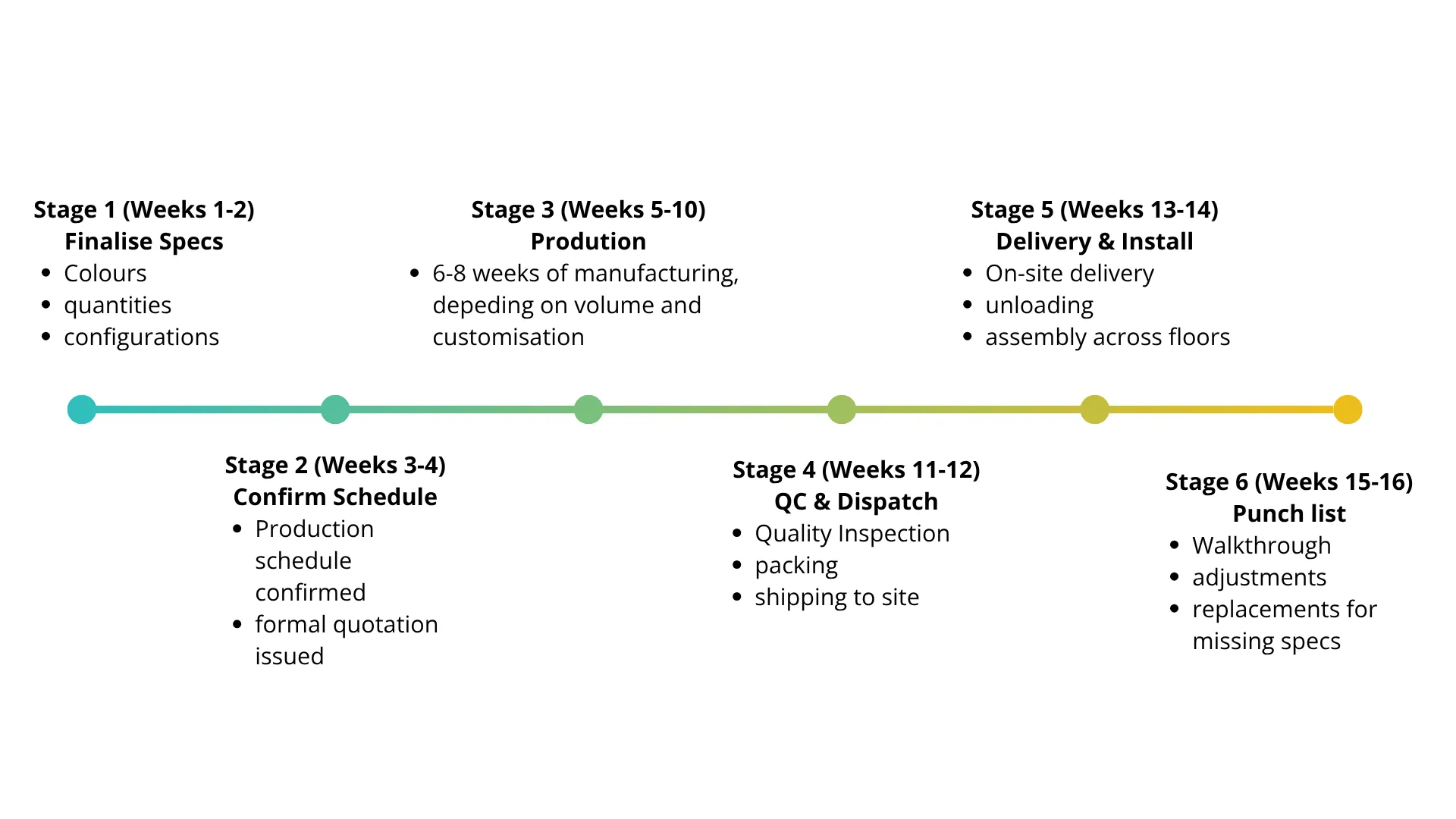
Note: The timeline is a snapshot of a general procurement process. For detailed information, please contact our team.
Should I buy system furniture or loose furniture for my office?
System furniture (modular workstations, partition-based desking) connects into an integrated system. Loose furniture (standalone desks, chairs, cabinets) operates independently.
For corporate fit-outs, the answer depends on growth plans.
If headcount will grow by 20% or more in three years, system furniture pays for itself. Modular panels can be reconfigured or extended without buying new units. You’re buying flexibility. Browse our system furniture and desking solutions to see how modular configurations work in practice.
If the layout is fixed and unlikely to change, loose furniture gives more design freedom. Each piece stands alone, so you can mix styles.
Most corporate fit-outs use a hybrid approach. System furniture goes in open-plan workstation areas. Loose furniture fills executive offices, meeting rooms, and breakout spaces. Understanding what each tilt mechanism does helps your team specify the right seating within this setup.
Modular furniture costs more at purchase and saves more at every renovation after that.
What happens if furniture arrives damaged or doesn’t fit the floor plan?
Warranty terms and after-sales support earn their place in your evaluation here. Before signing any purchase order, confirm three things in writing.
What is the replacement policy for damaged items? Reputable suppliers inspect and replace within 5-7 business days. Some manufacturers absorb the cost; others split it.
What does the warranty cover, and for how long? A 5-year structural warranty is standard for commercial-grade furniture. Anything less than 3 years signals consumer-grade product at commercial prices.
What’s the process if furniture doesn’t fit the floor plan? Experienced suppliers conduct a pre-delivery site measurement. If they skip this step, the risk shifts entirely to you.
The Procurement Decision That Pays for Itself Over 10 Years
Corporate furniture isn’t consumed. It depreciates slowly, works daily, and touches every employee’s comfort and output.
A systematic review published in PMC found that musculoskeletal disorders rank among the top three occupational health problems in Malaysia. Non-ergonomic furniture contributes directly to that statistic.
Procurement decisions carry legal weight: OSHA 1994’s ergonomic seating requirements cover every Malaysian workplace as of June 2024.
Use the 5-Point Supplier Fit Test. Compare sourcing models on total cost, not unit price. Start procurement the moment your floor plan is locked.
Choose a supplier who manufactures their own products. Look for internationally recognised certifications. Verify their corporate installation track record.
The right furniture supplier doesn’t just fill your office. They protect your investment, your people, and your timeline.
We at Merryfair have manufactured office furniture in Malaysia since 1974. With BIFMA compliance, ISO 9001, and Greenguard Gold certification, we supply ergonomic chairs, system furniture, and desking solutions directly to corporate clients from our Klang facility. Explore our complete range of seating products or contact our project team for a consultation.
The furniture you choose today is the workspace your team sits in for the next decade. Choose as if ten years of comfort depends on it. Because it does.
Frequently Asked Questions
How do I choose an office furniture supplier in Malaysia?
Evaluate suppliers using five criteria: manufacturing control, certifications (BIFMA, ISO, Greenguard), completed project track record, delivery and installation coverage, and scalability for growth. Request case studies and client references before comparing any quotes.
What is the average cost of office furniture for a corporate fit-out in Malaysia?
Office furniture takes a significant share of total fit-out costs. Malaysian fit-out budgets range from RM90 to RM250 per square foot overall. For a 10,000 sqft office, furniture allocation may run from RM180,000 to RM875,000 depending on specification and sourcing model.
Can I customise office furniture for my corporate branding?
Yes, if you source from a manufacturer like Merryfair directly. Most Malaysian manufacturers offer custom colour, fabric, size, and branding options for bulk orders. Dealers and retailers typically offer limited customisation. Minimum order quantities for custom work usually start at 50 units.
How far in advance should I order office furniture for a fit-out?
Begin procurement 12-16 weeks before your target move-in date. Custom orders require 6-8 weeks of production, plus 2-4 weeks for delivery and installation. Starting earlier gives buffer for revisions and avoids conflicts with other fit-out trades.
What is the difference between BIFMA and ISO certification for office furniture?
BIFMA compliance tests the furniture itself for durability, structural integrity, stability, and ergonomic performance. ISO 9001 certifies the manufacturer’s quality management system. Both matter, but they measure different things. BIFMA confirms the product. ISO confirms the factory.
MORE BLOGS
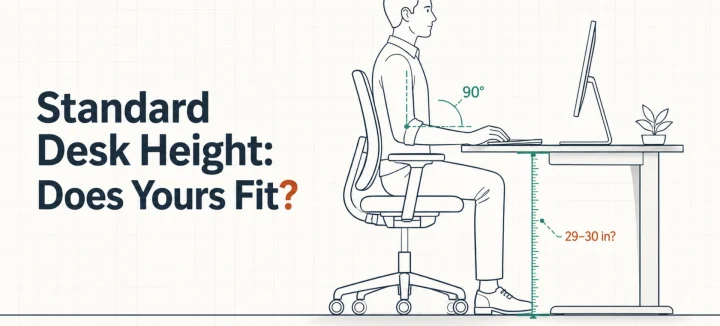
Standard Desk Height: Is 29 Inches Right for Your Body?
Standard desk height is 29 to 30 inches (73 to 76 cm). That number fits far fewer people than you’d think. A desktop that tall matches the seated elbow height of someone around 6’2″. The average American man stands 5’9″, and the average woman 5’3.5″. So this guide does two jobs. It shows you how […]
Read More
Exploding Office Chairs: The Full Truth From a Chair Maker
The exploding office chair story resurfaces every few years, same grainy photos attached. So can a chair really burst? A handful have, and every documented case involved an uncertified gas cylinder (the pressurized tube that raises and lowers your seat). Chairs built to recognized safety standards fail differently: seals leak, the seat sinks, nothing bursts. […]
Read More
How to Fix a Squeaky Office Chair by Sound and Location
A squeaky office chair makes four different noises, and each one points to a different part. To silence it for good, find the source first: the tilt mechanism, gas cylinder, casters, or armrests. Then tighten what’s loose and lubricate with the right product for that joint. This guide matches each sound to its fix, and […]
Read More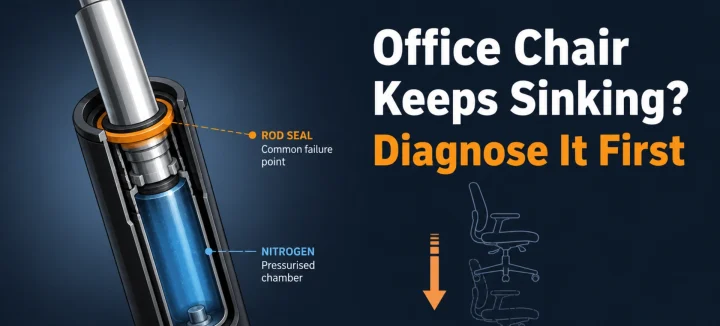
Office Chair Keeps Sinking? Diagnose and Fix It for Good
An office chair that keeps sinking or won’t stay up has one main cause: the gas cylinder under the seat is losing pressure. Worn seals let the nitrogen escape, so the piston stops holding your weight. A hose clamp or PVC pipe locks the height today; a new cylinder fixes it properly in 15 minutes. […]
Read More