How to Find The Best Office Furniture Supplier Malaysia for Your Business
Malaysian office furniture supplier lists promise one answer. Your procurement team shouldn’t buy it.
The best office furniture supplier Malaysia has to offer depends on three things: entity type, order volume, and warranty timeline.
An SME needs speed and ready stock. An MNC or hospital needs certifications, compliance, and multi-site delivery coverage.
No single list answers that. Here’s the real Malaysian shortlist plus a matching matrix for your first supplier call.
Key Takeaways
- The best office furniture supplier in Malaysia varies by entity type. No single vendor is optimal for every business.
- Use the Entity-Fit Supplier Matrix (five entity types against five supplier profiles) to shortlist before requesting a single quote.
- BIFMA compliance, ISO 9001, and Greenguard Gold form the minimum viable certification stack for any office above 50 seats.
- Manufacturer-direct sourcing saves 15-30% on unit cost for orders over 50 workstations. Dealers win on speed below that threshold.
- Budget 12-16 weeks from specification to installation for custom orders. Ready stock closes in 1-2 weeks but limits customisation.
Who Makes Office Furniture in Malaysia in 2026
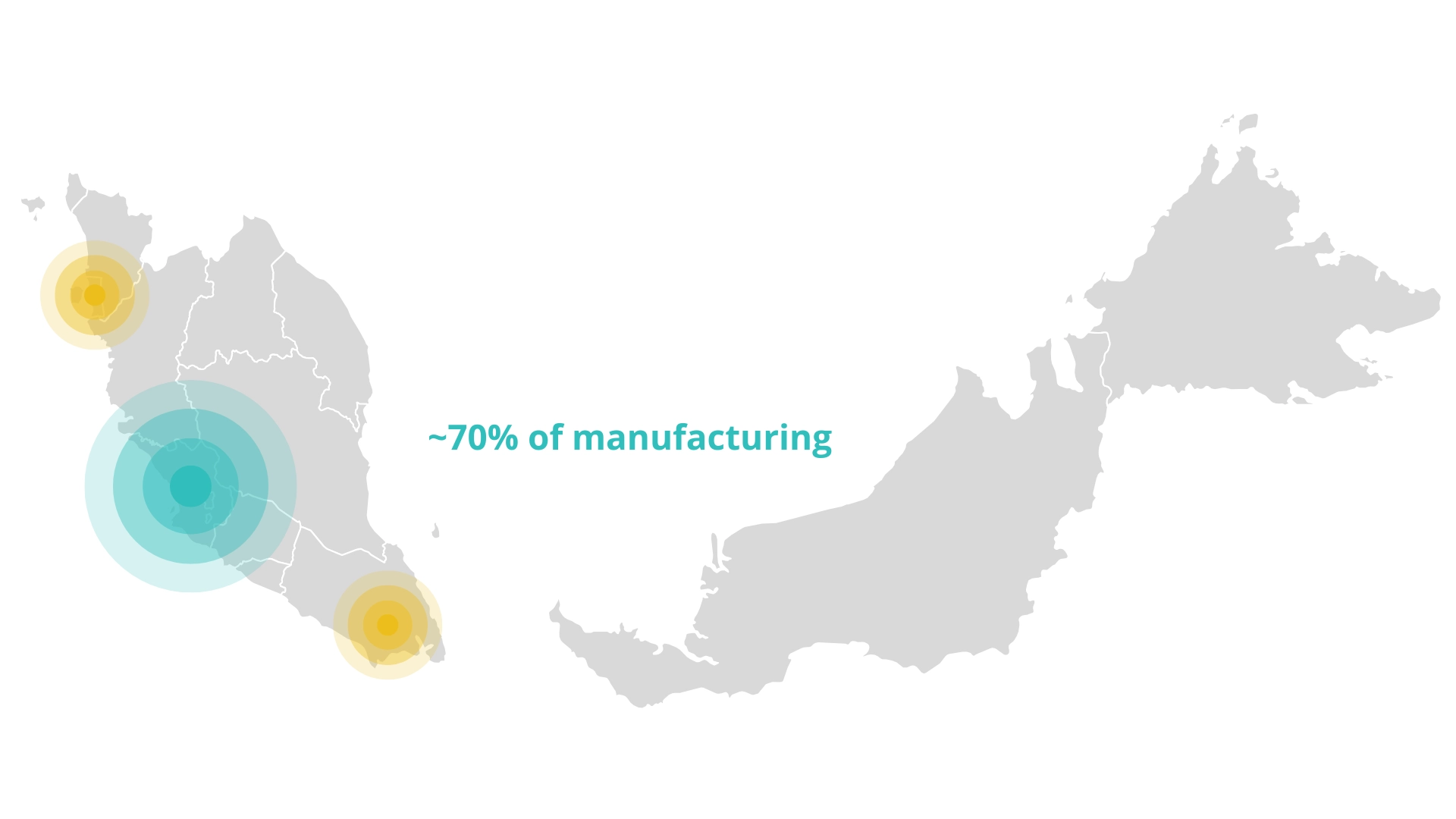
Malaysia’s office furniture industry concentrates in one belt. Around 70% of the country’s commercial furniture manufacturing sits within 40 kilometres of Port Klang.
The rest splits between Penang’s free industrial zones and Johor’s southern corridor.
Vendors outside the Klang Valley cluster typically quote longer lead times. Delivery fees for multi-site rollouts run higher too.
In Malaysian procurement, vertical integration isn’t a buzzword. It’s the difference between a six-week lead time and a six-month delay.
Who actually manufactures office furniture in Malaysia?
Fewer suppliers manufacture than claim to. Many “suppliers” are resellers who attach a showroom to a China import pipeline.
Real manufacturers run their own fabrication lines. They handle injection moulding in-house and answer to their own QC team.
Why does the distinction matter? Warranty claims move faster when you’re talking to the factory, not a reseller’s support desk.
For enterprise-scale fit-outs, the sister guide on how Malaysian corporate buyers run full fit-out procurement goes deeper on timeline planning.
What makes Malaysian suppliers competitive for regional buyers?
Three things. Labour cost below Singapore and Japan, raw material access via Port Klang, and an experienced manufacturer cluster exporting to ASEAN and beyond.
The result: Malaysian-made office furniture often undercuts imported equivalents by 20-40% at comparable specification.
For regional buyers running cross-border fit-outs, Malaysia is frequently the value anchor of the shortlist.
The Entity-Fit Supplier Matrix: Matching Supplier to Business Type
Most buyer guides stop at listing suppliers. That’s where the real decision starts, not ends.
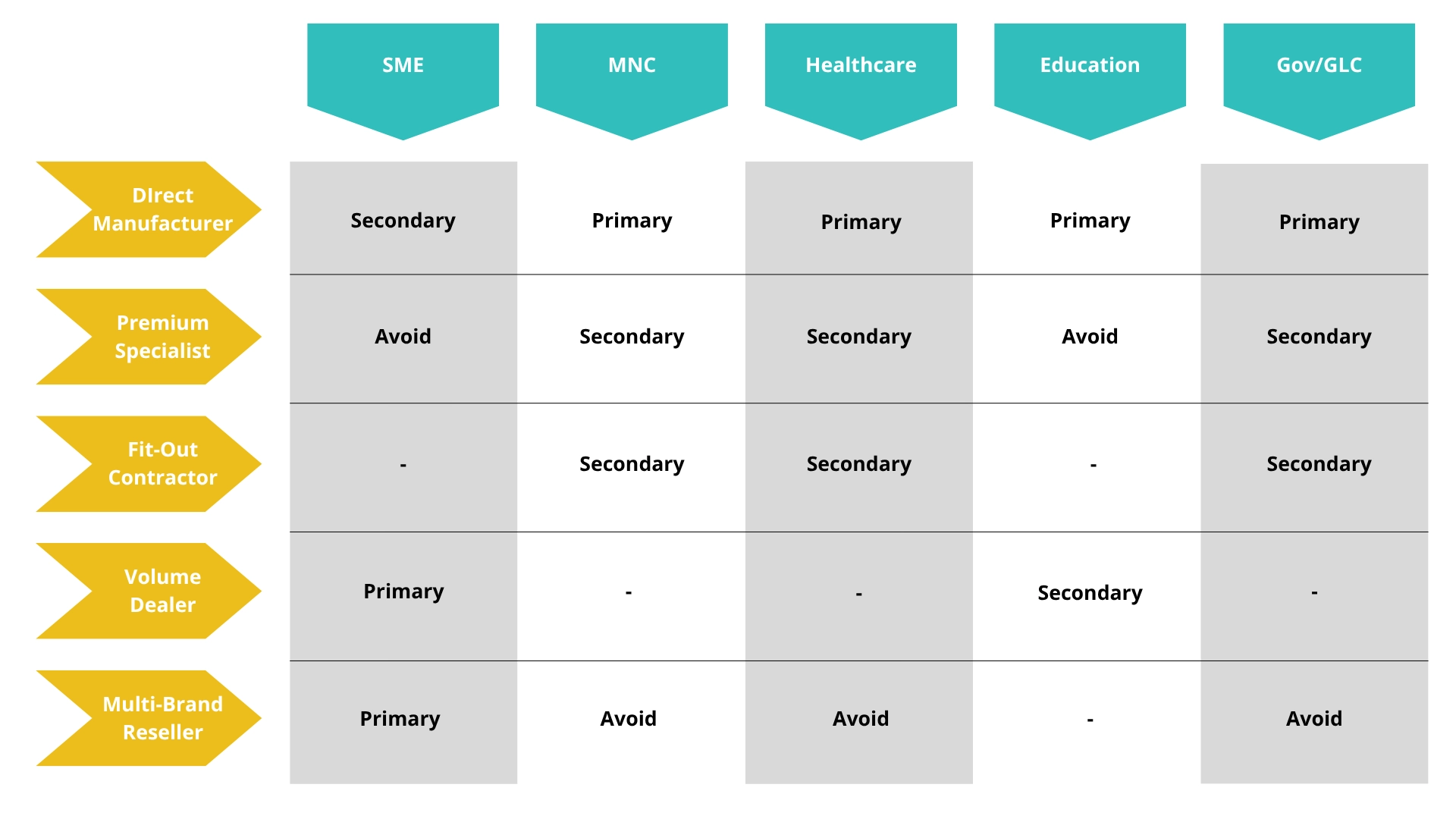
The Entity-Fit Supplier Matrix maps five common entity profiles against the five supplier models operating in Malaysia.
The goal is simple. Stop asking “who is the best,” and start asking “who fits us.”
Here’s the matrix:
| Entity type | Primary fit | Secondary fit | Avoid |
|---|---|---|---|
| SME (5-50 seats) | Multi-Brand Reseller / Volume Dealer | Direct Manufacturer (if ordering 30+) | Premium Specialist (over-spec’d) |
| MNC / Regional HQ | Direct Manufacturer | Fit-Out Contractor | Retailer-only (no warranty depth) |
| Healthcare (hospitals, clinics) | Direct Manufacturer + Vertical Specialist | Fit-Out Contractor | Budget retailers (cleanability + IPC compliance) |
| Education (schools, universities) | Direct Manufacturer (bulk custom) | Volume Dealer | Premium Specialist (budget mismatch) |
| Government / GLC | Direct Manufacturer | Fit-Out Contractor (G7 CIDB) | Unregistered dealers (tender ineligible) |
The best office furniture supplier in Malaysia for an SME is rarely the best one for an MNC.
How should an SME with 5-50 workstations choose a supplier?
SMEs live in a specific constraint set. Short timelines, tight budgets, and usually no dedicated procurement officer.
A multi-brand reseller or volume dealer typically wins for SMEs. They carry ready stock, quote in 24 hours, and deliver within two weeks.
Here’s the caveat (nobody flags this at SME scale). Once your order crosses 30-40 workstations, the math inverts.
Manufacturer-direct becomes cheaper, often by 15-30% per unit. That’s before warranty value enters the picture.
A practical rule: fewer than 20 chairs, go ready-stock. Between 20 and 50, request quotes from both a dealer and a manufacturer.
The manufacturer usually wins on total cost of ownership once you factor in a five-year warranty. Understanding the best ergonomic chair for every budget tier in Malaysia helps you compare value, not sticker price.
What should MNCs and regional HQs prioritise in supplier selection?
Certifications and multi-site coverage. In that order.
An MNC sourcing furniture in Malaysia often has group procurement policies requiring BIFMA or equivalent third-party testing. Suppliers without that paperwork can’t survive the RFQ shortlist.
Then comes service radius. A KL HQ, a Penang satellite, and a Johor sales office need one supplier handling all three.
The alternative is three separate contracts to manage. Nobody wants that.
Direct manufacturers with owned logistics tend to win these deals. Dealers win when the local office manager values speed over centralised governance.
How do healthcare, education, and hospitality buyers differ?
Each vertical carries an invisible compliance layer most generic buyer guides skip.
Healthcare buyers need furniture that survives infection prevention and control protocols. That means easy-clean surfaces, minimal fabric in clinical areas, and tolerance to hospital-grade disinfectants.
Hospital administrators in Malaysia typically run private tenders with clinical engineering involvement. Poor-quality seating directly affects staff fatigue in 12-hour nursing shifts.
The ergonomic evidence behind why correct sitting posture breaks down within twenty minutes isn’t optional knowledge in a healthcare environment.
Education buyers include schools, universities, and polytechnics. They need volume pricing, durability against student use, and a G-grade CIDB contractor for government-backed projects.
Most go through direct manufacturers with bulk-order discounts or government-registered dealers.
Government and GLCs need vendors registered under the Ministry of Finance (MOF). CIDB G-grade registration is often mandatory for works-included contracts.
The shortlist for a GLC fit-out is rarely longer than six names nationwide.
What to Verify Before You Sign a Supplier Agreement
[IMAGE: A clean verification checklist graphic with eight first-call questions rendered as ticked boxes in a clean editorial style | type: conceptual]
Shortlisting is half the job. Verification is the other half.
Most procurement disasters trace back to something nobody asked during supplier qualification.
Which certifications matter for office furniture in Malaysia?
Three certifications carry real weight in commercial procurement:
- BIFMA compliance tests furniture for durability, stability, and safety across 10+ years of simulated commercial use. See what BIFMA compliance actually tests on an office chair for the mechanical detail.
- ISO 9001 certifies the manufacturer’s quality management system, not the product itself. Different layer, both matter.
- Greenguard Gold tests for low chemical emissions. This matters for enclosed offices, and doubly so for hospitals, schools, and spaces with children or immunocompromised occupants.
If a supplier offers none of these, they’re selling to a different market than commercial procurement.
If they offer one, ask why the other two are missing. When all three are present, ask to see certificates dated within the last certification cycle.
Certifications don’t sell furniture. They survive audits.
How do you confirm a supplier can actually deliver on time?
Ask for three completed projects at similar scale, not testimonials. Request names, addresses, dates, and at least one callable reference.
Then ask about their worst recent project. Every experienced supplier has one.
The honest ones will tell you what went wrong and how they fixed it. Anyone who claims every project was perfect is either very new or very unreliable.
Finally, ask whether delivery and installation are done by their own team or subcontracted. Subcontracting isn’t disqualifying, but it adds a coordination layer when timing is most critical.
What questions should you ask on the first supplier call?
Eight questions separate serious suppliers from the rest. Ask them all on the first call:
- Do you manufacture in Malaysia, or do you import and resell?
- What’s your current lead time for a [your quantity] order, from PO to installation?
- What certifications does the product line carry, and can you send the certificates?
- What’s the warranty period, and what does it cover (structural, mechanical, upholstery)?
- Is delivery and installation done by your own team?
- Can you send photos of three completed projects at similar scale?
- What’s the replacement process if items arrive damaged?
- Do you do a pre-delivery site measurement, and is it included in the quote?
A supplier who can’t answer these in one conversation will not answer them faster during a warranty claim.
Supplier Pitfalls That Drain SME and Corporate Budgets Alike
Three pitfalls cost Malaysian buyers more than any others.
Why is the lowest quote usually the most expensive choice?
Furniture is a depreciation asset, not a consumable.
A chair at RM400 that lasts two years costs roughly the same as a chair at RM1,200 that lasts eight. But on paper, it looks one-third the price.
Procurement dashboards rarely track replacement cycles. So the lowest quote keeps winning until someone does the ten-year math.
Who tracks that kind of long-run cost? Rarely procurement.
Picking a supplier on price alone guarantees you pay twice. Once at purchase, once at replacement.
What happens when you skip the pre-delivery site measurement?
Workstation kits arrive. They don’t fit.
Columns block partition runs. Storage towers hit the ceiling, and assembled desks won’t pass through doorways.
Now your installation becomes a negotiation. And the negotiation runs in the supplier’s favour.
Ask explicitly whether the supplier measures on site before production or just works off the architect’s drawings.
Drawings miss cable trays, fire safety adjustments, and last-minute structural changes. On-site measurement catches all three.
How do warranty gaps ambush buyers 18 months in?
Most Malaysian commercial warranties cover the structure for five years. But mechanisms (tilt, gas lift, armrest adjustment) are covered for one or two.
The chair looks fine. Then the mechanism fails.
You pay out of pocket, or the supplier proposes a “goodwill” discount on a new unit.
Ask for the warranty table in writing: structural, mechanism, upholstery, casters. Separate coverage periods for each line.
A single-line “5-year warranty” claim hides the gap every time. Understanding the office chair tilt mechanism most Malaysian buyers misunderstand helps you negotiate warranty depth on the most failure-prone component.
Picking the Supplier Who Will Still Be Useful in 2030
The furniture is the easy part. Your supplier relationship is the decade-long decision.
Use the Entity-Fit Matrix. Shortlist two or three suppliers.
Ask the eight first-call questions and measure on site. Get the warranty table in writing.
Do this, and the supplier you choose today is still answering your calls in 2030.
For entities whose Entity-Fit profile points to manufacturer-direct, Merryfair fits the profile. That includes MNCs, healthcare procurement teams, education bulk buyers, and SMEs above 30 seats.
The certification stack is complete (BIFMA, ISO 9001, Greenguard Gold). Its home base is a 65,000 sqm vertically integrated plant in Klang, operating since 1974.
Visit the showroom and test-sit the chairs. Or explore the full Merryfair seating product range first to narrow the conversation.
Your team sits in this furniture for the next ten years. Choose the supplier accordingly.
Frequently Asked Questions
How do I choose an office furniture supplier in Malaysia?
Match supplier type to your entity type first. SMEs usually fit multi-brand resellers or volume dealers. MNCs, healthcare, education, and government buyers almost always fit direct manufacturers with full certification stacks. Use the Entity-Fit Supplier Matrix to shortlist two or three suppliers before requesting any quote.
Who are the best office furniture suppliers in Malaysia in 2026?
No single supplier is best for every buyer. However, Merryfair, one of the branded direct manufacturers, has been in the business and dominating corporate and government work, including KLIA 2, hospitals, etc.
Should an SME buy from a manufacturer or a dealer?
Under 20 chairs, a dealer or multi-brand reseller is usually faster and competitive on price. Between 20 and 50 chairs, request quotes from both. Above 30-40 chairs, direct manufacturer pricing often beats dealer pricing by 15-30% per unit, and warranty terms are generally stronger at the manufacturer level.
What certifications should I require from a Malaysian office furniture supplier?
BIFMA compliance (product durability testing), ISO 9001 (manufacturer quality management), and Greenguard Gold (low chemical emissions). Ask for certificates dated within the current certification cycle, not just a marketing claim. Healthcare and education buyers should treat all three as non-negotiable.
How long does it take to furnish a new office in Malaysia?
Ready-stock orders ship within 1-2 weeks. Custom manufacturer-direct orders typically run 12-16 weeks from specification to installation: 6-8 weeks production, 2-4 weeks delivery, plus 1-2 weeks for punch-list resolution. Start procurement the moment your floor plan is approved to avoid pushing move-in dates.
MORE BLOGS
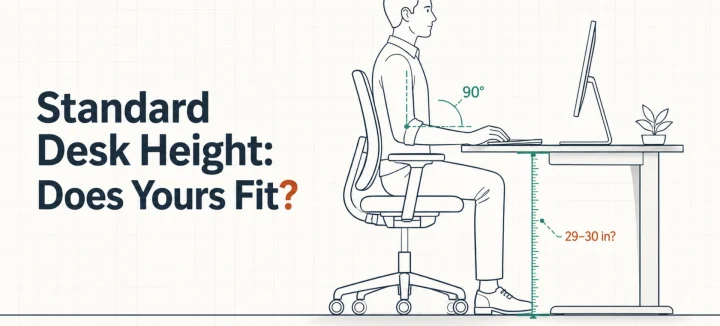
Standard Desk Height: Is 29 Inches Right for Your Body?
Standard desk height is 29 to 30 inches (73 to 76 cm). That number fits far fewer people than you’d think. A desktop that tall matches the seated elbow height of someone around 6’2″. The average American man stands 5’9″, and the average woman 5’3.5″. So this guide does two jobs. It shows you how […]
Read More
Exploding Office Chairs: The Full Truth From a Chair Maker
The exploding office chair story resurfaces every few years, same grainy photos attached. So can a chair really burst? A handful have, and every documented case involved an uncertified gas cylinder (the pressurized tube that raises and lowers your seat). Chairs built to recognized safety standards fail differently: seals leak, the seat sinks, nothing bursts. […]
Read More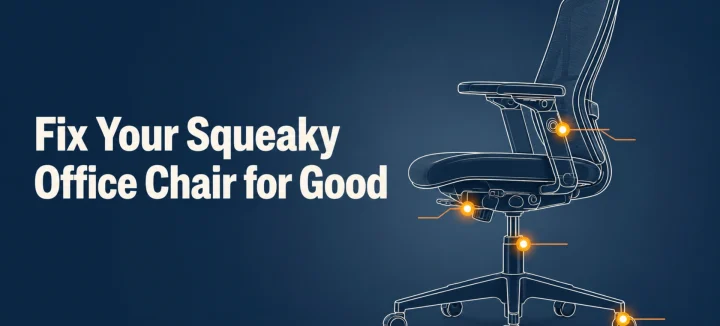
How to Fix a Squeaky Office Chair by Sound and Location
A squeaky office chair makes four different noises, and each one points to a different part. To silence it for good, find the source first: the tilt mechanism, gas cylinder, casters, or armrests. Then tighten what’s loose and lubricate with the right product for that joint. This guide matches each sound to its fix, and […]
Read More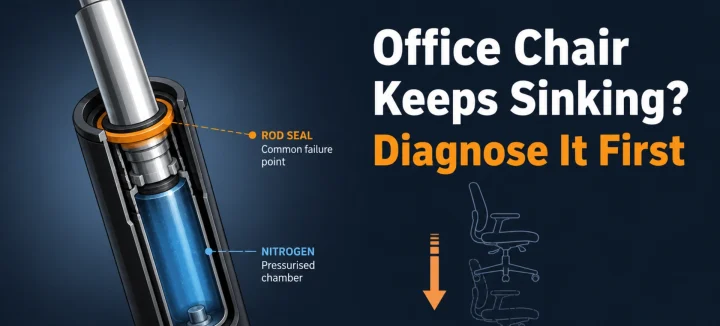
Office Chair Keeps Sinking? Diagnose and Fix It for Good
An office chair that keeps sinking or won’t stay up has one main cause: the gas cylinder under the seat is losing pressure. Worn seals let the nitrogen escape, so the piston stops holding your weight. A hose clamp or PVC pipe locks the height today; a new cylinder fixes it properly in 15 minutes. […]
Read More