DOSH Ergonomics Workplace Malaysia: The Compliance Guide
Since 1 June 2024, the Occupational Safety and Health Act 1994 applies to every Malaysian workplace, and the maximum fine for breaching the employer’s general duty has multiplied tenfold.
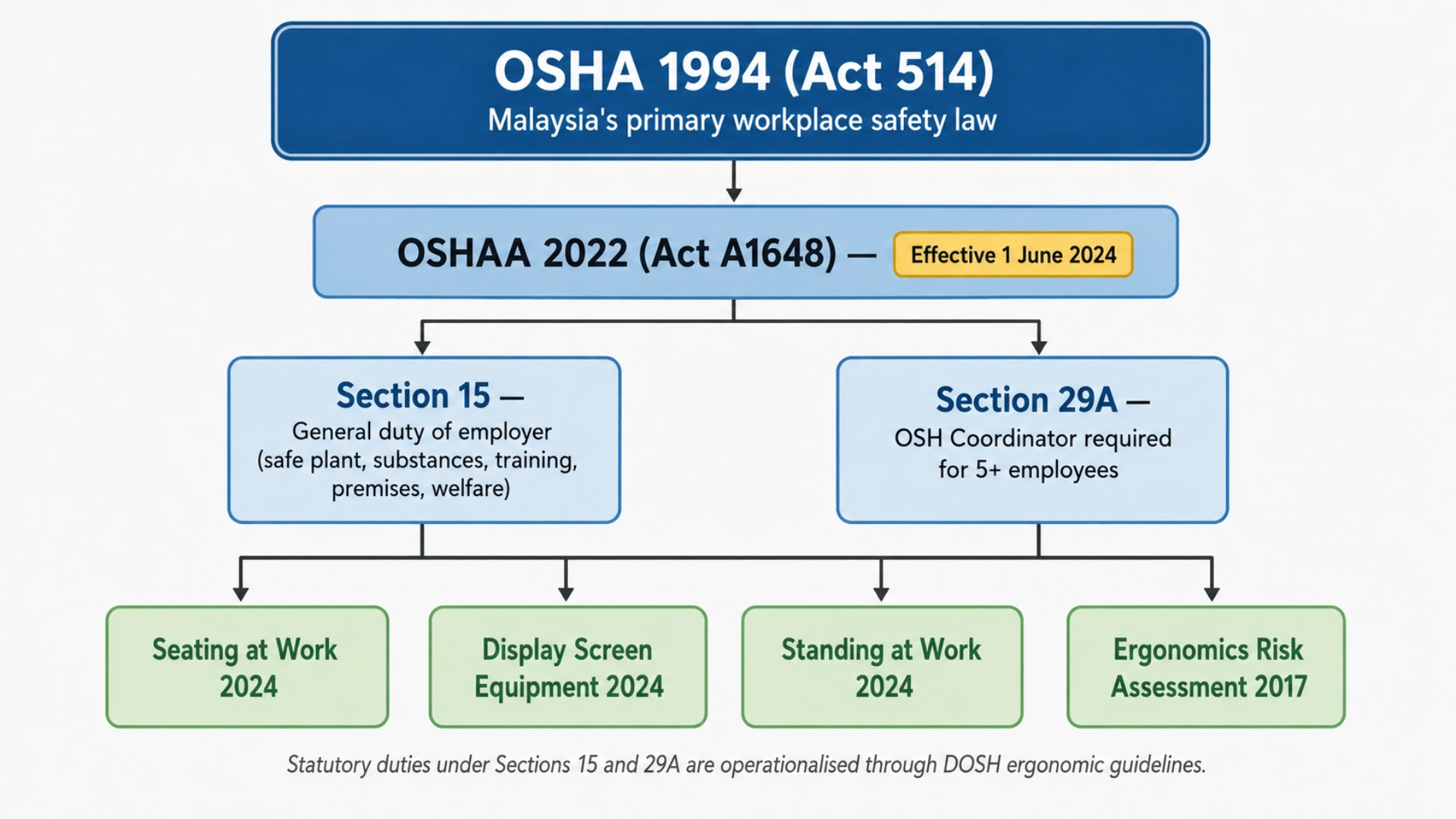
DOSH ergonomics workplace Malaysia obligations sit under the Occupational Safety and Health Act 1994 (Act 514), as amended by Act A1648 in 2022. Effective 1 June 2024, the law covers every workplace, requires ergonomic risk assessments, and exposes non-compliant employers to fines of up to RM500,000.
This guide consolidates the legal architecture, the four DOSH ergonomic guidelines, the penalty exposure, and a procurement-ready checklist. Everything an HR manager, OSH officer, or procurement lead needs to act on this week.
Key Takeaways
- The OSHA 1994 amendment (Act A1648) took effect on 1 June 2024 and removed every industry-based exemption. DOSH ergonomics workplace Malaysia rules now reach every employer, including pure office environments.
- Maximum penalties for breaching Section 15 employer duties rose from RM50,000 to RM500,000, with potential personal prosecution of directors and managers under Section 52.
- Four DOSH guidelines govern workplace ergonomics: Seating at Work 2024, Display Screen Equipment 2024, Standing at Work 2024, and Ergonomics Risk Assessment 2017.
- Companies with five or more employees must appoint a trained Safety and Health Coordinator under Section 29A.
- Compliant ergonomic seating must offer adjustable lumbar support, seat depth, and recline. Not just a label.
Why DOSH Now Reaches Every Malaysian Workplace
For three decades, OSHA 1994 only applied to industries listed in its First Schedule: manufacturing, construction, mining, agriculture, and a few others. Pure office environments could argue scope. That argument died on 1 June 2024.
The Occupational Safety and Health (Amendment) Act 2022, known as Act A1648, removed the First Schedule restriction entirely. If you employ workers in Malaysia, OSHA applies. Period.
The 1 June 2024 amendment ended thirty years of First Schedule exemptions and brought every Malaysian office, retail floor, and remote workforce inside DOSH’s enforcement reach.
What is OSHA 1994, and what changed in 2024?
The Occupational Safety and Health Act 1994 (Act 514) is Malaysia’s primary workplace safety law. It establishes employer duties, employee rights, and DOSH’s enforcement authority. The 2022 amendment, gazetted as Act A1648 and enforced from 1 June 2024, broadened scope, raised penalties, and introduced new mandatory provisions including risk assessment and a Safety and Health Coordinator.
Who does the OSH Act apply to after Act A1648?
Every workplace in Malaysia. The amendment deleted the industry-restricted First Schedule and now covers all places of work, including the public sector. The only exemptions are domestic employment, the armed forces, and ship-based work covered by the Merchant Shipping Ordinance. Contract workers, gig workers, and remote employees are all in scope.
That last point matters. Hybrid and remote arrangements common to Malaysian knowledge work since 2020 don’t sit outside the Act. Employer ergonomic responsibility follows the worker home, within the limits of practicability the Act sets.
What does Section 15 actually require of employers?
Section 15 imposes a general duty on every employer to ensure, so far as is practicable, the safety, health, and welfare at work of all employees. It’s the cornerstone of the entire Act. Section 15(2) breaks it into five areas: safe plant, safe substances, training and supervision, safe premises, and welfare facilities.
According to Mahwengkwai & Associates’ analysis, Section 15 is the most commonly cited section in DOSH prosecutions. Workplace ergonomics falls primarily under the “safe plant” and “welfare” limbs. A chair that creates predictable musculoskeletal harm is, in OSHA terms, unsafe plant.
For broader context on how seating regulation connects to back pain outcomes, our analysis of DOSH Malaysia workplace seating regulations covers the back-injury science behind the rule.
Do small offices really need a Safety and Health Coordinator?
Yes, if you employ five or more people. Section 29A, introduced by Act A1648, requires every employer with five or more employees to appoint a trained Safety and Health Coordinator (OSH-C). The OSH-C oversees policy, conducts internal monitoring, and is the first line of accountability when DOSH knocks.
A six-person digital agency is now covered. A two-partner consultancy is not. The five-employee threshold is the practical line most Malaysian SMEs will cross at scale.
The Four DOSH Guidelines That Govern Office Ergonomics
The Act sets the duty. DOSH guidelines tell employers what fulfilling that duty looks like operationally. Four are directly relevant to office ergonomics, and three of them are new in the last two years.
So which one applies to which workplace?
| Guideline | Year | Scope | Core employer obligation |
|---|---|---|---|
| Seating at Work | 2024 | Any workplace where employees sit ≥30 minutes continuously | Provide adjustable, ergonomically designed seating; conduct ergonomic assessment of seated work |
| Display Screen Equipment | 2024 | Workstations using monitors, laptops, tablets for sustained work | Address screen, keyboard, posture, and lighting; train users; provide eye-strain breaks |
| Standing at Work | 2024 | Workplaces requiring prolonged standing | Provide anti-fatigue support, rotation, and seating opportunity |
| Ergonomics Risk Assessment | 2017 | All workplaces with ergonomic hazards | Conduct initial and (where indicated) advanced ergonomic risk assessment |
How does the Seating at Work guideline 2024 define compliant chairs?
The DOSH Seating at Work guideline applies to all workplaces under OSHA where employees sit for more than 30 minutes continuously. It states: “Seating design is crucial in reducing the risk of musculoskeletal disorders. Chairs should provide adequate lumbar support, allow adjustability, and promote comfort during prolonged sitting.”
That language is not optional decoration. Lumbar support, adjustability, and prolonged-sitting comfort are framed as required attributes. A non-adjustable seat in a workplace where staff sit for full shifts is, on the guideline’s logic, inadequate.
The guideline also requires employers to conduct ergonomic risk assessment specific to seated work, train employees on proper seating practice, and respond to employee complaints about seating-related discomfort. It’s not a procurement document. It’s a duty framework that procurement decisions must satisfy.
What does the Display Screen Equipment guideline 2024 require?
The DSE 2024 guideline addresses every workstation using monitors, laptops, or tablets for sustained work. It covers screen placement, keyboard position, posture, ambient lighting, and break frequency.
For most Malaysian office environments, this is the most operationally dense of the four. Monitor at eye level, keyboard at elbow height, screen distance roughly arm’s length. Add structured eye-strain breaks of around 20 seconds every 20 minutes.
Where does the Standing at Work guideline 2024 apply?
Standing at Work 2024 governs workplaces requiring sustained standing, more common in retail, healthcare, and assembly than in pure office environments. But hybrid sit-stand desk programs in offices are within scope. Anti-fatigue matting, rotation, and the option to sit are the headline employer obligations.
If you’ve rolled out standing desks as a wellness benefit, the standing-time obligations now sit alongside the seated obligations. They’re complementary, not alternative.
Is ergonomic risk assessment mandatory under the 2017 guideline?
The 2017 Guidelines on Ergonomics Risk Assessment (ERA) at Workplace remain DOSH’s main framework for identifying ergonomic hazards. ERA is currently a guideline, not a gazetted regulation. But Section 15 of OSHA 1994 requires employers to identify and control workplace risks, and DOSH treats ERA as the established method of doing so for ergonomic exposures.
[REFRESH NOTE: ICOP for ERA was proposed in 2019 and remains in development. Update this section when gazetted, as ICOP would convert ERA from recommended practice into legally binding requirement.]
The ERA process has two tiers: an initial assessment using a structured checklist, followed by an advanced assessment where the initial flags elevated risk. The output is a documented risk control plan. A guide on office chair material choice in Malaysian humidity covers one operational dimension assessors flag often.
What Compliant Ergonomic Seating Actually Looks Like
“Adjustable, ergonomically designed seating” is regulation language. Procurement teams need specifications.
So what does the Seating at Work guideline mean in terms employers can write into a tender?
The functional translation is a chair offering adjustability across the dimensions that affect spinal loading during sustained sitting. At minimum, that includes:
- Seat height adjustment to set hip angle at 90–100 degrees with feet flat on the floor.
- Seat depth adjustment that maintains a two-to-three finger gap between seat edge and the back of the knee.
- Lumbar support adjustable in height and depth so it aligns with the user’s lumbar curve, not the manufacturer’s assumed average.
- Backrest recline with tension control to enable postural change throughout the day.
- Armrest height adjustment to support shoulders at neutral elevation.
A chair that fixes any of these dimensions cannot accommodate a typical Malaysian workforce’s body-size distribution. That’s the procurement problem the guideline is solving.
A chair sold as ergonomic without adjustable lumbar height, seat depth, or recline is a chair that satisfies a marketing claim, not the DOSH Seating at Work 2024 specification.
For the full breakdown of features that meet the standard, see ergonomic seating requirements for office compliance.
Which chair specifications meet DOSH’s adjustability requirement?
The guideline doesn’t list specific numeric thresholds. It frames adjustability as a functional requirement that the chair must accommodate user body sizes. International references like MS ISO 9241 (the Malaysian Standard adoption of ISO ergonomic requirements for office work) offer measurable dimensions employers can reference in tenders. Most reputable manufacturers test against these or against BIFMA standards.
How does an HR officer evidence chair compliance during a DOSH inspection?
Three documents typically satisfy inspectors. First, the procurement specification recording which adjustability features were required. Second, the ergonomic risk assessment conducted at installation or annually. Third, training records showing employees received instruction on adjusting their seating.
A chair without documentation is hard to defend. A documented chair, even if mid-range, usually is not. For practical body-fit guidance employers can include in onboarding, how to match a chair to your body using the 3-Layer Fit Test is a useful reference.
The Penalty Map: What Non-Compliance Costs You
The 2022 amendment did not refine penalty structures. It detonated them. The financial calculus for ergonomic procurement is no longer “is the chair worth the cost.” It’s “is the chair cheaper than the fine.”
The tenfold penalty increase that took effect on 1 June 2024 turned ergonomic procurement from a welfare conversation into a financial-risk decision.
| OSHA section | Nature of offence | Maximum penalty | Daily continuing fine |
|---|---|---|---|
| Section 15 | Failure to ensure employee safety, health, and welfare | RM500,000 fine and/or 2 years imprisonment | Not specified |
| Section 51 (general penalties) | General OSHA breach | RM100,000 fine | Not specified |
| Section 49 | Non-compliance with improvement/prohibition notice | RM500,000 fine and/or 2 years imprisonment | RM2,000 per day during continuance |
| Section 52 | Personal liability of directors, managers, partners | Same penalty as the company offence | Same |
How much can DOSH fine an employer for ergonomic non-compliance?
Up to RM500,000 for a Section 15 breach involving failure to provide safe plant or welfare, with imprisonment up to two years also available. According to Get Foundation Malaysia’s compliance analysis, this is a tenfold increase from the pre-amendment ceiling of RM50,000.
These figures are maximum exposure, not typical outcomes. But the maximum is what insurance pricing and risk committees calibrate against. And the maximum just moved.
Can a director be personally prosecuted for a workplace MSD?
Yes. Section 52 of OSHA 1994 enables personal prosecution of directors, managers, compliance officers, and anyone responsible for management of the company. The provision applies a reverse-onus presumption: the individual must prove they did not know, did not consent, and took all reasonable precautions.
This is the structural change boards have not fully internalised. The company can settle a compound fine. A director can still face individual prosecution on the same facts.
Behind the penalty math is a real injury rate. MSD prevalence among Malaysian office workers is the underlying outcome employers should care about regardless of fines.
What happens after a DOSH improvement or prohibition notice?
An improvement notice tells the employer to fix a specified deficiency within a set period. A prohibition notice orders immediate stoppage of the unsafe activity. Failure to comply with either invokes Section 49: maximum fine of RM500,000, imprisonment up to two years, plus RM2,000 per day during the continuance of the offence.
Daily continuing fines are the structure that escalates quickly. A four-week delay on remediation can exceed the headline penalty.
The Employer’s Compliance Checklist for Workplace Ergonomics
Most regulatory writing stops at “ensure compliance.” Useful guidance tells the HR officer what to do on Monday morning.
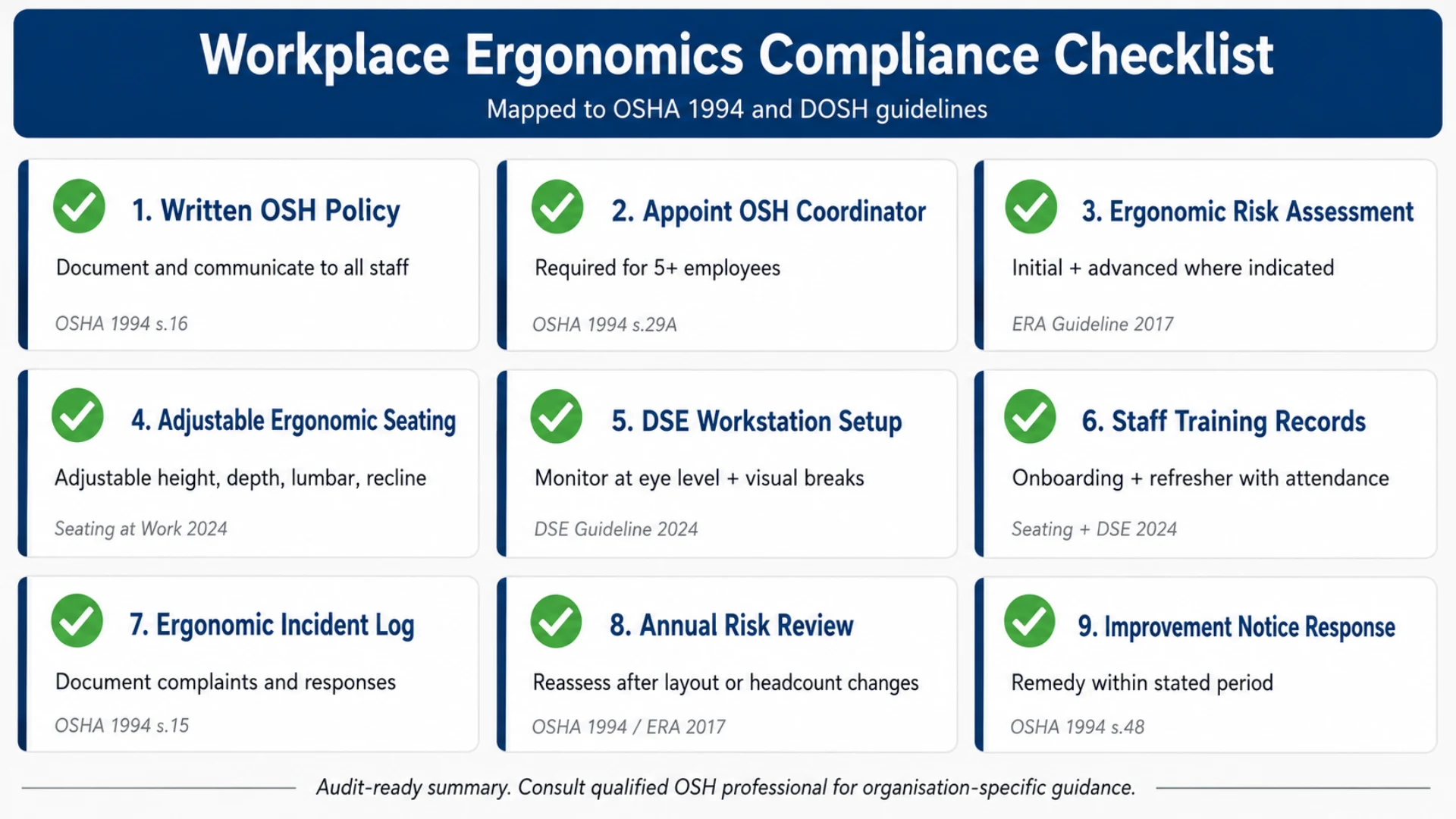
Here’s the operational checklist mapped to the source authority:
| Obligation | Source | Required action |
|---|---|---|
| Establish written OSH policy | OSHA 1994 s.16 | Document policy, communicate to all employees |
| Appoint OSH Coordinator | OSHA 1994 s.29A | Required for 5+ employees; appointee must complete DOSH-recognised training |
| Conduct ergonomic risk assessment | ERA Guideline 2017 | Initial assessment for all seated and DSE work; advanced assessment where elevated risk |
| Provide adjustable ergonomic seating | Seating at Work 2024 | Adjustable height, depth, lumbar, recline, armrests; document procurement spec |
| Configure DSE workstations | DSE Guideline 2024 | Monitor at eye level, ergonomic input devices, scheduled visual breaks |
| Train staff on seating and DSE use | Seating + DSE 2024 | Onboarding training and refresher; keep attendance records |
| Maintain ergonomic incident log | Section 15 duty of care | Log discomfort complaints; demonstrate response |
| Review the OSH risk assessment | OSHA 1994 / ERA 2017 | Annually or after any significant change in workplace layout, headcount, or equipment |
| Respond to improvement notices | OSHA 1994 s.48 | Remedy within stated period; document closure |
[REFRESH NOTE: Update this table when the ICOP for ERA is gazetted or any of the four DOSH guidelines are revised.]
What should an HR manager audit this quarter?
Three deliverables. First, confirm the OSH-C appointment is current and the coordinator has completed recognised training. Second, refresh the ergonomic risk assessment to incorporate the 2024 Seating, DSE, and Standing guidelines. Third, audit chair inventory against the adjustability specifications above and document the gap.
The audit doesn’t need to be perfect. It needs to be evidenced. A documented audit showing identified gaps and a remediation plan is a stronger position in a DOSH visit than perfect compliance with no paper trail.
How do you build an ergonomic procurement specification that holds up?
Write the specification around adjustability ranges, not brand names. State the required adjustment ranges for each dimension (seat height, seat depth, lumbar, recline, armrest). Require manufacturer evidence of testing against MS ISO 9241 or equivalent.
BIFMA certification from office furniture suppliers documents structural safety separately from ergonomic risk assessment, satisfying a distinct DOSH requirement.
Add a body-size accommodation clause referencing your workforce’s anthropometric distribution.
That specification is defensible. A specification listing brands without functional criteria is not. For the budget reality of meeting these specifications across an organisation, ergonomic office chair options across procurement budgets breaks down the price-to-feature trade-off.
Make Compliance the Floor, Not the Ceiling
Compliance language frames ergonomics as a cost. The data frames it as an outcome.
A 2025 Scientific Reports cross-sectional study found over 80% of office workers showed signs of work-related musculoskeletal disorders. SOCSO data confirms MSDs as a leading occupational disease category in Malaysia, with ergonomic-related compensation cases rising year over year.
The RM500,000 fine is the legal floor. The MSD prevalence rate is the actual outcome metric. Compliance done well moves both.
Start with one tangible change this quarter: audit your seating against the Seating at Work 2024 adjustability requirements, document the gap, and align procurement to close it. The ergonomic gains compound across years; the compliance position compounds immediately. For organisations treating seating as a strategic lever rather than a fixed cost, why executive seating comfort drives measurable productivity is a useful next read.
Disclaimer: The information in this article reflects Malaysian workplace ergonomics regulations as of May 2026. It is provided for general informational purposes and does not constitute legal advice, occupational safety advice, or medical advice. OSHA 1994, its amendments, DOSH guidelines, and the proposed Industry Code of Practice for Ergonomic Risk Assessment may be revised without notice. Verify current provisions directly with the Department of Occupational Safety and Health Malaysia before acting on any compliance decision. Application of these requirements varies by industry, workplace context, headcount, and the specific facts of each organisation. For situation-specific guidance, consult a qualified Occupational Safety and Health professional, a registered Safety and Health Officer (SHO), or legal counsel admitted in Malaysia. Merryfair publishes this content as a reference resource and does not warrant its completeness, accuracy, or applicability to any specific case. Reliance on this article is at the reader’s discretion and does not create any advisory, professional, or contractual relationship.
Frequently Asked Questions
Is ergonomic risk assessment legally mandatory in Malaysia?
The 2017 ERA Guideline is currently advisory rather than gazetted regulation. However, Section 15 of OSHA 1994 requires employers to identify and control workplace risks, and DOSH treats ergonomic risk assessment as the established compliance method for ergonomic exposures. Inspectors expect to see documented ERA in any workplace with sustained seated or DSE work.
What does DOSH consider an ergonomic office chair?
A chair meeting the Seating at Work 2024 functional criteria: adjustable lumbar support, adjustable seat depth and height, controlled recline, and adjustable armrests. The guideline frames adjustability as the qualifying attribute, not branding or marketing language. Fixed-feature chairs in workplaces with sustained sitting fall short of the standard.
Does the OSH Act apply to home office or remote workers?
Yes. The 2022 amendment removed industry exemptions and now covers contract, gig, and remote workers. Employer duty of care under Section 15 follows the worker, within practicability limits. Most Malaysian employers address this through hybrid-work ergonomic stipends, home-office assessment forms, and equipment provision for hybrid roles.
What is the difference between the 2017 ERA Guideline and the proposed ICOP?
The 2017 ERA Guideline is advisory; employers should follow it but are not legally bound by it specifically. The proposed Industry Code of Practice (ICOP) for ERA, under development since 2019, would make ERA legally binding when gazetted under Section 37 of OSHA 1994. As of 2026, the ICOP remains pending.
How often should a Malaysian employer conduct an ergonomic risk assessment?
DOSH recommends annual review at minimum, plus reassessment whenever workplace layout, headcount, equipment, or job design changes significantly. After any reported MSD case or ergonomic-related complaint, a focused reassessment is expected. Document each assessment cycle to evidence ongoing compliance during DOSH inspections.
MORE BLOGS
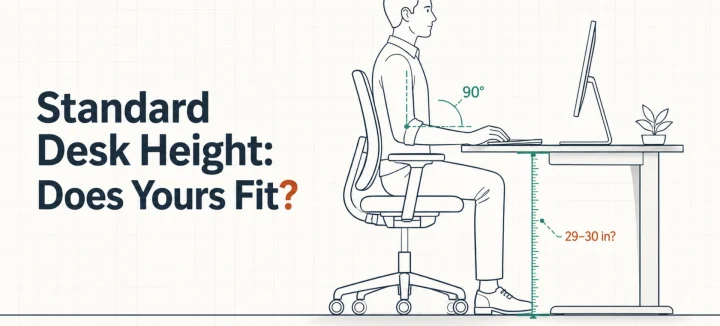
Standard Desk Height: Is 29 Inches Right for Your Body?
Standard desk height is 29 to 30 inches (73 to 76 cm). That number fits far fewer people than you’d think. A desktop that tall matches the seated elbow height of someone around 6’2″. The average American man stands 5’9″, and the average woman 5’3.5″. So this guide does two jobs. It shows you how […]
Read More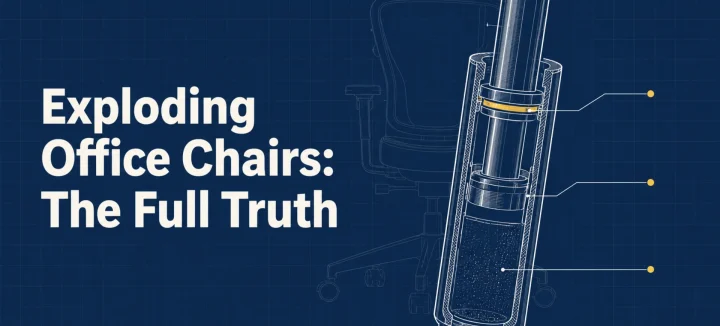
Exploding Office Chairs: The Full Truth From a Chair Maker
The exploding office chair story resurfaces every few years, same grainy photos attached. So can a chair really burst? A handful have, and every documented case involved an uncertified gas cylinder (the pressurized tube that raises and lowers your seat). Chairs built to recognized safety standards fail differently: seals leak, the seat sinks, nothing bursts. […]
Read More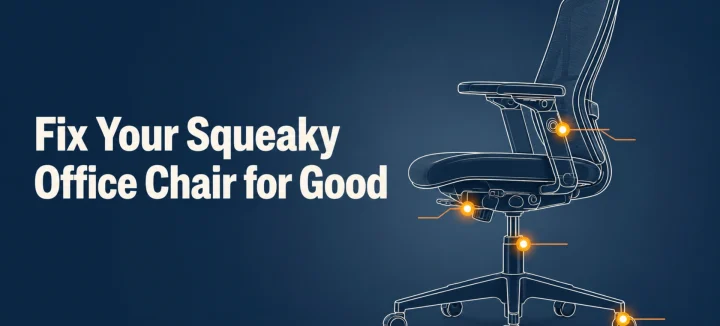
How to Fix a Squeaky Office Chair by Sound and Location
A squeaky office chair makes four different noises, and each one points to a different part. To silence it for good, find the source first: the tilt mechanism, gas cylinder, casters, or armrests. Then tighten what’s loose and lubricate with the right product for that joint. This guide matches each sound to its fix, and […]
Read More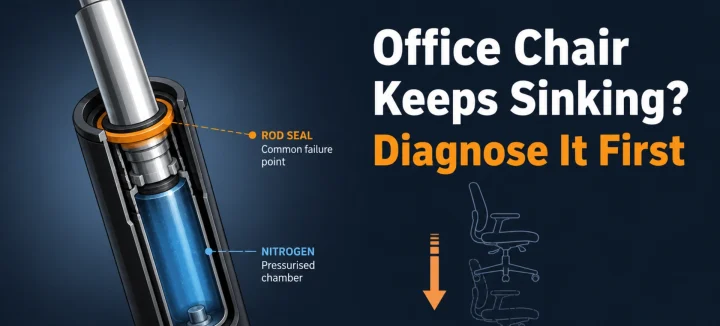
Office Chair Keeps Sinking? Diagnose and Fix It for Good
An office chair that keeps sinking or won’t stay up has one main cause: the gas cylinder under the seat is losing pressure. Worn seals let the nitrogen escape, so the piston stops holding your weight. A hose clamp or PVC pipe locks the height today; a new cylinder fixes it properly in 15 minutes. […]
Read More