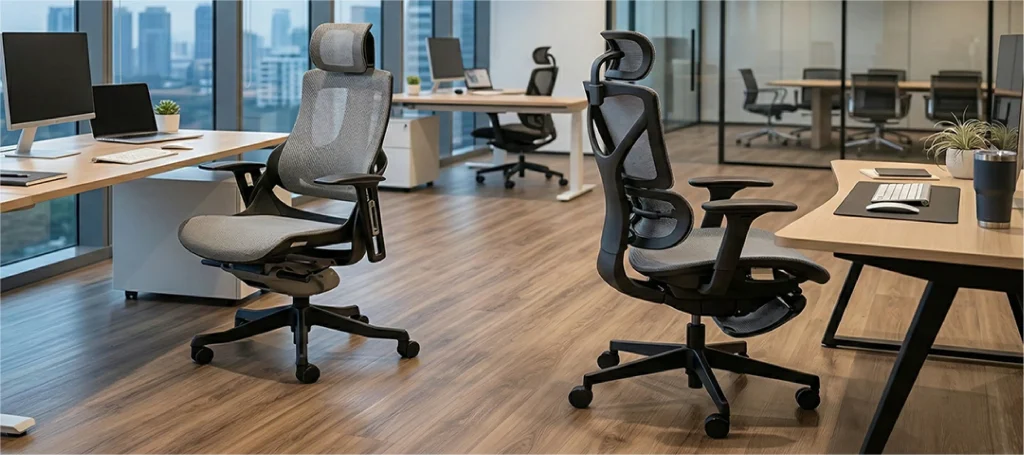
Office Chair for Sciatica: Why Seat Depth Beats Lumbar
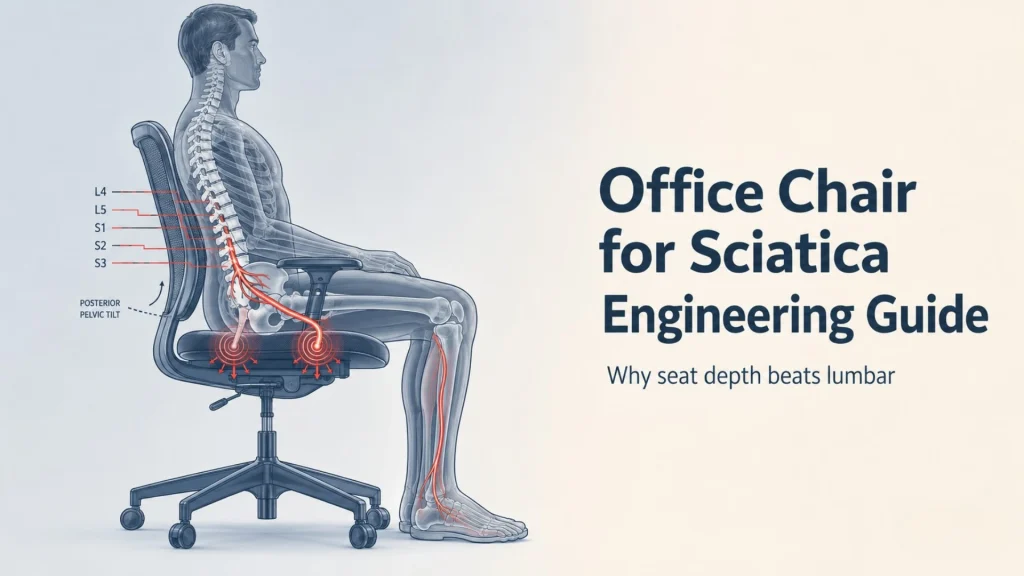
The right office chair for sciatica fixes the seat pan first. Adjustable depth, dynamic cushioning, and a waterfall front edge carry most of the relief work.
Sciatic compression starts at the pelvis and sit bones, not the lumbar curve. Lumbar support stabilises what the seat pan establishes.
Most buying guides flip that order. This piece gives you the biomechanics behind every spec and the calibration sequence that actually works.
Key Takeaways
- For sciatica, seat-pan engineering matters more than lumbar support. The nerve compresses at the pelvis, not at the lumbar curve.
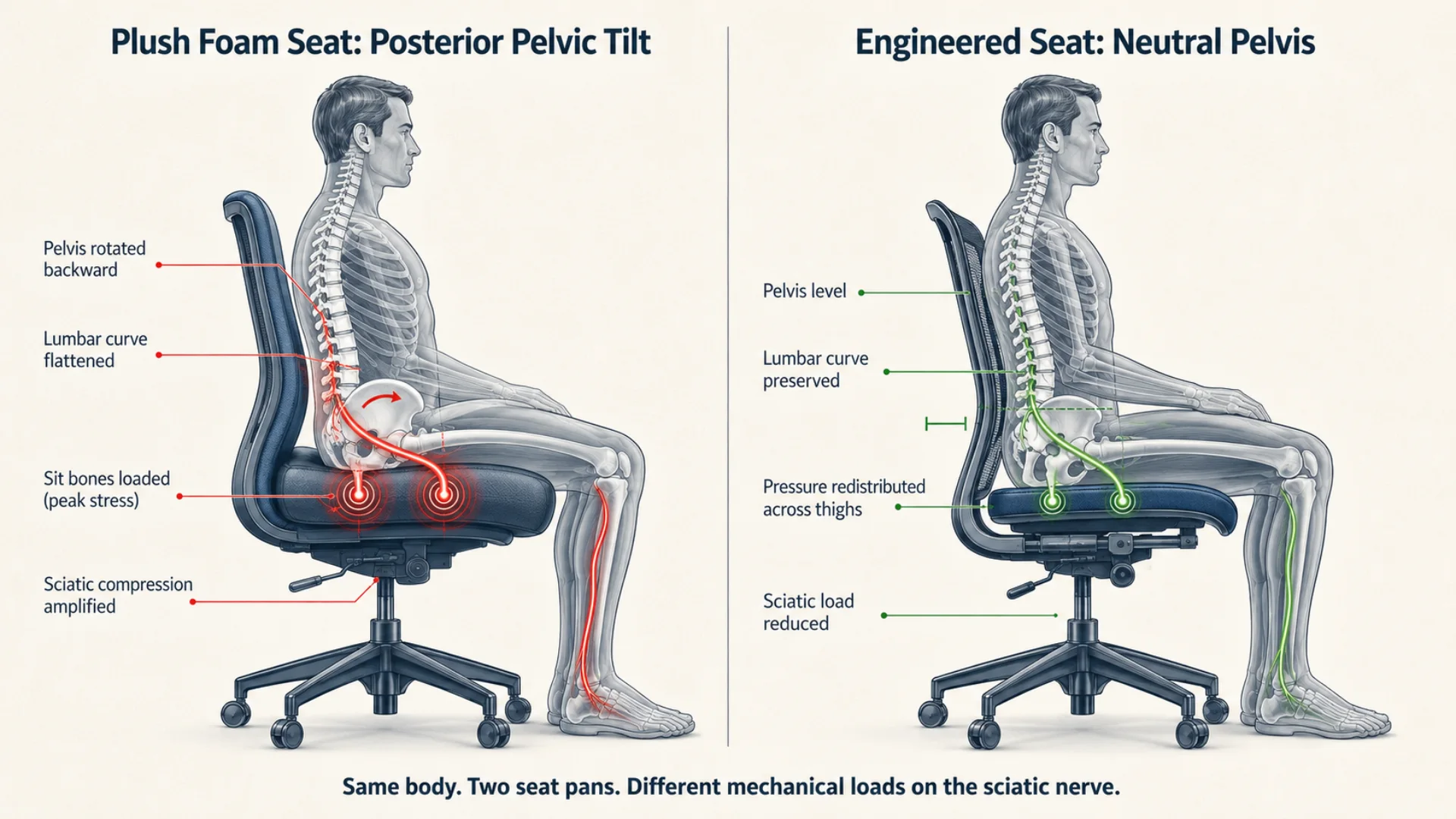
- Plush cushioning is a common trap. It sinks the pelvis into posterior tilt and concentrates load on the sit bones.
- Look for adjustable seat depth (slider with at least 50mm of travel), dynamic cushioning, and a real waterfall front edge.
- A synchro-tilt 2:1 mechanism redistributes ischial loading across the day. Static “perfect” posture causes sciatic compression on its own.
What Sciatica Actually Does to Your Body When You Sit
Sciatica isn’t a back problem dressed up as a leg problem. The nerve compresses where its roots exit the spine, then refers pain down a leg.
Sitting amplifies that compression two ways. Body weight loads the sit bones, and the seat changes the angle of your pelvis.
Knowing the mechanism is what separates a chair that helps from one that just feels comfortable for 20 minutes.
Where does sciatic pain originate when you’re seated?
The sciatic nerve emerges from the L4 to S3 nerve roots. It travels through the greater sciatic notch of the pelvis.
From there, the nerve passes beneath the piriformis muscle in the gluteal region. Sitting compresses it from above and below.
The compression points are predictable: the ischial tuberosities, the piriformis, and the foraminal exits at L4–L5 and L5–S1.
That’s why “lumbar pillow first” misses for sciatica. The pillow sits above the worst compression zone, not on it.
The lumbar support that fixes generic back pain is downstream of the seat pan that causes sciatica.
Why does sitting make sciatica worse?
Three forces stack up the moment you sit. Your pelvis tips backward if the seat doesn’t keep it level.
Body weight then loads the ischial tuberosities. Soft tissue between bone and seat compresses, transmitting that force deeper.
A 3D finite element model of the seated buttock found something striking. Peak compressive stress in the deep muscle under the ischial tuberosities reached about 76 kPa (570 mmHg).
That figure represents a stress amplification of roughly 3.6 times the surface pressure. In plain terms: the load on your tissue is triple what you feel under your sit bones.
Multiply by three. That’s the load your seat pan has to redistribute.
Can a bad office chair cause sciatica pain?
A bad chair rarely causes sciatica in a healthy spine. It does, however, trigger and aggravate symptoms in people with disc disease, piriformis tightness, or pelvic misalignment.
A seat that forces posterior pelvic tilt for eight hours daily is doing slow mechanical damage. The chair can still feel acceptable on day one.
The answer, then, is this: rarely the root cause, often the amplifier. The amplifier is what your chair has to stop being.
Seat-Pan Engineering: The Three Features That Decide Whether Your Chair Helps
This is where most sciatica buying guides go vague. They list “seat depth adjustability” without explaining what it’s doing mechanically.
We’ll do that now. Three engineering features carry most of the load for sciatica relief.
Get these right, and your chair has already done 80% of its job.
Why seat depth matters more than most buying guides admit
Seat depth controls whether your pelvis sits in neutral, posterior tilt, or perched. Too long, and you slide forward to escape pressure behind your knees.
Sliding forward disconnects your lumbar from the backrest. The pelvis tips backward, and the sit bones take more of the load.
Too short, and your thighs aren’t supported. Weight transfers straight to the ischial tuberosities.
The clearance target is 2 to 3 fingers (roughly 5cm) between the seat’s front edge and the back of your knees. Hitting that target needs a seat slider with at least 50mm of travel.
Without that travel range, a chair fits one body and fails everyone else.
Your seat depth controls whether your pelvis tilts forward, back, or stays where your sciatic nerve needs it.
What is dynamic cushioning and why static foam fails for sciatica
Static foam supports you in one shape. Dynamic cushioning adapts as you shift, redistributing peak pressure away from the bony prominences beneath.
The difference shows up at hour three, not hour one.
Here’s the trap most sciatica buyers walk into. Plush memory foam feels supportive on first sit.
But foam compresses unevenly under the sit bones. The deepest compression sinks the pelvis into posterior tilt, and the lumbar curve flattens behind it.
A 2021 Journal of Biomechanics study found that ergonomically designed seat cushions significantly reduced peak interface pressure versus static foam.
What “dynamic” looks like in practice:
| Cushioning type | How it works | Sciatica behaviour |
|---|---|---|
| Soft memory foam | Deforms to shape, holds it | Sinks pelvis into posterior tilt; loads ischial tuberosities |
| High-density contoured foam | Slower deformation, structured support | Holds pelvis level; redistributes pressure |
| Coil-spring matrix | Independent springs respond to local pressure | Tracks weight shifts; redistributes load continuously |
| Tensioned mesh | Pressure spread across tension surface | Breathable; redistributes weight by suspension |
This is why the Merryfair Reya for disc-related and sciatic pain replaces foam with 62 coil springs in the seat. The springs deform independently, so load redistributes locally as you move. [REFRESH NOTE: Reya spec count.]
Don’t read this as “spring beats foam every time.” Read it as: the chair has to redistribute pressure dynamically, not just feel soft.
Mechanisms vary. The requirement doesn’t.
Plush cushioning feels safe and behaves like a trap. The pelvis sinks, and the sciatic nerve pays for it.
How a waterfall front edge protects the popliteal area
The popliteal area is the soft tissue behind your knees. Major veins and nerves run close to the surface there.
A squared-off seat edge presses into that tissue. Blood return to the lower legs drops.
You shift forward to relieve it. Your pelvis tips back, and the posterior-tilt problem returns.
A waterfall edge curves gently downward at the front of the seat. The contact line moves up the thigh and away from the popliteal area.
Circulation stays intact. The pelvis stays where the depth setting put it.
Most listicles mention “waterfall edge” without explaining it. The mechanism is straightforward: keep weight off the structures behind your knee.
Forward seat tilt: the most underused feature for sciatica
Forward tilt drops the front edge of the seat a few degrees below horizontal. The pelvis rotates slightly forward, the lumbar curve opens, and ischial pressure shifts onto the thighs.
For sciatica sufferers, this is one of the highest-leverage features available. Also one of the rarest.
Few chairs include it. Reviewers rarely test for it. Buyers don’t know to ask.
You won’t use it constantly. Reserve it for focused desk work, when the pelvic tilt opens the hip angle.
Then return to neutral for the rest of the session.
Forward tilt is the most underused feature in sciatica seating because it looks like a tilt, not a treatment.
Where Lumbar Support Actually Fits (and Why It’s Second, Not First)
Lumbar support matters. For sciatica specifically, it’s a stabiliser, not a primary intervention.
The seat pan establishes pelvis position. Lumbar support then holds the curve that pelvis position creates.
Get the order wrong, and the lumbar pad pushes into a spine the seat pan has already collapsed.
Does lumbar support help sciatica at all?
It helps once the pelvis is in neutral. Lumbar support fills the inward curve (lordosis) at the L3–L5 region.
That fill keeps disc pressure spread evenly. It also unloads the erector spinae muscles.
If the seat pan tilts the pelvis backward, the lumbar curve has already flattened. The pad then pushes against a flat surface, creating local pressure without restoring the curve.
Yes, lumbar support helps. Only after the seat pan is set up correctly.
Depth-adjustable lumbar vs. height-only: which matters for sciatica
A 2015 PLOS One study measured lordosis across 158 individuals. Curve angles ranged from −69° to −13.6°.
That’s a 55-degree spread. One fixed lumbar bulge cannot serve that range.
Height-only adjustment moves the support up or down to find your L3–L5 region. Depth adjustment controls how far the pad pushes into your back.
A shallow lordosis needs less push. Deep ones need more.
For sciatica, over-pushing a shallow curve forces hyperextension at the lumbar segments. That hyperextension can refer pain through the same nerve roots the sciatic compression originates from.
Under-pushing a deep curve leaves a gap. The slouch returns within minutes.
For the depth-versus-height breakdown, see how lumbar support depth tracks the sacral curve.
How the synchro-tilt 2:1 mechanism reduces ischial loading
Static loading is what aggravates sciatica. Same muscles tensed, same nerve roots compressed, same ischial pressure for hours on end.
The solution isn’t standing constantly. It’s a chair that invites micro-movement without you thinking about it.
A synchro-tilt 2:1 mechanism reclines the backrest twice as far as the seat tilts. Feet stay flat, and weight shifts back off the sit bones.
The hip angle opens. None of it needs conscious effort.
For the mechanical depth, see the synchro-tilt 2:1 ratio and how it coordinates seat and back motion.
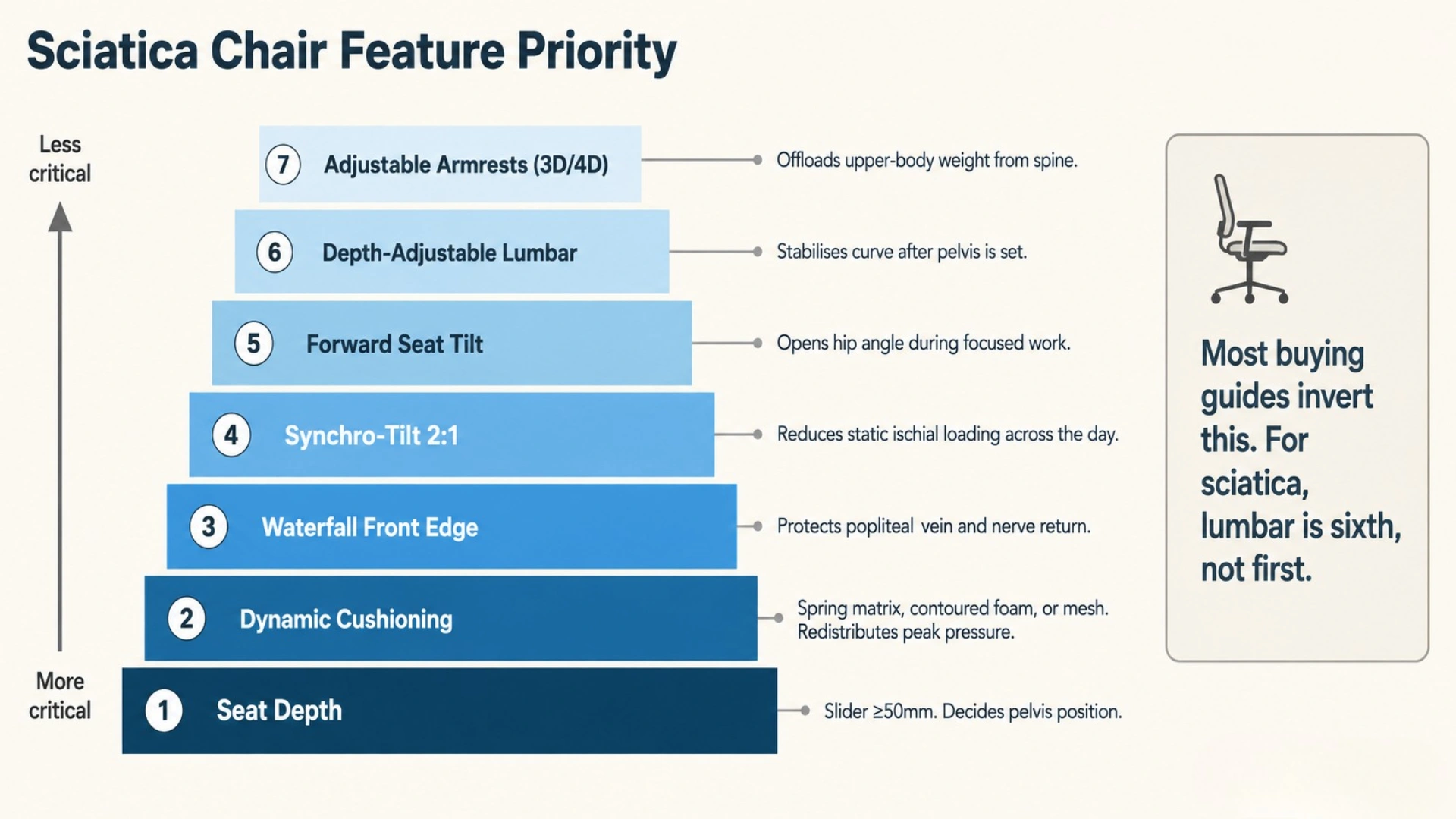
How do these pieces stack up? Here’s the priority order for sciatica:
- Seat depth (slider travel ≥50mm)
- Dynamic cushioning (spring matrix, contoured high-density foam, or tensioned mesh)
- Waterfall front edge
- Synchro-tilt 2:1 mechanism with adjustable tension
- Forward seat tilt option
- Depth-adjustable lumbar support
- Adjustable armrests (3D or 4D)
Lumbar is sixth, not first. That’s the engineering ordering, and most buying guides invert it.
The 2:1 synchro-tilt ratio matters for sciatica because it shifts load off the ischial tuberosities while you stay productive.
Setting Up Your Chair for Sciatica: Sequence Matters
A chair with the right features still fails if you set it up wrong. The sequence below mirrors the engineering priority.
Establish the pelvis first. Then the curve. Load distribution last.
What’s the best sitting position with sciatica?
The best sitting position keeps the pelvis level or slightly anterior-tilted. Ischial tuberosities should unload toward the thighs.
The lumbar curve fills but doesn’t get pushed. Both feet flat.
Hips at or slightly above knee level. Spine following its natural three curves.
But hold any position too long and the nerve compression resumes. Dynamic posture beats static posture, every time.
The five-step calibration order
- Set seat depth first. Slide the seat until you have 2 to 3 fingers (5cm) of clearance behind your knees.
- Set seat height second. Hips slightly above knees, feet flat on the floor or a footrest.
- Adjust forward tilt if your chair has it. A few degrees during focused work opens the hip angle.
- Set lumbar height and depth. Position the pad at L3–L5, firm enough to fill the curve without pushing you forward.
- Set tilt tension and unlock the synchro recline. Let the chair move with you.
The 2025 scoping review by Alaca et al. covered 22 studies and 7,814 participants. It found that sitting behaviour showed a stronger link to back pain than posture alone.
For sciatica, that finding lands harder. Static perfect posture is still static.
The five-point body alignment reset for sitting pairs with this chair setup. It covers the whole body, not just the chair.
When the chair isn’t enough
Two to three weeks of consistent daily use is the realistic window for symptom change. That assumes the chair is set up correctly.
The six-adjustment calibration sequence for sciatica prioritises the seat pan first: pelvic position, then sacral angle, then load distribution.
If nothing’s changed after three weeks, the chair isn’t the variable. Disc issues, piriformis impingement, and nerve root compression all need clinical care.
That’s when a physiotherapist, chiropractor, or spine specialist enters the picture. The chair gave them a stable platform to work from.
For body-specific calibration, see how to configure each of these features for your body type.
This content is for informational purposes only. If you have diagnosed sciatica or disc disease, consult a qualified healthcare professional before changing your seating setup.
The Trade-Off Buyers Keep Getting Wrong
Most sciatica chair guides treat the spine as the problem. The seat pan does the actual harm. Your spine just reports it.
Fix the seat pan. The spine settles.
Sciatica isn’t a back-rest problem. It’s a seat-pan problem with a back-rest disguise.
So if you’re scrolling chair listings tonight, ignore the lumbar marketing first. Start with the seat depth slider range and travel.
Then assess the cushioning mechanism. Is it static foam, contoured foam, springs, or tensioned mesh?
A real waterfall edge and a 2:1 synchro-tilt make the cut. Forward tilt is the bonus.
That filter alone removes most chairs sold for sciatica relief. What’s left is where engineering meets the actual mechanism of the pain.
Ready to test seat-pan engineering against your own pain pattern? Browse the full ergonomic seating range at Merryfair showrooms in Malaysia, Singapore, Thailand, and China.
Bring your sciatica. We’ll fit the chair to it.
Common Questions About Office Chairs and Sciatica
What office chair is best for sciatica?
The best office chair for sciatica has an adjustable seat depth slider with 50mm or more of travel. Dynamic cushioning, a waterfall front edge, and a synchro-tilt 2:1 mechanism handle the rest. Forward seat tilt is a strong bonus, and depth-adjustable lumbar comes after all of these.
How should you sit at the office with sciatica?
Set seat depth so 2 to 3 fingers fit behind your knees. Keep hips level with or slightly above knee height, feet flat. Use forward tilt during focused work to open the hip angle. Shift position every 20 to 30 minutes. The right static posture still becomes harmful if held all day.
Is a hard or soft chair better for sciatica?
Neither extreme works well. Soft, plush cushioning sinks the pelvis into posterior tilt and concentrates pressure on the sit bones. Hard, flat surfaces transmit shock straight to the ischial tuberosities. The right firmness redistributes peak pressure dynamically through a spring matrix, contoured high-density foam, or tensioned mesh.
Does a forward tilt mechanism help with sciatica?
Yes, when used selectively. Forward tilt drops the front of the seat a few degrees below horizontal. That rotates the pelvis slightly forward and shifts ischial load onto the thighs. Use it during focused desk work to unload the sciatic compression zone. Return to neutral the rest of the time.
How long before a new chair starts reducing sciatic pain?
Two to three weeks of consistent daily use with correct setup is the realistic window. The first 48 hours can feel worse as your body adjusts to corrected posture. If nothing changes after three weeks, the chair likely isn’t the source. A clinical assessment is the next step.
MORE BLOGS
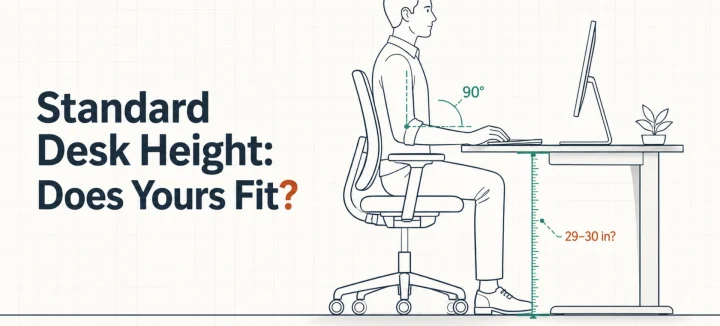
Standard Desk Height: Is 29 Inches Right for Your Body?
Standard desk height is 29 to 30 inches (73 to 76 cm). That number fits far fewer people than you’d think. A desktop that tall matches the seated elbow height of someone around 6’2″. The average American man stands 5’9″, and the average woman 5’3.5″. So this guide does two jobs. It shows you how […]
Read More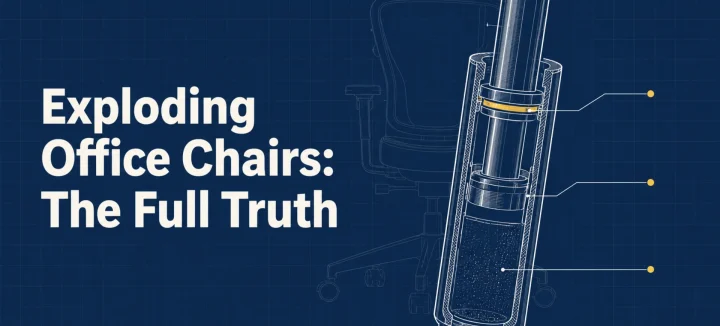
Exploding Office Chairs: The Full Truth From a Chair Maker
The exploding office chair story resurfaces every few years, same grainy photos attached. So can a chair really burst? A handful have, and every documented case involved an uncertified gas cylinder (the pressurized tube that raises and lowers your seat). Chairs built to recognized safety standards fail differently: seals leak, the seat sinks, nothing bursts. […]
Read More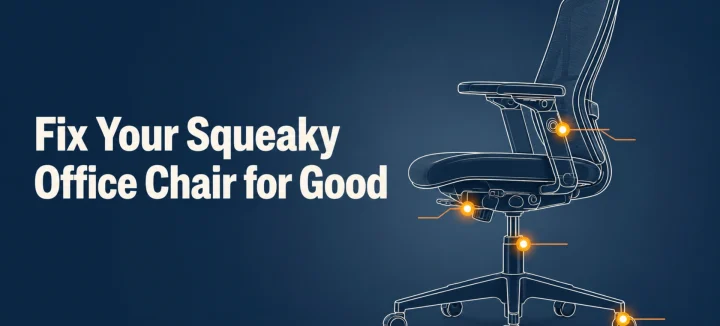
How to Fix a Squeaky Office Chair by Sound and Location
A squeaky office chair makes four different noises, and each one points to a different part. To silence it for good, find the source first: the tilt mechanism, gas cylinder, casters, or armrests. Then tighten what’s loose and lubricate with the right product for that joint. This guide matches each sound to its fix, and […]
Read More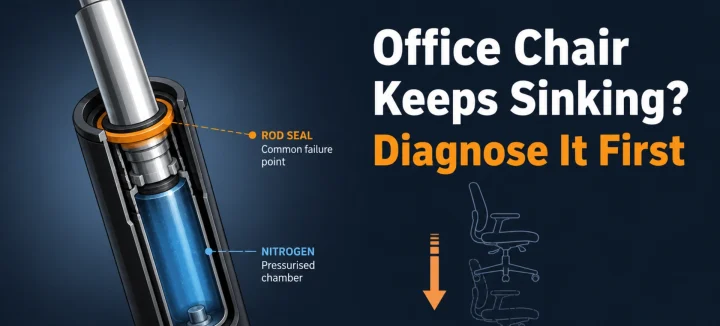
Office Chair Keeps Sinking? Diagnose and Fix It for Good
An office chair that keeps sinking or won’t stay up has one main cause: the gas cylinder under the seat is losing pressure. Worn seals let the nitrogen escape, so the piston stops holding your weight. A hose clamp or PVC pipe locks the height today; a new cylinder fixes it properly in 15 minutes. […]
Read More