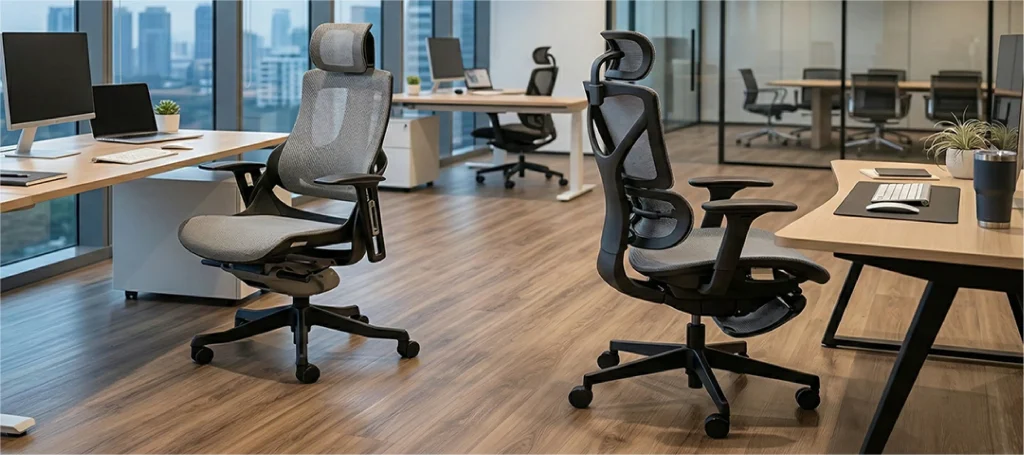
Exploding Office Chairs: The Full Truth From a Chair Maker
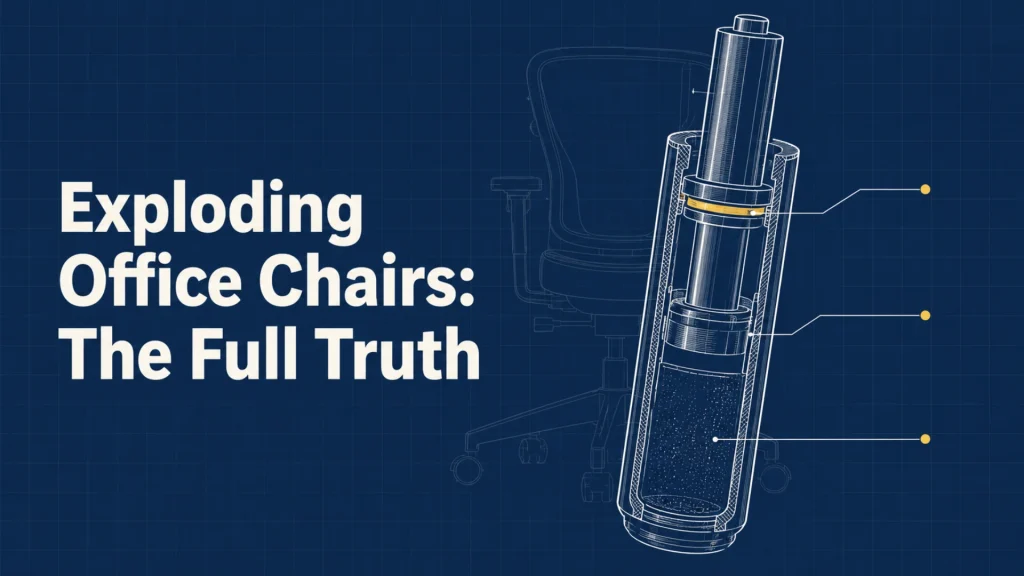
The exploding office chair story resurfaces every few years, same grainy photos attached. So can a chair really burst?
A handful have, and every documented case involved an uncertified gas cylinder (the pressurized tube that raises and lowers your seat). Chairs built to recognized safety standards fail differently: seals leak, the seat sinks, nothing bursts.
That behavior is deliberate engineering. This guide covers the physics, the real incidents, and a one-minute check for your own chair.
Key Takeaways
- Exploding office chair incidents are documented but rare, and every known case involved an uncertified gas cylinder.
- A certified cylinder holds pressurized nitrogen and is engineered to leak slowly rather than burst.
- Cylinder classes under DIN 4550 run from 1 to 4 and reflect steel wall thickness; Class 3 and 4 are the benchmarks.
- Sinking, hissing, oil residue, and rust are the four signs a cylinder has reached the end.
- The stamp on the cylinder itself tells you in seconds whether your chair meets recognized standards.
Can an Office Chair Actually Explode? The Honest Answer
Yes, office chairs have exploded, but the confirmed cases are vanishingly few and share a single cause. Each one involved a cheap, unmarked gas cylinder rather than a certified one.
There is no verified case of a certified cylinder bursting under normal use. That distinction is the whole story, and most viral posts miss it.
Search the topic and you’ll meet two camps. Forum threads treat every chair as a time bomb, while retail myth posts wave the whole thing off as debunked.
Both camps miss what matters. The truth sits in the middle, and it’s more useful than either extreme.
Every documented failure shares one detail. We’ll get there.
How rare is it for an office chair to explode?
Rare enough that no consumer safety agency tracks chair explosions as a category. The documented cases span two decades against hundreds of millions of chairs in daily use.
In five decades of chair manufacturing, we have never seen a certified cylinder burst in the field. The panic outruns the numbers by a wide margin.
So what exactly is pressurized down there?
Inside the Gas Cylinder: What’s Pressurized Under Your Seat
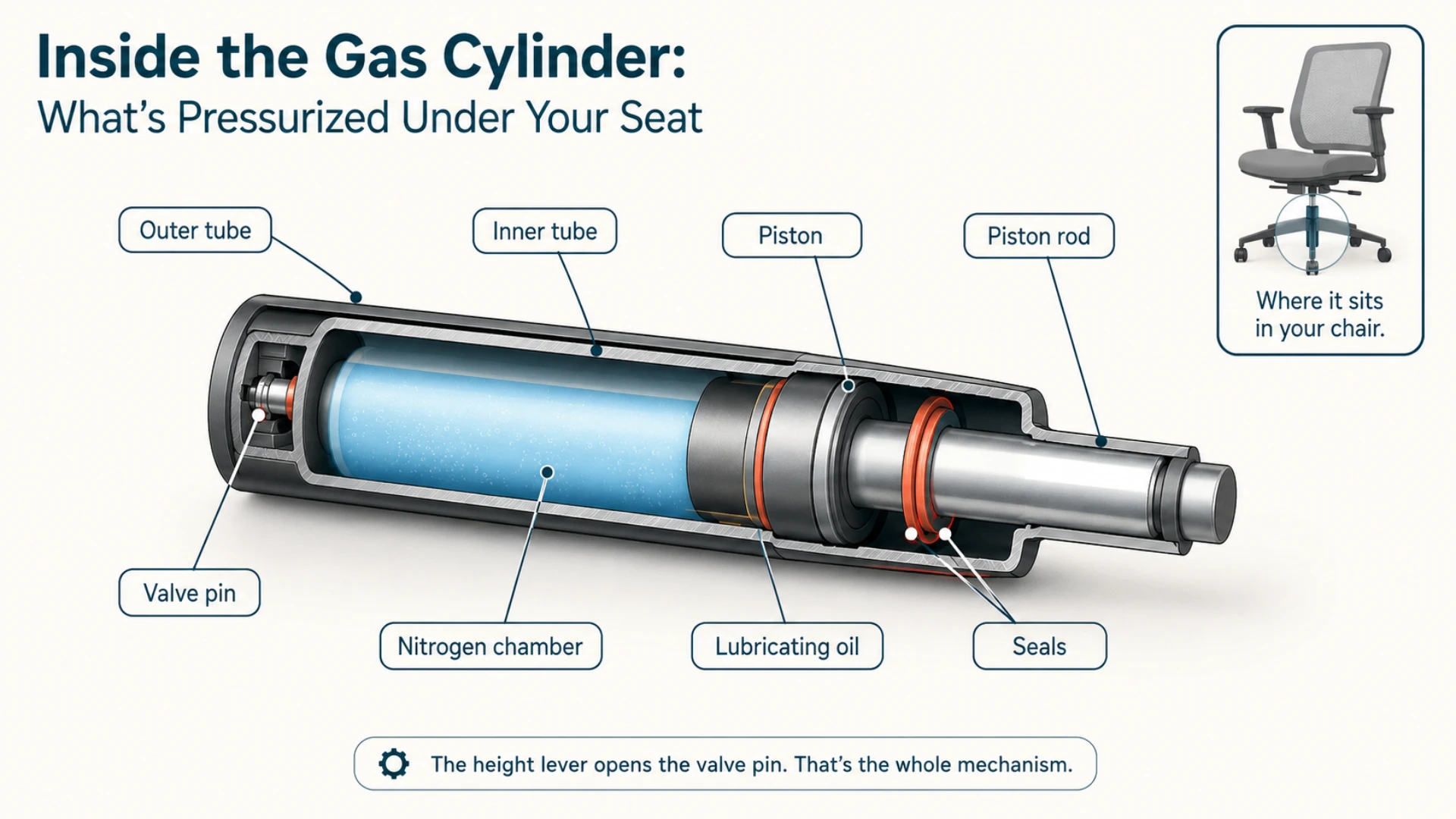
Under your seat sits a sealed steel tube holding nitrogen, a piston, a valve, and a little oil. The height lever opens the valve to let the piston move; closing it locks the seat.
That’s the whole mechanism.
Nitrogen wasn’t a random choice. It’s inert, so nothing inside the tube can ignite or react with the steel around it.
And the pressure inside is real, which is why certified cylinders carry wide burst margins. The design puts the weakest link where it can’t hurt you: worn seals bleed pressure gradually instead of letting go at once.
A certified gas cylinder fails the way a tire goes flat, not the way a balloon pops.
What is an office chair gas cylinder filled with?
High-purity nitrogen, typically 99.9% in certified Class 3 and Class 4 cylinders, plus a small amount of oil for lubrication. Nitrogen is chosen because it’s inert; the only stored energy is pressure, never chemistry.
How are office chair gas cylinders tested?
Certified cylinders pass third-party testing against standards such as ANSI/BIFMA X5.1 in the US and DIN 4550 in Europe. Labs cycle them tens of thousands of times under load and verify they hold pressure far beyond normal sitting forces.
The bar is deliberately conservative. According to ANSI/BIFMA X5.1-2017 (R2022), its tests are built around an estimated ten-year product life on single-shift use.
Marks like TUV, LGA, and SGS on the tube mean an independent lab did that work. A claim on the product listing means less; the marks on the steel mean everything.
Here’s the part most buying guides skip: a manufacturer qualifies the cylinder supplier, not just the part. In practice, we review batch test reports and burst-pressure margins before any cylinder reaches a chair.
The seals are designed to give up decades before the steel does.
The Exploding Office Chair Incidents on Record
The famous case dates to 2009, when Chinese media reported a 14-year-old killed by a bursting chair cylinder. Western tech press ran it within days, and even Gizmodo’s 2009 report doubted the physics.
Industry roundups of the documented cases add a 2013 injury in China and a 2008 piston launched into a ceiling. Three headline incidents across two decades is close to the entire public record.
Was the exploding office chair story real?
The 2009 story was genuinely reported by mainstream outlets, not invented by the internet rumor mill. But no published case identifies a certified, stamped cylinder; every detail on record points to unbranded budget hardware.
Treat it as a warning about counterfeit parts, not about chairs.
What did the failed cylinders have in common?
Every case with product details points to the same profile: thin walls, no third-party markings, no traceable maker. Cheap chairs from unknown factories, sold on price alone.
That’s the one detail promised earlier.
Every documented chair explosion shares one detail: nobody could point to a certification stamp on the cylinder.
Corner-cutting rarely stops at one component. The factories that skip cylinder certification usually skip material quality too; it’s part of why bonded leather office chairs peel.
4 Warning Signs Your Gas Cylinder Is Reaching the End
A gas cylinder rarely quits without notice. It advertises retirement, and the four signals below deserve action whatever brand you sit on.
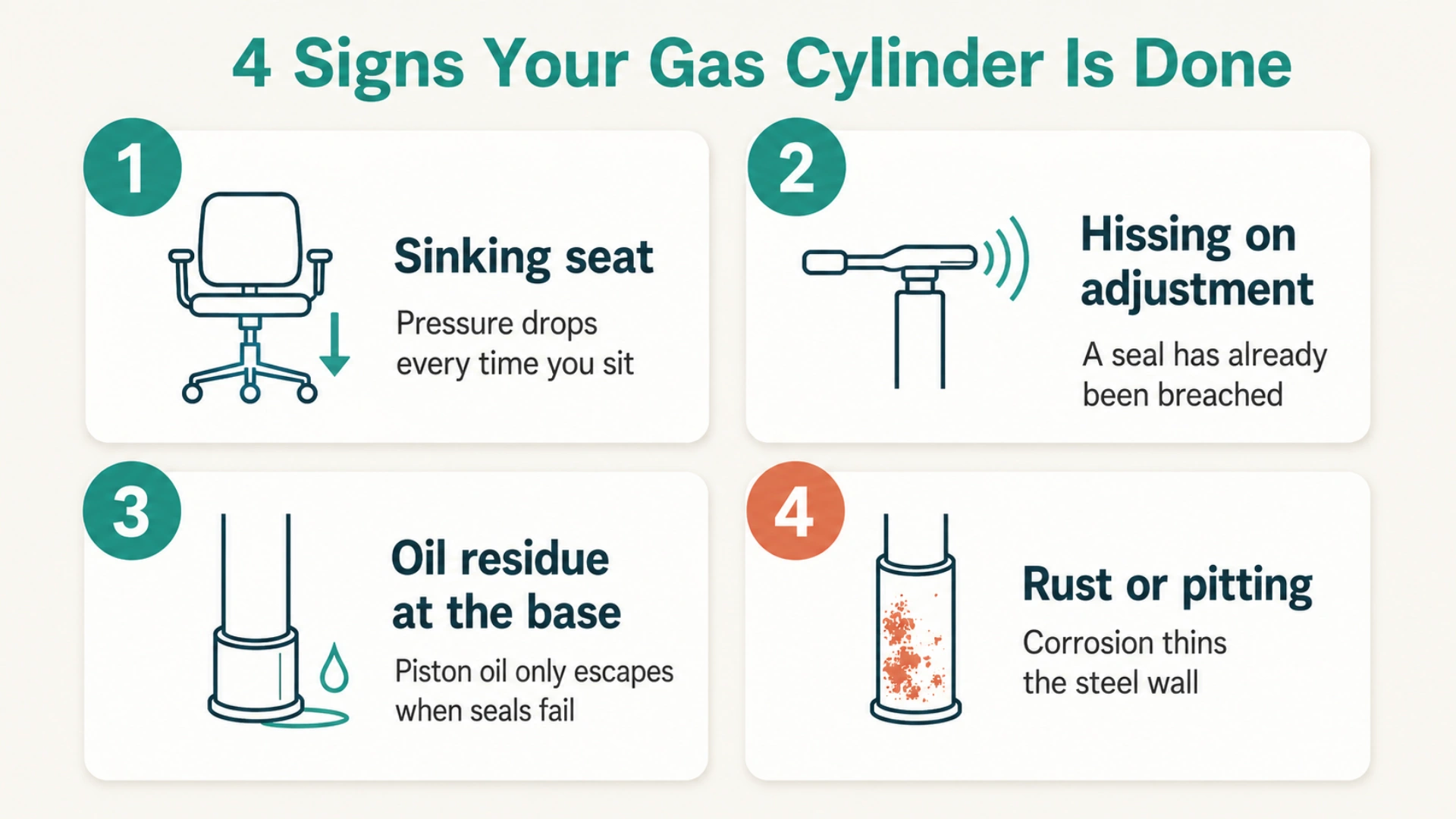
- The seat sinks while you sit. Worn seals are leaking nitrogen, so pressure drops every time you load the seat. Our guide to diagnosing and fixing a sinking office chair includes a one-minute sink test.
- Hissing during height adjustment. Escaping gas means a seal has already been breached. The leak only widens from here.
- Oil residue at the cylinder base. The oil that smooths the piston only escapes when seals fail. Wipe it clean, then check again in a week.
- Rust or pitting on the tube. Corrosion thins the steel wall, the one dimension you never want thinned.
A sinking seat is a cylinder retiring politely.
If several signs arrive together, the cylinder may not be the only tired part. Check the seven signs your ergonomic chair is due for an upgrade before spending on components.
Do these signs mean the chair could burst?
On a certified cylinder, no; these signs mean the part is worn, and slow pressure loss is the designed failure. If the cylinder is unmarked, stop using the chair rather than gamble on unknown steel.
Does heat or heavy load make a cylinder dangerous?
Not on certified steel. A certified cylinder carries wide safety margins for both temperature and load, so daily heat and full-weight sitting sit far inside its design range. Heat and overload only turn dangerous as multipliers on an uncertified tube, where wall thickness and fill quality were never tested.
Heat first. A parked car or an unshaded sunroom can push past 60°C, raising internal pressure well above room-temperature spec. Certified tubes absorb that; a chair living in those conditions still deserves a periodic look at the four signs above.
Load second. Weight ratings are duty grades, not cliff edges: exceeding them daily fatigues seals and shortens cylinder life. Match the chair’s rating to its heaviest daily user and the margin stays intact.
How to Check If Your Chair Has a Certified Cylinder
You don’t need tools, just decent light and one minute. The cylinder carries its own paperwork, printed straight onto the steel.
- Lower the seat fully, then tip the chair on its side.
- Slide the plastic telescopic cover up to expose the cylinder body.
- Find the printed label or stamped ring near the top of the tube.
- Read the markings: a class number plus marks such as TUV, LGA, SGS, BIFMA X5.1, or EN 1335 signals third-party testing.
- Treat a bare, unmarked tube as low grade, whatever the chair cost.
Cylinder quality is invisible in the showroom and readable in ten seconds on the stamp.
What do gas cylinder classes 1 to 4 mean?
Classes grade a cylinder’s construction under DIN 4550, the German standard most of the industry references. Higher classes use thicker cold-drawn steel; Class 3 is the mainstream benchmark and Class 4 the professional grade.
| Class | Typical outer tube wall | Where you’ll find it |
|---|---|---|
| 1 | Around 1.0 mm | Ultra-budget chairs, light duty |
| 2 | Around 1.2 mm | Entry-level home chairs |
| 3 | Around 1.5 mm | Mainstream office chairs |
| 4 | 2.0 mm or more | Professional and heavy-use chairs |
Wall figures are typical supplier specifications rather than legal minimums (exact values vary by maker). The pattern holds regardless: more steel, more margin, longer life.
Where is the certification stamp on an office chair cylinder?
On most chairs, it sits on the outer tube just below the seat mechanism. Look for a wraparound label or stamped characters; the dust cover slides up by hand if it’s hiding them.
This is also where a manufacturer shows its work. Merryfair publishes cylinder class and BIFMA testing in its chair specifications; the stamp guarantees the steel, not the price tag.
That transparency is part of what separates a truly ergonomic chair from one that just looks the part. Any maker confident in its cylinders will state the class without being asked.
The One-Minute Check That Ends the Worry
Go read your cylinder. A stamped Class 3 or 4 tube means the scary videos have nothing to do with the chair you own.
If the tube is bare, or the warning signs have started, the fix is straightforward. Replace the cylinder on a chair worth keeping.
Or start fresh with the best ergonomic chairs for long-hour sitting, where certified components are part of the spec.
The viral stories were never about your chair. They were about steel nobody inspected, and yours takes one minute to inspect.
Fear spreads faster than physics, but physics is what you’re sitting on.
Frequently Asked Questions
Why does my office chair pop?
Occasional pops usually come from the taper joints at the base and seat mechanism, or flexing plastic parts, not gas escaping. A pop paired with sudden sinking or hissing is different; treat that as a failed seal and get the cylinder inspected.
Can gaming chairs explode?
Gaming chairs use the same nitrogen gas cylinder and taper fittings as standard office chairs, so identical safety logic applies. A certified Class 3 or 4 cylinder fails by slow leaking; an unmarked budget cylinder is the only meaningful risk factor.
Is it safe to keep sitting in a chair that keeps sinking?
A sinking certified cylinder isn’t about to burst; it’s losing pressure exactly as it was designed to. The real cost is posture strain from a seat that won’t hold working height, so plan a cylinder replacement soon.
Do office chair gas cylinders expire?
There’s no printed expiry date, but seals age with every cycle, plus humidity and temperature swings. Quality chairs typically last seven to ten years, and the cylinder is often the first major part to retire within that span.
Should I replace the cylinder or the whole chair?
Replace just the cylinder when the rest of the chair is sound: supportive foam, solid mechanism, intact upholstery. Replace the chair when several parts fail at once, since a new cylinder can’t rescue worn foam or a loose mechanism.
Can an office chair break in other ways?
Yes, and none of them are explosive. Bases crack at the leg joints, casters shear off, tilt mechanisms loosen, and armrest bolts strip; each fails by giving way, not bursting. Watch for new wobble, clicks, or drift, the same early-warning logic that applies to the cylinder.
MORE BLOGS
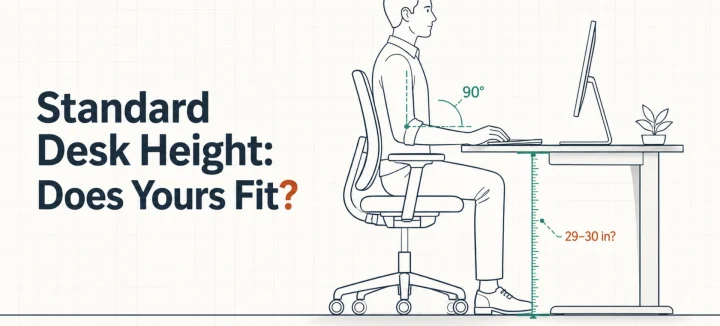
Standard Desk Height: Is 29 Inches Right for Your Body?
Standard desk height is 29 to 30 inches (73 to 76 cm). That number fits far fewer people than you’d think. A desktop that tall matches the seated elbow height of someone around 6’2″. The average American man stands 5’9″, and the average woman 5’3.5″. So this guide does two jobs. It shows you how […]
Read More
How to Fix a Squeaky Office Chair by Sound and Location
A squeaky office chair makes four different noises, and each one points to a different part. To silence it for good, find the source first: the tilt mechanism, gas cylinder, casters, or armrests. Then tighten what’s loose and lubricate with the right product for that joint. This guide matches each sound to its fix, and […]
Read More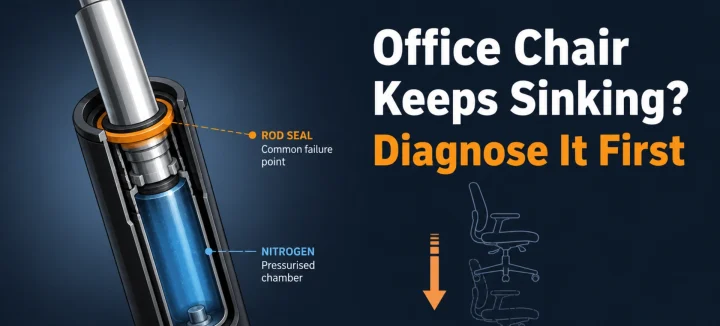
Office Chair Keeps Sinking? Diagnose and Fix It for Good
An office chair that keeps sinking or won’t stay up has one main cause: the gas cylinder under the seat is losing pressure. Worn seals let the nitrogen escape, so the piston stops holding your weight. A hose clamp or PVC pipe locks the height today; a new cylinder fixes it properly in 15 minutes. […]
Read More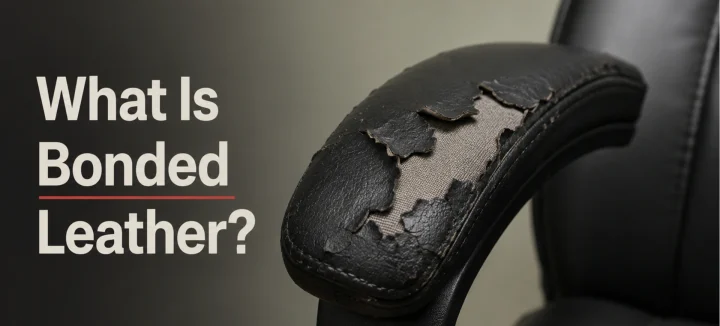
What Is Bonded Leather and Why It Peels in Office Chairs
Bonded leather is mostly plastic. The real hide inside usually makes up just 10 to 20 percent of it. The rest is polyurethane binder pressed onto a fabric or paper backing. It looks like leather on day one. By year three, it’s flaking onto your trousers. This guide covers what it’s made of, why office […]
Read More