Office Chair Keeps Sinking? Diagnose and Fix It for Good
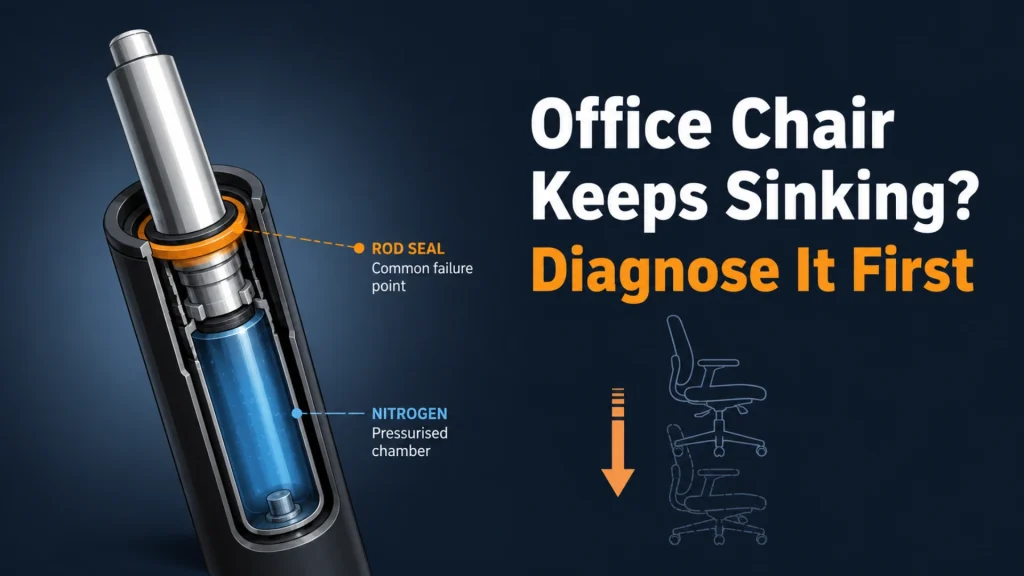
An office chair that keeps sinking or won’t stay up has one main cause: the gas cylinder under the seat is losing pressure. Worn seals let the nitrogen escape, so the piston stops holding your weight. A hose clamp or PVC pipe locks the height today; a new cylinder fixes it properly in 15 minutes. Diagnose first, and you’ll only fix it once.
Key Takeaways
- A sinking office chair almost always traces back to the gas cylinder, where a worn seal lets pressurized nitrogen leak until the piston can’t support you.
- A sink test that takes about a minute tells you whether the fault sits in the cylinder, the lever, or the seat mechanism before you spend a cent.
- Hose clamp and PVC fixes work, but they lock your height permanently and carry a posture cost.
- Replacement cylinders are graded by DIN 4550 class. Matching the class to your body and hours decides how long the repair lasts.
Why Your Office Chair Keeps Sinking: Inside the Gas Cylinder
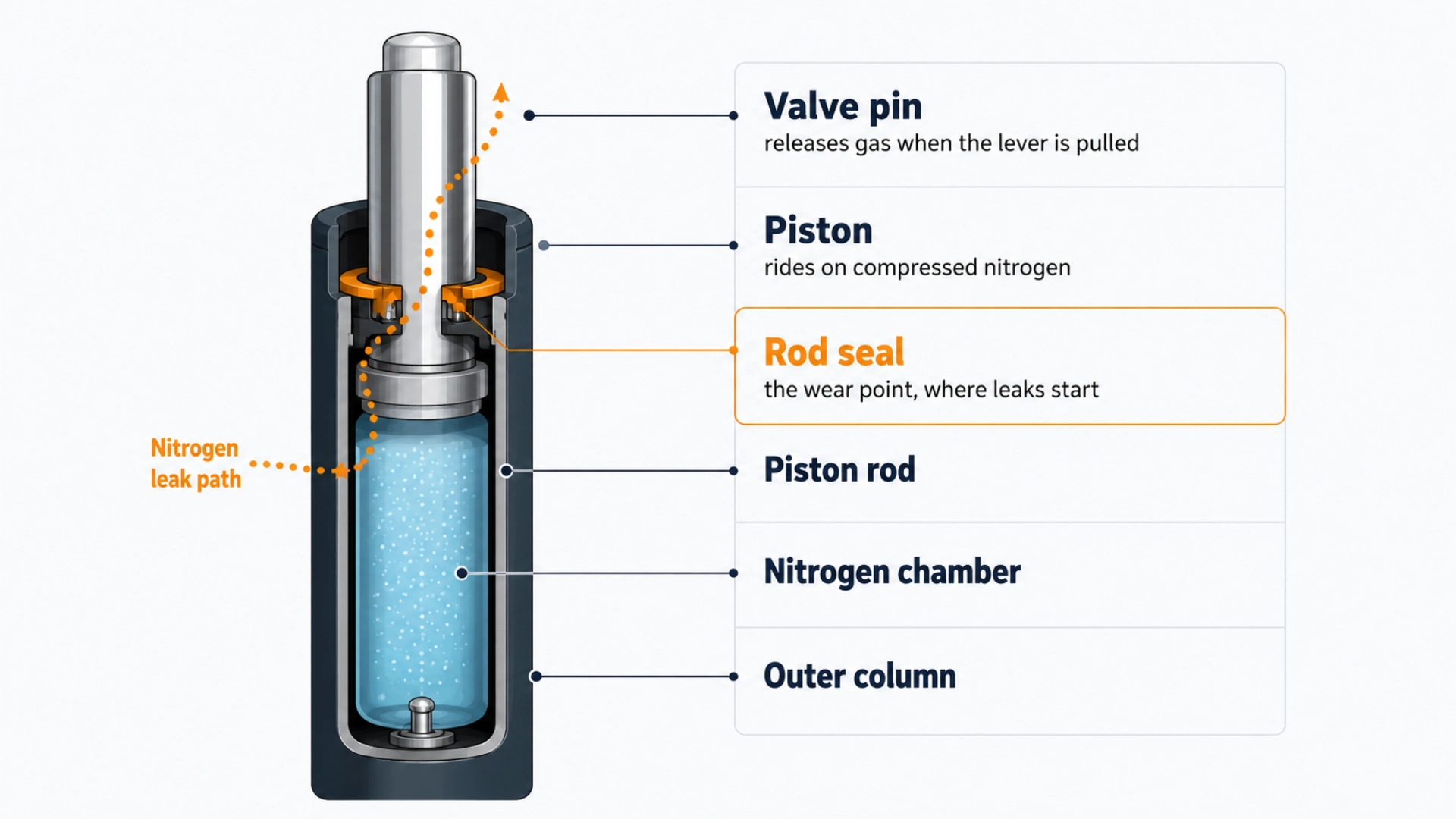
Your chair sinks because its pneumatic cylinder can no longer hold pressure. The column under the seat contains a sealed chamber of compressed nitrogen. A piston rides on that gas, and a small valve releases it when you pull the height lever. Once the seal wears, nitrogen bleeds past the piston and the chair drops under load.
That’s the short version. The longer version explains why every fix in this guide works, so it’s worth 90 seconds.
How does an office chair gas cylinder work?
A gas cylinder (also called a gas lift) is a sealed pneumatic spring. Compressed nitrogen sits behind a piston, and that pressure carries your entire seated weight.
Pulling the height lever presses a valve pin at the top of the cylinder. Gas shifts between chambers, and the seat rises or falls.
The physics is Boyle’s law: squeeze a gas into less space and its pressure climbs, pushing back harder. Explain That Stuff has a clear breakdown of the principle.
One small part makes all of this possible. According to Industrial Gas Springs, the guide and seal package is both a rod bearing and a gas-tight barrier.
Every office chair is a person sitting on a column of compressed gas. The only thing keeping you up is a seal a few millimeters thick.
Why do gas cylinders fail?
Gas cylinders fail in three ways: seal wear, contamination, and load mismatch.
Seal wear is gradual friction damage from years of the rod sliding through it.
Contamination is grit dragged into the seal housing.
Load mismatch is a light-duty cylinder doing heavy-duty work.
Each ends the same way, with nitrogen escaping.
Seal wear is the honest, expected failure. The rod cycles through the seal thousands of times a year, and friction slowly abrades the sealing surface.
Contamination speeds that up. Carpet fiber, dust, and pet hair cling to the oiled rod, then get dragged into the seal housing.
There they behave like sandpaper. A clean rod extends cylinder life, which is an overlooked reason to follow how to clean and maintain your office chair on a schedule.
Load mismatch is the failure nobody tells you about. Put a thin-walled budget cylinder under heavy daily hours, and the seal runs at pressures it wasn’t built to hold.
We’ll come back to cylinder classes. They decide this.
The Sink Test: Find What’s Actually Broken
Here’s where most guides go wrong. They jump straight to fixes, but a sinking seat has three possible culprits: the cylinder, the lever linkage, or the seat mechanism. A quick sink test takes about 60 seconds and separates them with three checks, using no tools.
A squeal during height changes narrows it further, since each chair squeak sound maps to a failing part.
How do I know if my chair cylinder is broken?
Run the three checks in order:
- The drop check. Raise the chair fully, sit down, and stay still for two minutes. A slow, steady drift downward points to a leaking cylinder seal.
- The lever check. Sit and watch what happens when you leave the lever alone. If the chair only sinks while the lever is pulled or held under tension, the cylinder is fine.
- The rest check. Tip the chair and inspect the underside. Loose seat bolts or a bent lever plate can hold the valve pin pressed, venting gas with no one touching anything.
Diagnosis costs you sixty seconds. The wrong fix costs a replacement cylinder that solves nothing, because the cylinder was never the problem.
Why does my chair still sink after replacing the cylinder?
Because the cylinder was never the fault. If a new gas lift still sinks, the lever’s actuator is usually pressing the valve pin at rest, venting gas continuously. A bent lever, loose mechanism bolts, or a misaligned linkage all cause this. Fix the geometry, not the cylinder.
The actuator lives on the mechanism plate bolted under your seat, the same housing that carries the tilt controls. If you’re unsure what you’re looking at under there, how different office chair tilt mechanisms control your seat maps out that plate and its parts.
The usual cure is a shim. Slip a washer between the seat plate and the mechanism so the actuator sits clear of the pin.
If the sinking stops, the fault was geometry all along.
Temporary Fixes That Stop the Sinking Today
Two temporary fixes hold a sinking chair at a fixed height: a hose clamp tightened around the piston rod, or a PVC pipe slotted over it. Both cost a few dollars and take minutes. Both also delete your height adjustment, which is a bigger trade than it sounds.
Does the hose clamp trick actually work?
Yes. Raise the chair to your preferred height, wrap a hose clamp around the exposed piston rod, and tighten it flush against the cylinder collar.
The chair can’t compress past the clamp, so it can’t sink. Wrapping the rod with a strip of rubber or tape first gives the clamp more grip.
The PVC version does the same job with more contact area. A length of 1.5-inch pipe, cut lengthwise, snaps over the rod and props the seat at one height.
But here’s the catch. Both fixes freeze the chair at a single height, permanently (or until you remove them).
A hose clamp doesn’t repair a sinking chair. It freezes the failure in place at the one height you can live with.
If that locked height is wrong for your desk, your neck, wrists, and lower back pay for it. The research on what poor sitting posture does to your body is blunt on this point.
Height is the first of six chair adjustments for a reason: everything downstream depends on it.
| Fix | Cost | Time | Height adjustable after? | Best for |
|---|---|---|---|---|
| Hose clamp | Around $2 | 5 minutes | No | Renters and stopgaps while parts ship |
| PVC pipe | $5 to $10 | 10 minutes | No | Chairs used by one person at one desk |
| Cylinder replacement | $20 to $40 | 15 minutes | Yes | Any chair worth keeping |
Replacing the Cylinder Properly: Class Ratings and Sizing
A proper repair means swapping the cylinder, and the swap is easier than it looks. The two decisions that matter happen before you buy: choosing the right DIN 4550 class and matching the old cylinder’s dimensions. Get those right, and the physical replacement takes 15 minutes with two tools.
Before you buy anything, check whether the chair is still under warranty. Gas cylinders are covered parts on most quality chairs. Merryfair’s 5-year warranty covers the gas lift, so a sinking seat inside that window costs an email, not a cylinder.
What class gas cylinder does my office chair need?
Most office chairs run a Class 3 cylinder, and most people replacing one should buy Class 4. DIN 4550 classes grade cylinders by tube wall thickness and build quality, not just weight capacity. Thicker walls hold pressure longer, which is what you’re actually paying for.
| DIN 4550 class | Where you’ll find it | What it means in practice |
|---|---|---|
| Class 1-2 | Budget and big-box chairs | Thin walls; shortest service life |
| Class 3 | Standard office chairs | Mid-spec walls; fine for light daily use |
| Class 4 | Quality ergonomic and 24/7 seating | Thickest walls, higher-purity nitrogen fill, longest life |
The jump from Class 3 to Class 4 buys thicker tube walls and a higher-purity nitrogen fill. ErgoDelux’s comparison of the two classes breaks down the differences.
Here’s a misconception worth killing: class is not a strict weight limit. It’s a durability grade.
Your current cylinder’s class is stamped on its body, usually near the base. ChairPartsOnline’s guide to cylinder stamping shows where to look and how to read the markings.
In North America, the ANSI/BIFMA X5.1 standard puts office chairs through a battery of structural and durability tests. Micom’s lab overview of X5.1 covers what the standard demands of components like gas lifts.
So the certification sticker matters more than the sales copy. It’s why Merryfair specs Class 4 cylinders on its ergonomic seating rather than treating the gas lift as a place to save cost.
Cylinder classes aren’t marketing tiers. They’re wall-thickness grades that decide how many years of sitting a seal survives.
How do you replace an office chair gas cylinder?
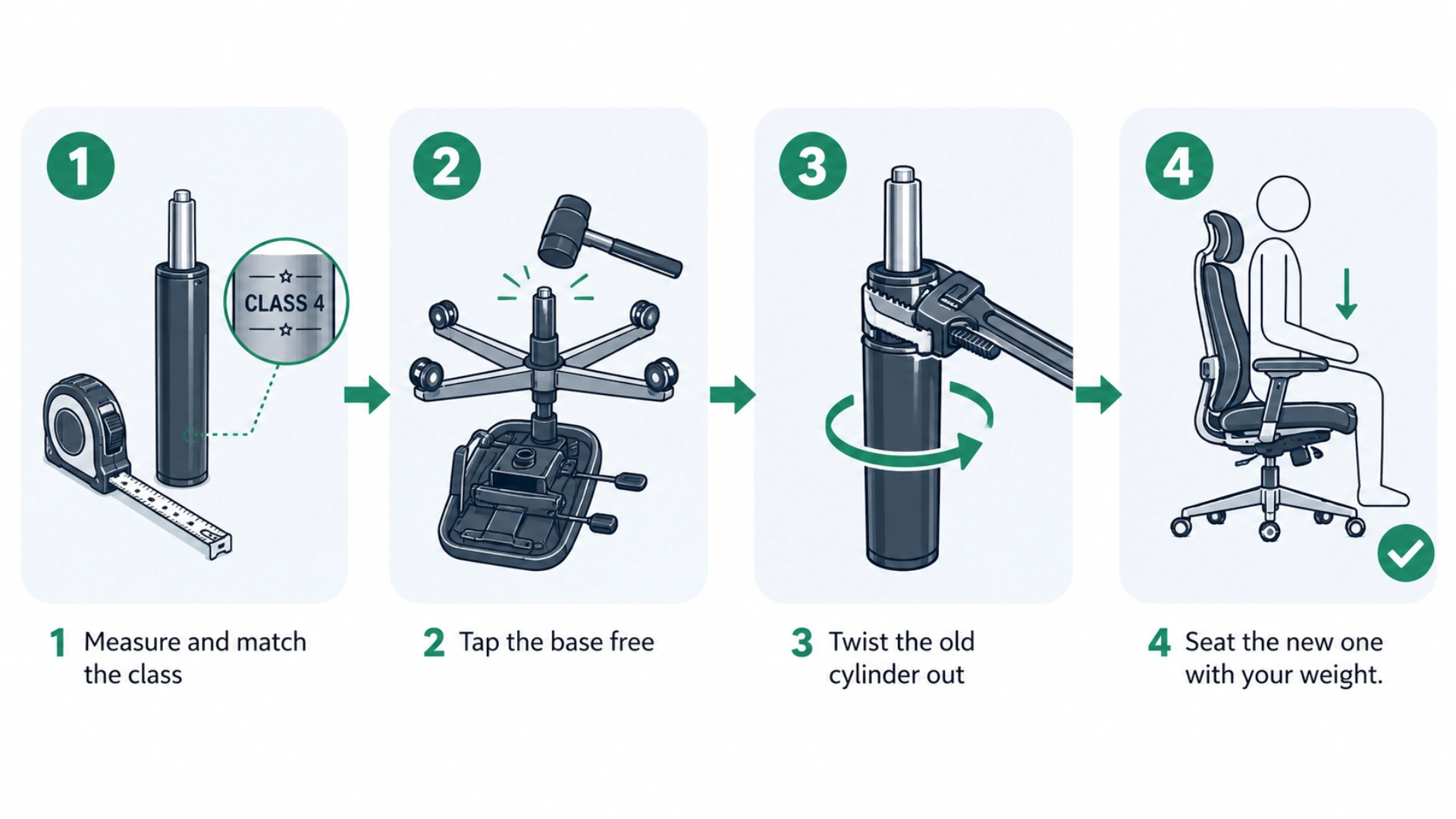
Replacing a cylinder needs a pipe wrench, a rubber mallet, and 15 minutes. These steps apply to standard ergonomic chairs, which use two friction-taper fits at the base and seat mechanism.
No screws or clips are involved, which surprises most first-timers.
- Measure the old cylinder first. Note its overall length and stroke, and check the class stamp. Buy a replacement matching both.
- Free the base. Flip the chair, then tap the base hub with a rubber mallet until the cylinder pops loose.
- Remove the old cylinder. Grip it with a pipe wrench and twist while pulling; the taper releases.
- Fit the new cylinder. Push it into the mechanism cone, press the base on, set the chair upright, and sit. Your body weight seats both tapers.
When Sinking Means the Chair Is Done
Sometimes the cylinder isn’t the problem; it’s the messenger. A gas lift that fails within a year or two usually signals a chair built with budget components throughout. And when a second cylinder fails, or the failure arrives with flattened foam and a loose mechanism, stop. Repair money is better spent on the chair itself.
A gas cylinder that dies at year two is rarely a one-off. It’s a preview of every other component built to the same budget.
A quality ergonomic chair should give you 7 to 10 years of daily use. Cylinder failure inside the first quarter of that lifespan says something about the whole build.
The features that mark a quality ergonomic chair go far beyond the cylinder.
Failure near the end of it is normal aging. There, a Class 4 swap can honestly extend the chair’s life.
Is it worth fixing a sinking office chair?
Fix it when the chair is otherwise sound and this is its first cylinder failure. That means supportive foam, a solid mechanism, and intact upholstery. Replace the chair when the sinking arrives with company. If several symptoms show up at once, check the 7 signs your ergonomic chair is due for an upgrade before spending on parts.
Your Chair Just Told You What It Needs
Components talk. A sinking seat is your chair reporting which part has worn out, and a one-minute sink test translates the message.
A $2 clamp buys time. A Class 4 cylinder buys years. Sometimes the honest answer is a better chair.
If the diagnosis points that way, start with ergonomic chairs tested for long-hour comfort, where the cylinder class is part of the spec rather than an afterthought.
And the next time a chair sinks under someone you know? You’ll fix it in one pass, because you’ll know what it’s saying.
Frequently Asked Questions
Why does my office chair keep sinking even after I raise it?
The cylinder seal is leaking nitrogen, so pressure drops every time you load the seat. Raising the chair only repositions the piston; it doesn’t restore pressure. The chair won’t stay up, and it will keep sinking further, until the cylinder is replaced or clamped at a fixed height.
Can I fix a sinking office chair without replacing the cylinder?
Yes, temporarily. A hose clamp or PVC pipe fitted around the piston rod locks the chair at one height. If the fault is a misaligned lever pressing the valve pin, a washer shim fixes it without new parts. Only a replacement restores true height adjustment.
Are office chair gas cylinders universal?
Mostly. The large majority of office chairs use a standard taper fit at the seat and base, so a standard replacement fits. Measure your old cylinder’s overall length and stroke before buying, though. A few brands use proprietary sizes, and stool-height chairs need longer cylinders.
How long should an office chair gas cylinder last?
It depends heavily on class and daily hours. Thin-walled Class 1 and 2 cylinders can fail within a couple of years of full-time use. A Class 4 cylinder in a quality chair should last as long as the chair’s 7-to-10-year working life.
Is a sinking office chair dangerous?
Rarely, but a fast-dropping seat can strain your back and startle you into awkward movements. The cylinder itself won’t explode; it vents gas gradually. The bigger health cost is subtle: weeks of sitting at the wrong height while you put off the repair.
MORE BLOGS
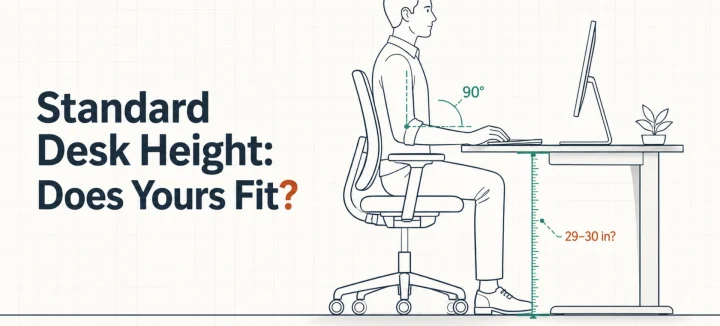
Standard Desk Height: Is 29 Inches Right for Your Body?
Standard desk height is 29 to 30 inches (73 to 76 cm). That number fits far fewer people than you’d think. A desktop that tall matches the seated elbow height of someone around 6’2″. The average American man stands 5’9″, and the average woman 5’3.5″. So this guide does two jobs. It shows you how […]
Read More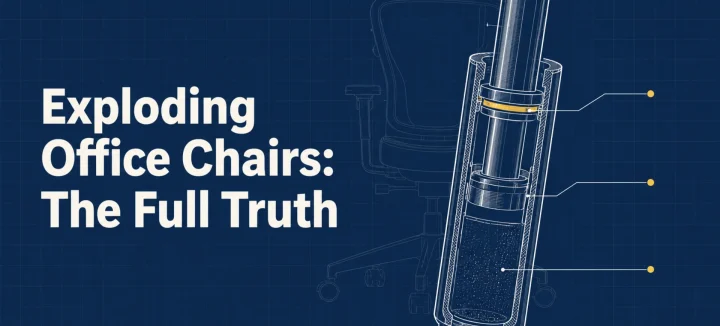
Exploding Office Chairs: The Full Truth From a Chair Maker
The exploding office chair story resurfaces every few years, same grainy photos attached. So can a chair really burst? A handful have, and every documented case involved an uncertified gas cylinder (the pressurized tube that raises and lowers your seat). Chairs built to recognized safety standards fail differently: seals leak, the seat sinks, nothing bursts. […]
Read More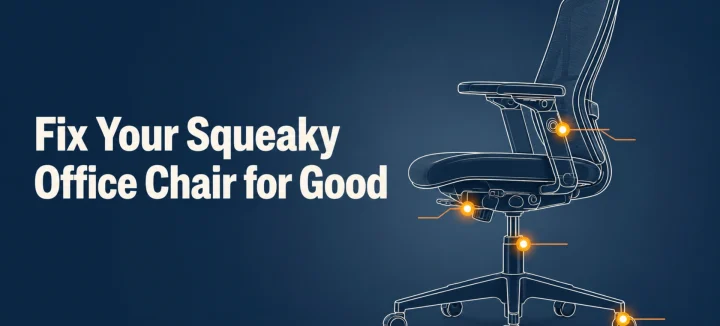
How to Fix a Squeaky Office Chair by Sound and Location
A squeaky office chair makes four different noises, and each one points to a different part. To silence it for good, find the source first: the tilt mechanism, gas cylinder, casters, or armrests. Then tighten what’s loose and lubricate with the right product for that joint. This guide matches each sound to its fix, and […]
Read More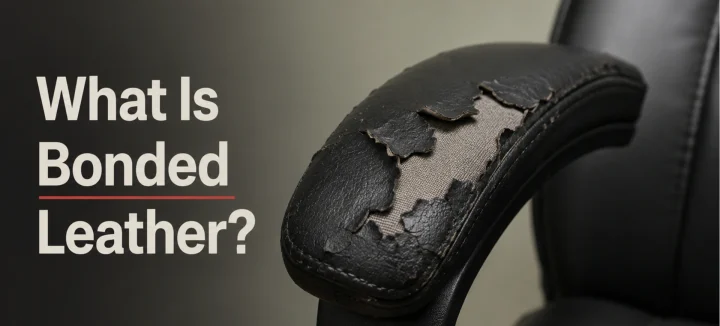
What Is Bonded Leather and Why It Peels in Office Chairs
Bonded leather is mostly plastic. The real hide inside usually makes up just 10 to 20 percent of it. The rest is polyurethane binder pressed onto a fabric or paper backing. It looks like leather on day one. By year three, it’s flaking onto your trousers. This guide covers what it’s made of, why office […]
Read More