How to Fix a Squeaky Office Chair by Sound and Location

A squeaky office chair makes four different noises, and each one points to a different part. To silence it for good, find the source first: the tilt mechanism, gas cylinder, casters, or armrests.
Then tighten what’s loose and lubricate with the right product for that joint. This guide matches each sound to its fix, and flags the squeaks that are early failure warnings.
Key Takeaways
- Office chairs squeak from four zones: the tilt mechanism, gas cylinder, casters, and armrest joints. Each zone makes a distinct sound.
- Tighten before you lubricate. A loose bolt squeaks exactly like a dry joint, and spray won’t fix it.
- WD-40 Multi-Use is a penetrating cleaner, not a lasting chair lubricant. Even WD-40’s own guide switches to silicone for the cylinder.
- Use white lithium grease on metal-to-metal pivots and silicone spray on plastic, rubber, and the cylinder column.
- A squeaky office chair that also sinks or wobbles isn’t asking for oil. It’s warning you a component is failing.
Find the Squeak: The Four Places Office Chairs Make Noise
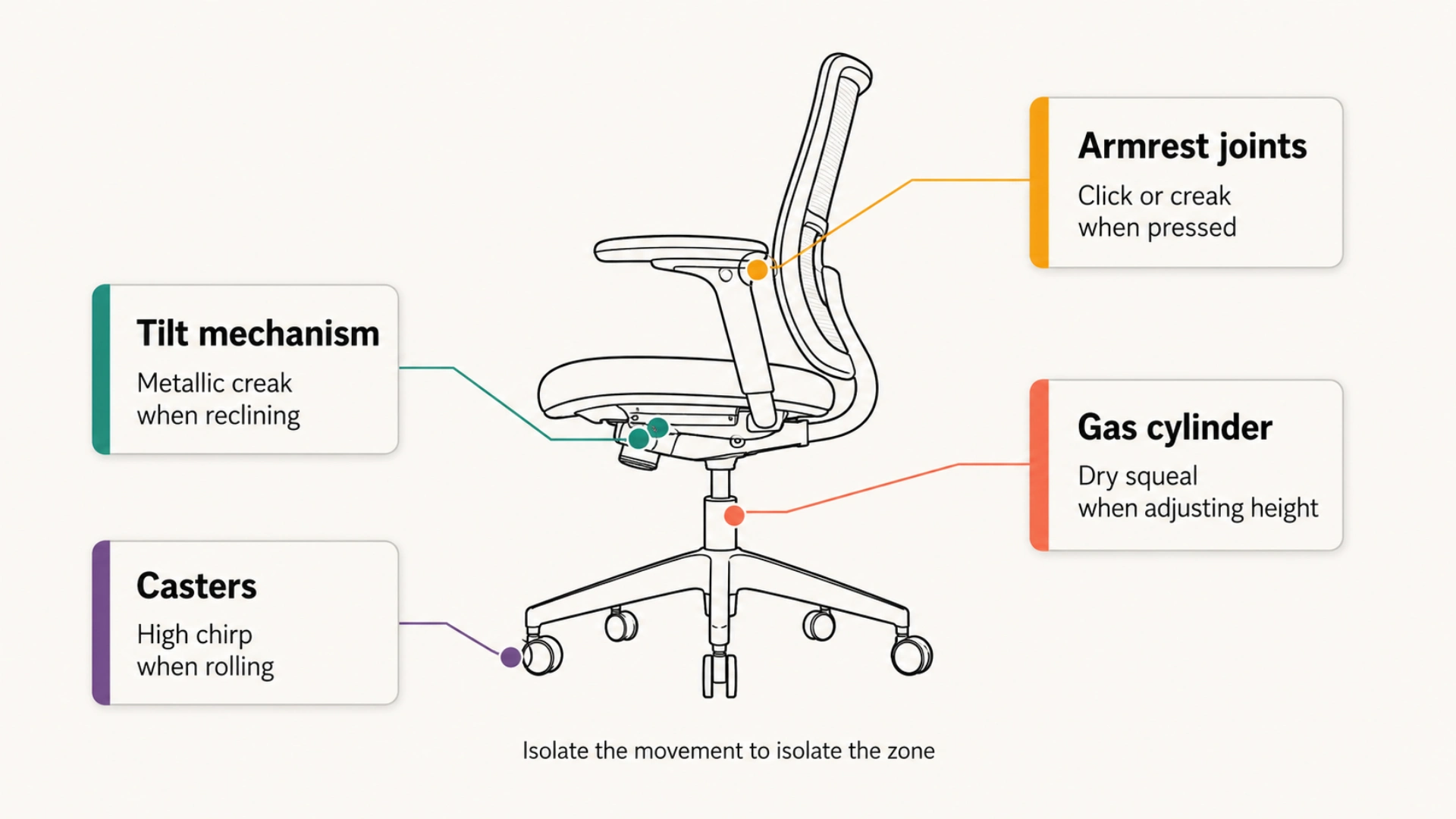
Almost every squeaky office chair earns its noise in one of four zones. Those zones are the tilt mechanism, the gas cylinder, the five casters, and the armrest joints.
Each zone squeaks for a different mechanical reason, so each one needs a different fix. Spraying the whole underside just masks the sound and wastes the can.
How do I find where my office chair squeak is coming from?
Isolate the movement and you isolate the zone. Sit still first, then run four tests in order.
Lean back and hold it. Adjust the seat height up and down.
Roll the chair a few feet across the floor. Then press down on each armrest and slide the adjusters.
Whichever movement triggers the noise names your culprit. A creak while reclining points to the tilt mechanism, and a squeal during height adjustment points to the cylinder.
Chirping while rolling means casters. Clicking under your forearms means the armrest joints.
Here’s the step most guides skip: borrow a second pair of ears. Sound travels along a steel frame, so a caster chirp can seem to come from under the seat.
One squeak on this list isn’t asking for a repair at all, and we’ll get to it.
Once you’ve named the zone, the sound itself tells you the rest.
Match the Sound to the Fix
Different failures make different sounds. A metallic creak, a deep groan, a high chirp, and a dry squeal each mean something specific.
The table below pairs what you hear with the likely cause and repair. Start there before you reach for any spray.
What does each office chair squeak mean?
A creak when reclining usually means dry tilt-mechanism pivots. A groan when you sit down usually means loose seat-plate bolts.
A chirp while rolling means debris in the casters, and a squeal during height changes means cylinder trouble.
| What you hear | When it happens | Likely cause | The fix |
|---|---|---|---|
| Metallic creak or clunk | Leaning back or reclining | Dry tilt-spring ends or loose pivot bolts | Tighten pivot bolts, then white lithium grease on spring ends and pivots |
| Deep groan or pop | Sitting down or standing up | Loose seat-plate bolts | Tighten the four bolts joining the mechanism to the seat pan |
| High-pitched chirp | Rolling across the floor | Hair and debris wound around caster axles | Pull the casters out, clean the axles, apply silicone spray |
| Dry squeal or grinding | Raising or lowering the seat | Dirty cylinder column or worn cylinder seal | Wipe the column, apply silicone spray; replace the cylinder if the seat also sinks |
| Click or creak | Pressing or adjusting armrests | Loose armrest bolts or dry adjustment slides | Tighten the bolts, silicone spray on the slide tracks |
Whatever the sound, the repair sequence never changes: tighten first, lubricate second. Why does tightening come first?
Because half the battle isn’t dryness at all.
A loose bolt squeaks exactly like a dry joint, and no amount of lubricant will ever tighten a bolt.
Flip the chair onto a towel and work through every bolt with an Allen key. Chairs leave the factory torqued to spec, but thousands of recline cycles gradually work fasteners loose.
That’s normal wear, not a defect. Retest the chair before you lubricate anything.
Caster chirps deserve one extra step. Pull each caster straight out and strip away the hair wound around the axle before any spray goes on.
Debris is the caster’s whole problem, and it builds fastest on carpet and around pets. Folding this into a full office chair cleaning and maintenance routine keeps the wheels quiet between fixes.
So the bolts are tight and the squeak survives. Now, and only now, it’s a lubrication job.
Pick the Right Lubricant (and Where WD-40 Backfires)
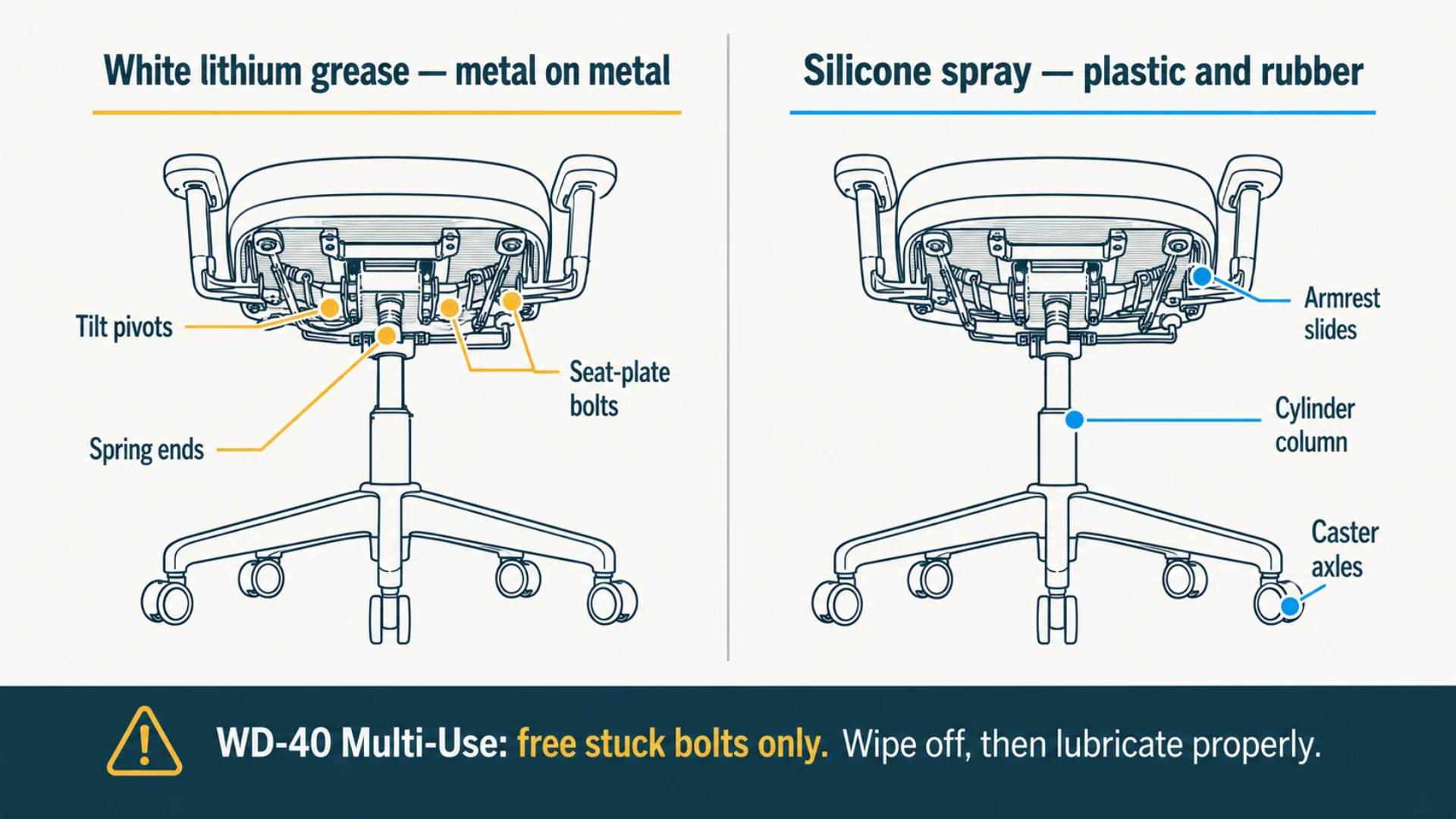
Match the lubricant to the materials that touch. White lithium grease belongs on metal-to-metal contact, and silicone spray belongs on anything involving plastic or rubber.
That single rule covers every joint on an office chair. And it explains why the most famous can in the garage keeps disappointing people.
Will WD-40 fix a squeaky office chair?
WD-40 Multi-Use can quiet a squeaky office chair for a few days, but the silence rarely lasts. It’s a light penetrating oil designed for cleaning and water displacement.
Its thin film wears off weight-bearing joints fast and attracts dust as it goes. The squeak comes back, often with grit mixed in.
Here’s where it gets interesting.
According to WD-40’s own repair guide, Multi-Use shouldn’t go anywhere near the gas lift piston. The company directs you to its silicone spray for that part instead.
Petroleum solvents and the rubber O-ring sealing your cylinder don’t mix.
When even WD-40’s own manual switches to silicone for the chair cylinder, that tells you everything about choosing lubricants.
WD-40 does earn its place for one chair job: freeing a rusted or seized bolt. Spray it, work the bolt loose, wipe the residue off, then apply a proper lubricant.
What is the best lubricant for a squeaky office chair?
Two products cover the whole chair. White lithium grease is best for metal-on-metal points like tilt pivots, spring ends, and the seat plate.
Silicone spray is best where plastic or rubber is involved: caster axles, armrest slides, and the cylinder column. A small, targeted amount always beats soaking the mechanism.
Apply grease with a fingertip or cotton swab, right at the pivot. Then cycle the mechanism a dozen times so the grease works into the joint.
Wipe every drip immediately. Lithium grease stains carpet, and silicone overspray turns hard floors slippery.
One safety line you should never cross: don’t open, puncture, or unscrew the gas cylinder itself.
The gas cylinder is a pressurized vessel, not a serviceable part. Lubricate around it, never inside it.
If a squeak seems to come from deep inside the mechanism housing, don’t guess at the anatomy. Our guide to the must-have features inside an ergonomic chair and how each works maps what every control connects to.
But there’s a catch. Some squeaks come back no matter how well you do all of this.
When a Squeaky Office Chair Means Replacement, Not Repair
Some squeaks aren’t maintenance requests. They’re failure announcements.
A noise that returns within days of a proper tighten-and-grease usually means a part has worn beyond reach. Three patterns tell you which part, and how urgent it is.
When should you replace a squeaky office chair?
Replace a part, or the chair, when the squeak arrives with a second symptom. A squeal plus a slowly sinking seat means the cylinder seal is failing.
A creak plus a wobble that tightening won’t hold means worn bolt holes or frame fatigue. And a squeak that keeps returning after correct fixes means internal bushings have worn out.
The cylinder case is the good news. Gas cylinders and casters are inexpensive to replace, and worth replacing while the frame and foam are still sound.
Frame fatigue is the bad news. Once bolt holes stretch oval, no fastener stays tight, and the creak becomes permanent.
Remember the squeak that isn’t asking for a repair? This is it: the one that keeps coming back.
A squeak that returns within days isn’t asking for oil. It’s telling you a part has worn past fixing.
Here’s the mechanism-level truth most repair guides never touch. Some chairs squeak by design, not by failure.
Budget mechanisms often ride stamped steel directly on stamped steel, with no bushings between the pivots. They start squeaking early because nothing separates the metal surfaces.
A mechanism built with nylon bushings or sealed pivots keeps its silence for years. Commercial durability standards exist to prove it, testing mechanisms through thousands of recline cycles.
So if your chair squeaked from month three, the design was the problem. No spray schedule fixes an unbushed pivot.
Does the squeak stack with sagging foam or lost adjustments? Then check the seven signs it’s time to upgrade your ergonomic chair before buying parts.
Even quality chairs work for 7 to 10 years before parts wear out in clusters. Past that point, repairs just postpone the decision.
When you reach it, prioritize ergonomic chairs engineered for full eight-hour workdays with bushed mechanisms and replaceable components.
The 15-Minute Fix, Start to Finish
Diagnosed by sound and ready to work? The full repair runs six steps:
- Isolate the movement. Sit, lean, swivel, and roll until you can name the motion that squeaks.
- Tighten every bolt. Seat plate, backrest, armrests, base: snug, not crushed.
- Clean the caster axles. Hair and grit around the axles mimic a squeaking joint.
- Grease the metal pivots. Lithium grease on tilt springs and metal-on-metal joints.
- Silicone the plastic contacts. Silicone spray wherever plastic or rubber meets anything.
- Retest each motion. Repeat the sit-lean-swivel-roll sequence; silence means done.
Read the Squeak Before You Reach for the Spray
A chair squeak is information: where it hurts, how badly, and whether it’s worth fixing. Locate the zone, tighten the bolts, and match the lubricant to the materials.
Most squeaks die right there, in fifteen minutes, with tools you already own. (And your video calls get noticeably more professional.)
The ones that survive are telling you something bigger. Listen early and you’ll replace one cheap cylinder instead of one entire chair.
A quiet chair isn’t a luxury. It’s the sound of every part still doing its job.
If your chair has moved past fixing, explore Merryfair’s full range of ergonomic office chairs. Every model is built around serviceable parts and a mechanism designed to stay quiet.
Five decades of building chairs taught us one thing about noise: silence is a design decision.
Frequently Asked Questions About Squeaky Office Chairs
How do I stop my office chair from squeaking?
Find the source first by testing one movement at a time: reclining, height adjustment, rolling, and armrest pressure. Tighten every bolt with an Allen key, then lubricate the noisy joint.
Use white lithium grease on metal pivots and silicone spray on casters, slides, and the cylinder column.
How do I stop a squeaky chair without WD-40?
Tighten every bolt first, because loose fasteners cause squeaks just as often as dry joints. If the noise survives, apply white lithium grease to metal pivots and silicone spray to casters, slides, and the cylinder column.
Both products outlast WD-40 on weight-bearing chair joints.
Why does my office chair squeak when I lean back?
Reclining loads the tilt mechanism, so a squeak here points to its spring ends, pivot bolts, or seat-plate connection. Tighten the pivot and seat-plate bolts, then work white lithium grease into the spring ends and pivots.
Cycle the recline a dozen times to spread it.
Is it safe to keep sitting on a squeaky office chair?
Usually yes, but treat two combinations as warnings. A squeal with a sinking seat means the gas cylinder seal is failing, and a creak with a wobble suggests frame fatigue.
Both call for replacement parts or a new chair rather than continued use.
How often should I lubricate an office chair?
Once or twice a year is enough for most chairs, applied only to joints that move. Over-lubricating attracts dust and gums up mechanisms.
A quarterly check for loose bolts matters more than frequent spraying, and it catches most squeaks before they start.
MORE BLOGS
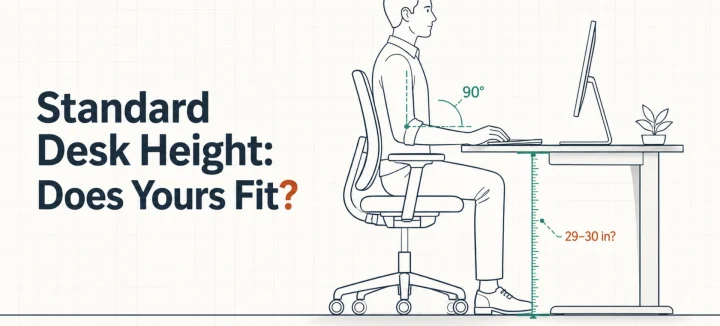
Standard Desk Height: Is 29 Inches Right for Your Body?
Standard desk height is 29 to 30 inches (73 to 76 cm). That number fits far fewer people than you’d think. A desktop that tall matches the seated elbow height of someone around 6’2″. The average American man stands 5’9″, and the average woman 5’3.5″. So this guide does two jobs. It shows you how […]
Read More
Exploding Office Chairs: The Full Truth From a Chair Maker
The exploding office chair story resurfaces every few years, same grainy photos attached. So can a chair really burst? A handful have, and every documented case involved an uncertified gas cylinder (the pressurized tube that raises and lowers your seat). Chairs built to recognized safety standards fail differently: seals leak, the seat sinks, nothing bursts. […]
Read More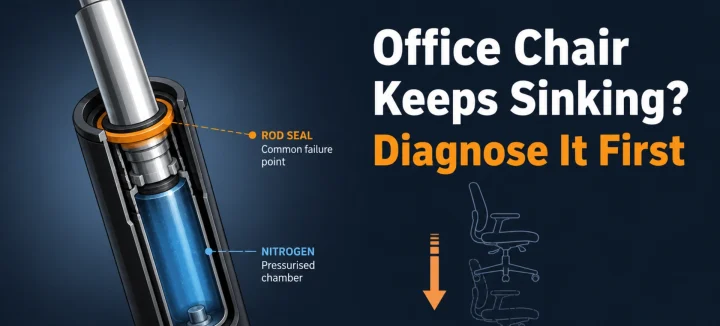
Office Chair Keeps Sinking? Diagnose and Fix It for Good
An office chair that keeps sinking or won’t stay up has one main cause: the gas cylinder under the seat is losing pressure. Worn seals let the nitrogen escape, so the piston stops holding your weight. A hose clamp or PVC pipe locks the height today; a new cylinder fixes it properly in 15 minutes. […]
Read More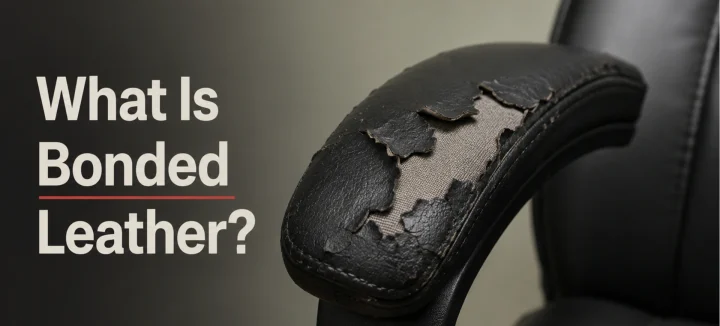
What Is Bonded Leather and Why It Peels in Office Chairs
Bonded leather is mostly plastic. The real hide inside usually makes up just 10 to 20 percent of it. The rest is polyurethane binder pressed onto a fabric or paper backing. It looks like leather on day one. By year three, it’s flaking onto your trousers. This guide covers what it’s made of, why office […]
Read More