Best Office Chair for Short People: 5 Picks That Truly Fit (2026)
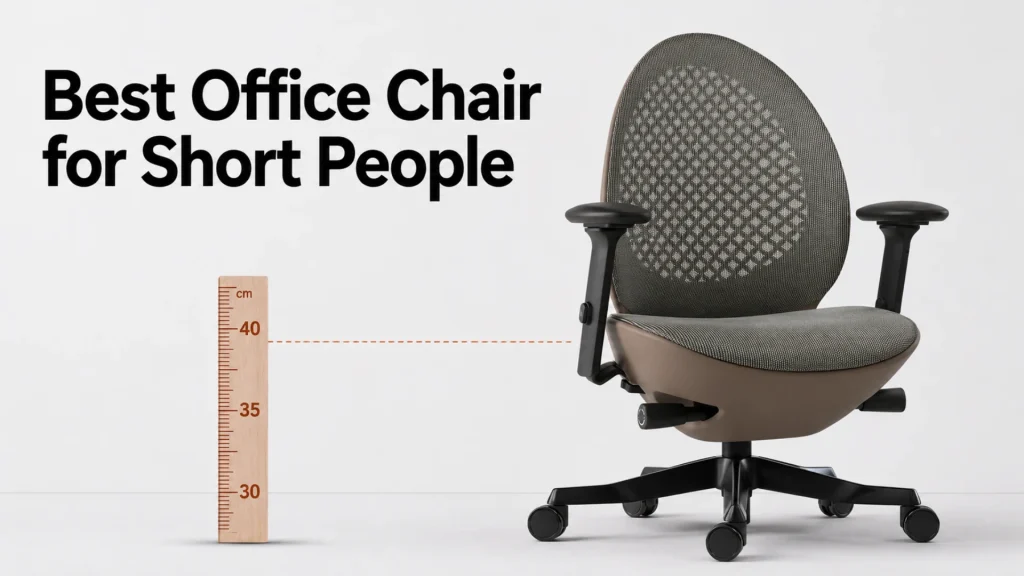
A petite user once tested 12 chairs marketed as “petite-friendly.” Nine still left her feet dangling at the lowest seat-height setting.
The best office chair for short people needs three specs other guides skip. The seat must drop low enough to match your popliteal height.
The seat depth must adjust shallow for shorter thighs. The lumbar pad must reach down to your spine’s curve.
Most chairs sold to petite users miss at least one. This guide ranks 5 Merryfair chairs against those exact requirements.
Key Takeaways
- The “petite” label means almost nothing. Most chairs marketed for short users still fail anyone under 5’2″.
- Three specs decide fit: a seat height that bottoms out low, an adjustable seat depth (slider mechanism), and an adjustable lumbar pad you can drop low.
- Among Merryfair models, the Spinelly drops to the lowest seat height at 425 mm (16.7″), and the Tune is officially engineered for the 150 to 185 cm range.
- The 5th-Percentile Fit Standard, developed here, filters most “best petite chair” claims out as misleading.
- A footrest never replaces a properly fitted chair; for users at 4’11” or shorter, both are needed.
Why Standard Office Chairs Quietly Fail Short Users
Most “ergonomic” chairs sold today are designed for the 5th to 95th percentile of the working population. That sounds inclusive on a spec sheet.
In practice, the 5th-percentile woman in current US data is 150.4 cm tall (about 4’11”). Most chairs miss her completely.
A 2023 anthropometric chair design study found that older datasets no longer reflect real body proportions. Most manufacturers still use them anyway.
The result is a quiet daily mismatch most petite users blame on themselves.
Petite users don’t need smaller chairs. They need chairs whose smallest setting is small enough.
How short is “short” when shopping for an office chair?
Most product copy uses “petite” loosely. The working consensus among ergonomists and office-furniture retailers is 5’6″ (168 cm) and under.
Inside that range, the experience splits into three tiers. The 5’4″ to 5’6″ tier has the most options.
The 5’0″ to 5’3″ tier finds half of those options stop fitting. The under-5’0″ tier is largely invisible to mainstream chair design.
If you’re closer to 4’11” than 5’6″, treat every “petite” claim as marketing. You need to see the minimum seat height in writing.
At the other end, chairs for tall frames above 185 cm have the mirror problem: seat ceilings, not floors.
What happens to your body in an oversized chair?
Three things, all bad.
First, your feet leave the floor. That presses your thighs against the seat’s front edge.
Circulation to your lower legs gets compressed. By 3 p.m., your calves feel heavy and your feet are cold.
Second, the seat extends too far forward. Your knees can’t bend over the front edge.
So you slide your back away from the lumbar support. Backrest contact goes with it.
Third, the lumbar pad lands too high. It usually hits between your shoulder blades, not your lower back curve.
The pad ends up pushing against your mid-back. Your hips tip forward into a posterior tilt.
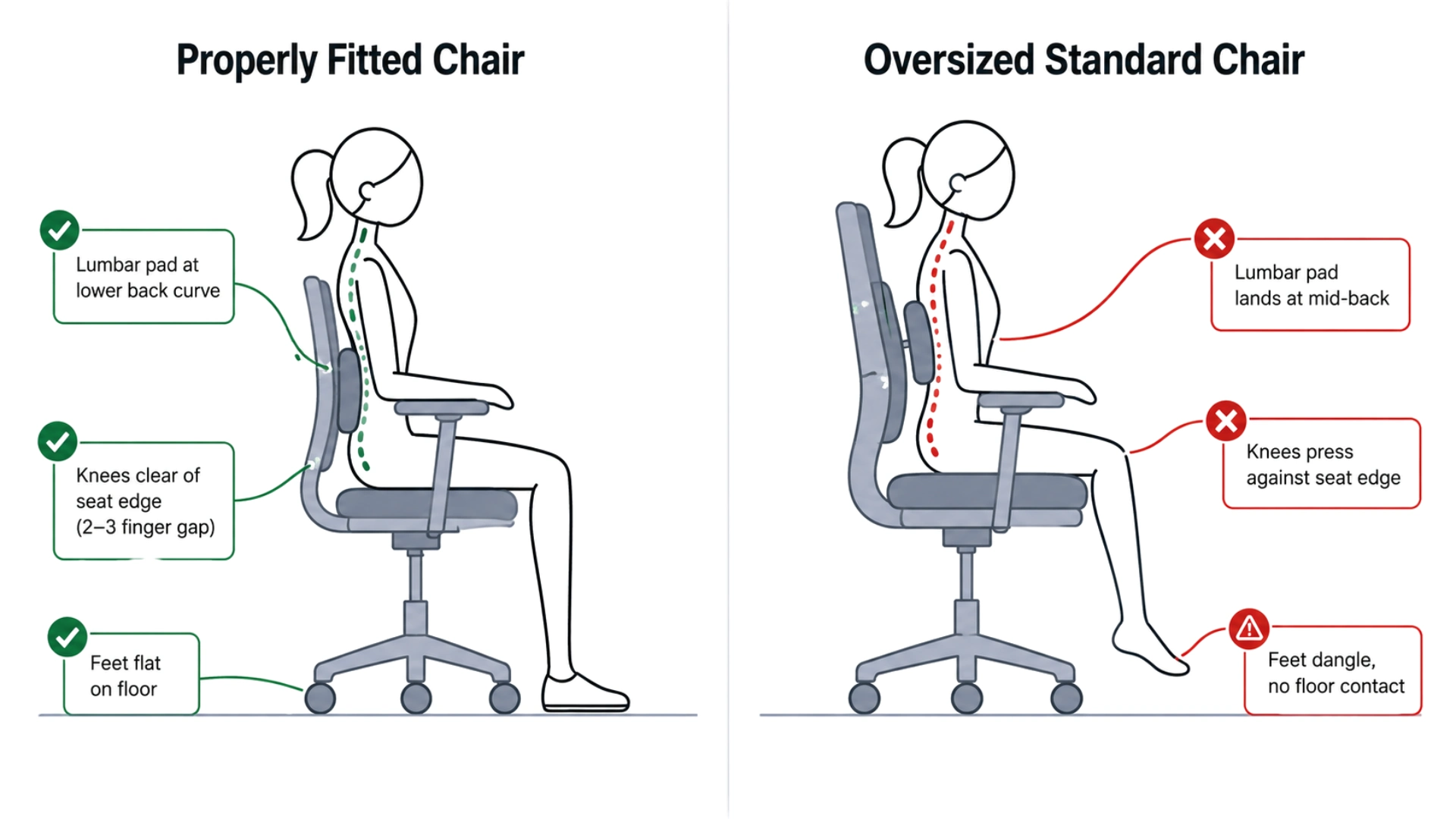
A chair that does all three at once isn’t ergonomic. It’s an injury you sit in for 40 hours a week.
Is the issue the chair’s height, or its depth?
Both, but the order matters. Seat height is what petite users notice first.
Seat depth is what hurts them by month two. A chair set 2 cm too tall produces visible discomfort.
A chair with seat depth 5 cm too deep produces invisible compensation. That manifests as chronic lower back fatigue.
The first is easy to diagnose. The second gets blamed on posture, age, or “weak core.”
Seat depth is the dimension that turns a “petite-friendly” chair into a 5 p.m. pain factory.
Want to know how every chair dimension connects to a body measurement? The 3-Number Sizing Method that maps body measurements to chair dimensions walks through it in full.
This guide covers what to do with those numbers once you have them.
The 5th-Percentile Fit Standard: Three Specs That Actually Matter
Most “best chair for short people” lists rank by brand prestige or price. Or by how nice a chair looks in a photograph.
You can follow thee 5th-Percentile Fit Standard to assess if it an ergonomic chair is apt for your height .
The standard is built on manufacturer-grade dimensional data and the 5th-percentile anthropometric reference set. It reduces fit to three quantitative thresholds.
What is the 5th-Percentile Fit Standard?
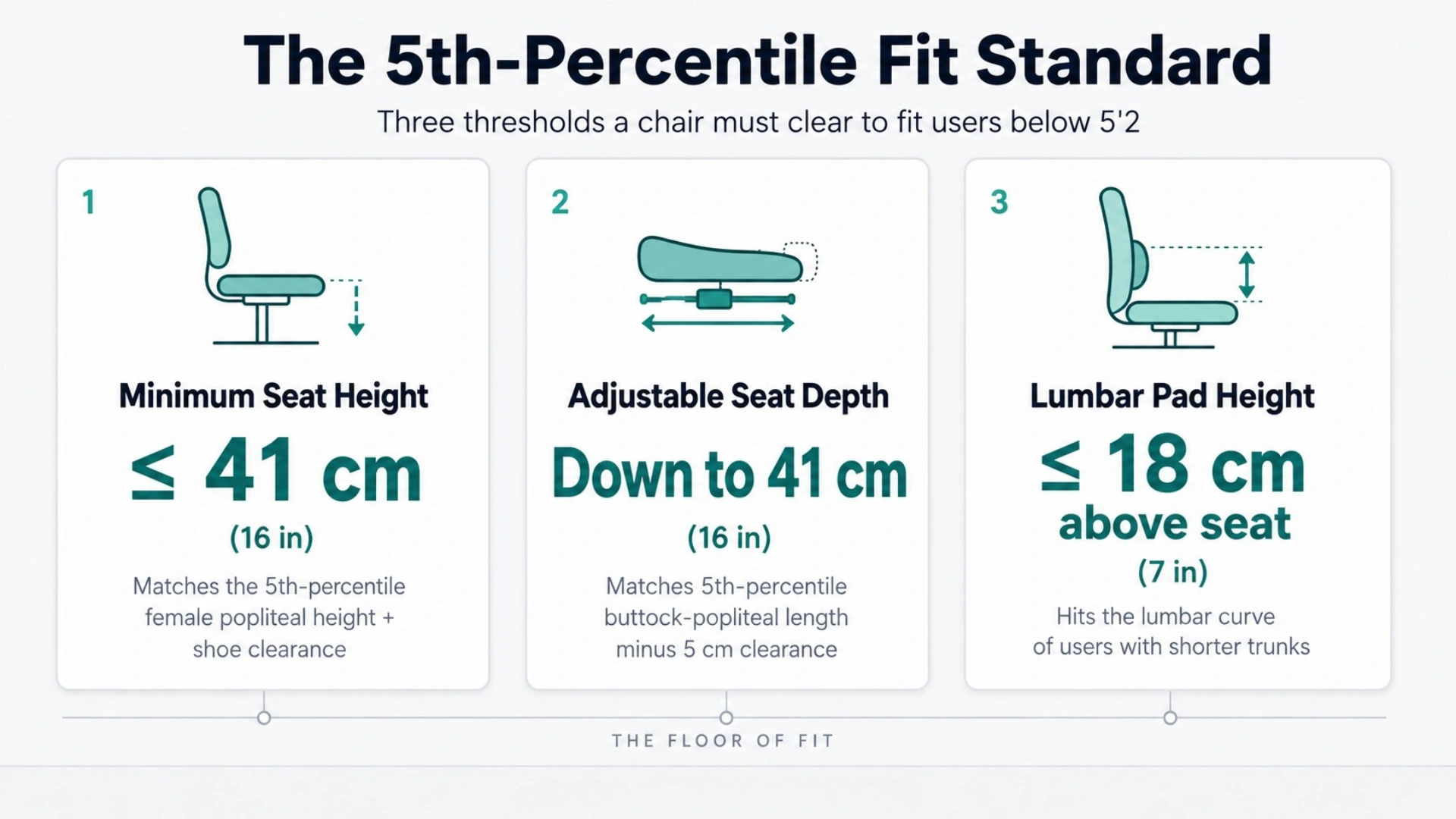
The 5th-Percentile Fit Standard is a three-spec test. It checks whether an office chair can genuinely fit users below 157 cm (5’2″).
A chair must clear all three thresholds to pass.
| Spec | Threshold | Why this number |
|---|---|---|
| Minimum seat height | ≤ 41 cm (16 in) | Matches the 5th-percentile female popliteal height plus shoe clearance |
| Adjustable seat depth | Adjusts down to 41 cm (16 in) | Matches the 5th-percentile female buttock-popliteal length minus 5 cm clearance |
| Lumbar pad height | Adjusts down to within 18 cm (7 in) of the seat surface | Hits the lumbar curve of users with shorter trunks |
A chair that misses any one of these isn’t bad. It just isn’t built for users below 5’2″.
Most ergonomic chairs that claim to fit short people only fit the 5th-percentile US adult. They still fail anyone under 5’2″.
Keep in mind that while seat height is important, it is the entry point. Lumbar depth, seat depth, and armrest range need to pass the same test: do they reach where your specific body needs them to?
How low does the seat need to go?
The BIFMA G1-2013 Ergonomics Guideline sets the standard adjustment range for office chairs at 16 to 21 inches. That’s the floor of “acceptable,” not the minimum needed for petite users.
A 5th-percentile woman has a popliteal height of about 36 cm (14 in) bare-footed. That’s the distance from floor to back of the knee, seated.
Add 3 cm for typical office shoes. The resulting target seat height is roughly 39 cm (15.4 in).
So a chair with a 17-inch minimum will leave a 4’11” user with at least 4 cm of dangle.
Every day. Every hour.
A chair’s minimum seat height matters more than its maximum. Petite users will never use the upper third of the gas cylinder range.
Why is seat depth the most overlooked spec for petite users?
Manufacturers list seat depth in spec sheets, but most don’t list adjustable seat depth. The chairs that cover the broadest user range have a seat slider.
The slider lets the seat pan move forward or backward by 4 to 8 cm.
Without a slider, your two options are both bad. Sit fully back and accept knee pressure from the seat front.
Or scoot forward, lose lumbar contact, and slouch all day.
The 5th-percentile female buttock-to-popliteal length is roughly 44 cm. Subtract 3 cm for knee clearance.
You need a seat that adjusts down to 41 cm. Most standard chairs start at 46 to 50 cm and cannot shrink.
Where should the lumbar pad sit if I’m under 5’4″?
For users under 5’4″, the natural lumbar curve sits at roughly 17 to 19 cm above the seat surface. Most chairs put their lumbar pad at 20 to 25 cm, calibrated for a 5’8″ reference user.
That gap of 3 to 5 cm is what produces the “this chair pushes my mid-back” complaint. The pad isn’t broken.
It’s just placed for someone taller than you. A height-adjustable lumbar with a downward range covering 17 cm or lower passes the standard.
A fixed-curve back, no matter how anatomically shaped, almost always fails.
5 Best Merryfair Chairs for Short People (Ranked by Body-Spec Match)
Each chair below is rated against the 5th-Percentile Fit Standard. Every spec comes directly from the official Merryfair product catalogue.
For users at 4’11” or shorter, a quality footrest stays necessary regardless of which chair you choose.
Before the per-chair breakdowns, here’s the quick-glance comparison.
Quick comparison: 5 Merryfair chairs for petite users
| # | Chair | Min seat height | Seat depth adjust | Lumbar | Armrest | Stand-out feature |
|---|---|---|---|---|---|---|
| 1 | Tune | 445 mm (17.5″) | Yes (slider) | Depth-adjustable pad (20 mm) + 105 mm backrest height | 3-way (height, depth, angle) | Engineered for 150–185 cm range |
| 2 | Spinelly | 425 mm (16.7″) | 50 mm slider | Height-adjustable (55 mm range) | Height-only (100 mm) | Lowest seat in lineup, vertebrae-flex back |
| 3 | Zenit | 445 mm (17.5″) | 50 mm slider | Adjustable + permanent contact | 4-directional (70 mm height + depth + angle + width) | Most adjustability, mesh seat |
| 4 | Aire | 12 cm range (min not published) | None | Built into structural frame (non-adjustable) | 2-way (depth + swivel) or fixed | Lightest, single-piece frame |
| 5 | Ovo | 450 mm (17.7″) | None | None (mesh shell, no lumbar pad) | 4-way (height 100, width 50, depth 60, swivel ±15°) | Largest armrest range, full-mesh thermal comfort |
The five chairs serve different segments of the petite-user spectrum. Match yours to the body-fit profile that fits you.
1. Tune: Best overall for 5’0″ to 5’8″
The Tune is the chair Merryfair officially engineers for the 150 to 185 cm range. That covers the 5th to 95th percentile of the working population.
It also has the most adjustability points relevant to petite fit. The list: depth-adjustable lumbar, depth-adjustable seat, 3-way armrest, and a backrest that lifts 105 mm.
| Spec | Value |
|---|---|
| Seat height range | 445–545 mm (17.5″–21.5″), 100 mm pneumatic range |
| Seat depth | Depth-adjustable seat (slider mechanism per catalogue page 11 icons) |
| Lumbar | Depth-adjustable pad via side knobs, 20 mm range; effective lumbar height adjusts via 105 mm backrest height range |
| Backrest | Polyester mesh, height-adjustable 105 mm |
| Headrest | Free-tilting, height-adjustable (high-back model 139 only) |
| Armrest | 3-way adjustable: height, depth, and 3 swivel angles (option A78) |
| Mechanism | YM synchro-tilt, 3-position tilt lock, auto weight-sensing tilt tension |
| Standards | ANSI/BIFMA X5.1 |
| 5th-Percentile Standard | Min seat height 17.5″ exceeds the 16″ floor by 1.5″. PASS on adjustable seat depth. Lumbar adjusts in depth (not height); height changes via backrest range. Best for 150 cm+ users; under 5’0″ needs footrest. |
| Best for | 5’0″–5’8″, office and corporate use, users who want every adjustability point in one chair |
For users at the very low end of the petite range (4’11” to 5’0″), test in a showroom first. The 17.5-inch minimum seat height is real; no chair adjustment hides it.
For users at 5’2″ and above, the Tune’s adjustability spread does more practical work. No other chair in this list comes close.
Explore the full spec sheet for Merryfair’s Tune task chair, engineered for the 150–185 cm range.
2. Spinelly: Lowest seat height in the Merryfair lineup
The Spinelly is the only chair in this lineup that drops to 425 mm (16.7″). That’s the closest any current Merryfair model gets to the 16-inch 5th-percentile floor.
Pair that with a height-adjustable lumbar and a 50 mm seat depth slider. The Spinelly is the strongest petite-fit story Merryfair currently makes.
| Spec | Value |
|---|---|
| Seat height range | 425–520 mm (16.7″–20.5″) |
| Seat depth | 50 mm depth-adjustable slider |
| Lumbar | Height-adjustable lumbar support, 55 mm range |
| Backrest | Vertebrae-inspired rib design with elastomer spine joints; mesh in jet grey |
| Headrest | Polypropylene frame with polyelastomer mesh (high-back model 999 only) |
| Armrest | Height-adjustable only, 100 mm range; soft-touch polyurethane armpad |
| Mechanism | Weight-sensing recline auto-adjusts to user weight; tilt-lock, seat height, seat depth controls |
| Standards | BIFMA X5.1, EN-1335 |
| Recyclability | Up to 62% at end of life |
| 5th-Percentile Standard | Min seat height 16.7″ is closest to the 16″ floor in the lineup. PASS on adjustable seat depth (50 mm). PASS on adjustable lumbar height (55 mm range). Best fit on this list for users at 5’0″–5’2″. |
| Best for | 5’0″–5’8″, knowledge workers, users who shift posture often, petite users who want the lowest seat available |
The flex-back is the secondary differentiator. For users who fidget, twist, or shift constantly, the rib-and-spine system moves with the torso.
But the real news here is the 16.7-inch minimum. That’s the spec petite users came to find.
3. Zenit: Best premium executive for petite professionals
The Zenit is Merryfair’s premium executive task chair. Most “executive” chairs are sized for taller frames; the Zenit isn’t.
Its 4-directional armrests have 70 mm of height adjustment. They drop low enough for petite users to keep forearms parallel to the desk, even with a low desk surface.
| Spec | Value |
|---|---|
| Seat height range | 445–545 mm (17.5″–21.5″) |
| Seat depth | 50 mm seat slide range |
| Lumbar | Adjustable lumbar with permanent-contact mechanism; follows the back through recline |
| Backrest | Breathable polyester mesh, ratchet height-adjustable |
| Headrest | 2-directional (height-adjustable, tiltable) |
| Armrest | 4-directional: height (70 mm) + depth + angle + width; soft-touch polyurethane pads |
| Seat | Full polyester mesh seat with seat slide |
| Mechanism | Auto weight-sensing synchro-tilt, 3-position tilt lock, pneumatic seat control |
| Optional | Retractable footrest models (1349/1348) |
| Standards | BIFMA X5.1, Greenguard certified |
| 5th-Percentile Standard | Min seat height 17.5″ exceeds 16″ floor. PASS on adjustable seat depth (50 mm). PASS on adjustable lumbar. PASS on full 4-directional armrest. |
| Best for | 5’2″–5’9″, executives, professionals in long meetings, users who need adjustability range plus office presence |
The lumbar-on-recline behaviour is what separates the Zenit from a standard adjustable lumbar. The pad stays in contact with your back as you lean back through the recline arc.
For petite users who lean into thinking work, that mechanism prevents the “lumbar gap.” It’s the gap you get with chairs whose lumbar is fixed to the backrest frame.
See full specs for Merryfair’s Zenit executive chair with 4-directional armrest control.
4. Aire: Best for compact home offices
The Aire is the lightest chair in this lineup. Its single-piece fiber-reinforced polyamide frame replaces the heavy modular joints of traditional chairs.
For petite users in apartments, study corners, or small home offices, footprint matters as much as fit.
| Spec | Value |
|---|---|
| Seat height range | 120 mm (12 cm) adjustment range; absolute min/max not published |
| Seat depth | No depth slider |
| Lumbar | Built into structural frame shape (not user-adjustable) |
| Frame | Single-piece fiber-reinforced polyamide, 100% recyclable |
| Headrest | Optional, 45 mm height range |
| Armrest | 2-way option: depth 60 mm, 3 swivel angles (no height adjust); or fixed soft-touch polyurethane |
| Mechanism | 4-position tilt limiter, auto-tilt tension (responds to body weight automatically) |
| Recyclability | Up to 90% at end of life |
| 5th-Percentile Standard | Min seat height not published; verify in showroom. FAILS on adjustable seat depth (no slider). FAILS on adjustable lumbar (built-in fixed shape). PASS on auto-calibrated tension for lighter users. |
| Best for | 5’0″–5’7″, apartments, study corners, lifestyle setups, lighter petite users who find manual tension dials too stiff |
The auto-tilt tension is the practical highlight. Petite users are often lighter, and manual tension dials default to a setting calibrated for heavier users.
The chair resists recline too aggressively at default settings. The Aire’s mechanism calibrates itself.
5. Ovo: Best for warm climates and armrest range
The Ovo is the most thermal-comfort-focused chair in the lineup. Full elastomeric mesh on both seat and back means no foam-trapped heat across an eight-hour day.
The seat shell also has a curved, rolled front edge. It reduces pressure behind shorter users’ knees even without a depth slider.
| Spec | Value |
|---|---|
| Seat height range | 450–550 mm (17.7″–21.7″) |
| Seat depth | No slider; rolled-edge front shell mitigates seat-edge pressure |
| Lumbar | None published in catalogue (mesh shell with no separate lumbar pad or lumbar adjustment) |
| Backrest | Translucent high-tensile elastomeric mesh |
| Armrest | 4-way: height 100 mm, width 50 mm, depth 60 mm, swivel ±15° |
| Mechanism | Hidden synchro-tilt; side controls for recline tension, locking, and seat height (not lumbar) |
| Base options | 350 Stiletto fibre-filled nylon, optional die-cast aluminium |
| Seat options | Mesh back + padded seat OR mesh back + mesh seat |
| 5th-Percentile Standard | Min seat height 17.7″ is the highest in this lineup. FAILS on adjustable seat depth (no slider). FAILS on adjustable lumbar (none published). PASS on full 4-way armrest with the longest height range in the lineup (100 mm). |
| Best for | 5’4″+ users in warm or air-conditioned offices, users who prioritise thermal comfort and design statement, those who run warm |
Be honest with yourself about the trade. The Ovo doesn’t have the adjustability story the other four chairs offer.
What it has is the best thermal performance and the longest armrest height range. For the right user, that’s the better daily-comfort trade.
For the strict petite-fit user, the other four come first.
How to Match a Merryfair Chair to Your Body in 5 Minutes
So how do you actually pick from this list? Height alone won’t tell you.
Two people at 5’2″ can need entirely different chairs depending on their torso-to-leg ratio and hip width.
Can I pick the right chair just from my height?
No. Height is a starting point.
Two users at 5’2″ may have a 4 cm difference in popliteal height because of leg-to-torso proportions. One needs a 38 cm seat height.
The other needs 42 cm. The same chair can fit one and fail the other.
What three measurements do I actually need?
Three numbers, taken in five minutes with a measuring tape and a hard-surfaced chair.
- Popliteal height. Sit with feet flat. Measure from floor to the crease behind your knee. This is the maximum seat height your chair should reach.
- Buttock-to-knee length. Sit back fully. Measure from your buttock to the back of your knee. Subtract 5 to 8 cm. That’s your target seat depth.
- Hip width. Measure across the widest point of your hips while seated. Add 2 to 5 cm for clearance. That’s your minimum seat width.
Your three numbers map to seat height, seat depth, and seat width. Match them against the spec tables above.
How do I test a chair before I commit?
Seat height minimums, depth sliders, and lumbar range differ more across chairs than the marketing suggests.
Sit in it for at least 15 minutes. Twenty seconds in a showroom tells you almost nothing.
After 15 minutes, run this check:
- Are your feet flat and steady on the floor?
- Is there a 2-to-3 finger gap between the seat edge and the back of your knees?
- Is the lumbar pad pressing into your lower back curve, not your mid-back?
- Are your forearms parallel to the floor with the armrests?
If any answer is no, the chair fails your body. The exact adjustment process is broken down in the proper sequence for setting seat height, depth, and lumbar.
The wrong chair makes a petite user lean forward all day. That isn’t a habit, it’s a workaround.
When the Chair Is Right, You’ll Stop Thinking About It
The shortlist above isn’t built on which chair has the best photo or the boldest brand story. It’s built on which Merryfair chairs let you sit properly for eight hours.
Feet flat, back to the lumbar, shoulders relaxed.
The body that struggles in a standard chair isn’t broken. The chair never had your dimensions in its design envelope.
The right chair stops being something you think about. It just disappears underneath you while you work.
Your three numbers tell you what your chair must do. The Tune is engineered for the 150 to 185 cm range, which makes it the natural starting point.
Match your numbers to the Tune chair on the Merryfair store and start there.
Frequently Asked Questions About Office Chairs for Short People
What size office chair is best for someone 5’2″?
A 5’2″ user needs a seat height adjustable down to about 39 to 41 cm (15.4 to 16.1 in). The seat depth should adjust down to 41 cm (16 in).
The lumbar pad should sit 17 to 19 cm above the seat. Merryfair’s Tune and Spinelly both clear those adjustment requirements.
How low should an office chair go for a short person?
For users under 5’2″, the chair’s minimum seat height should be 41 cm (16 in) or lower. For users under 5’0″, aim for 39 cm (15.4 in) or lower.
Always test the chair’s lowest setting in person. Manufacturer ranges describe span, not absolute floor.
Which Merryfair chair fits petite users best?
It depends on your height. The Spinelly drops to the lowest seat height in the lineup at 425 mm (16.7 in).
That makes it the closest fit for users at 5’0″ to 5’2″.
The Tune is the chair Merryfair officially engineers for the 150 to 185 cm range. For users at 5’2″ and above, the Tune’s broader adjustability does more daily work.
Can a mid-range Merryfair chair really fit a petite user?
Yes. The Tune covers the 5th to 95th percentile of users without an executive-tier price.
What petite users actually need is adjustability across seat height, seat depth, and lumbar height. The Tune delivers all three; premium chairs add finer tuning, not better basic fit.
Should I get a petite chair or use a footrest with a standard one?
Get the petite chair. A footrest fixes one of three problems: dangling feet.
It ignores the other two (seat depth too deep, lumbar pad too high). A footrest is a workaround, not a solution.
Does seat depth matter more than seat height for short people?
Seat height is what you notice first. Seat depth is what hurts you over months.
A seat 5 cm too deep forces you to slouch forward to clear your knees. That loses lumbar contact and produces chronic lower back fatigue.
MORE BLOGS
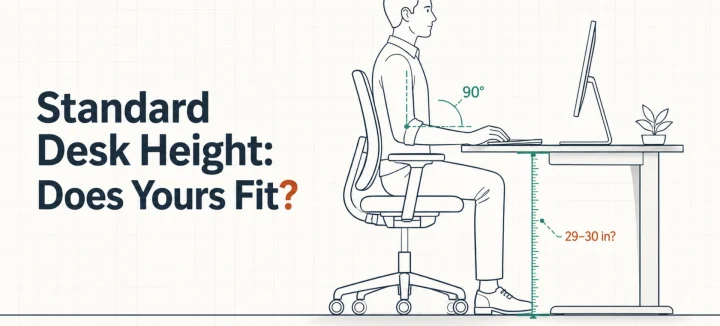
Standard Desk Height: Is 29 Inches Right for Your Body?
Standard desk height is 29 to 30 inches (73 to 76 cm). That number fits far fewer people than you’d think. A desktop that tall matches the seated elbow height of someone around 6’2″. The average American man stands 5’9″, and the average woman 5’3.5″. So this guide does two jobs. It shows you how […]
Read More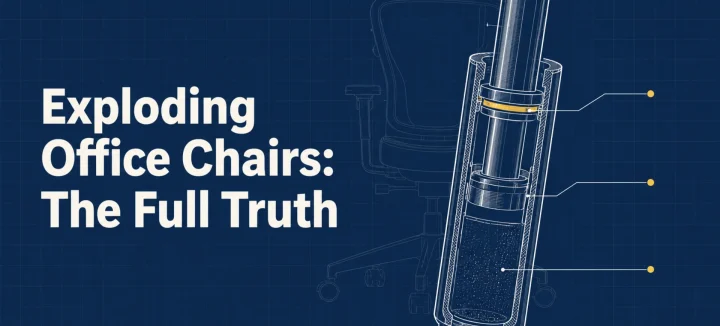
Exploding Office Chairs: The Full Truth From a Chair Maker
The exploding office chair story resurfaces every few years, same grainy photos attached. So can a chair really burst? A handful have, and every documented case involved an uncertified gas cylinder (the pressurized tube that raises and lowers your seat). Chairs built to recognized safety standards fail differently: seals leak, the seat sinks, nothing bursts. […]
Read More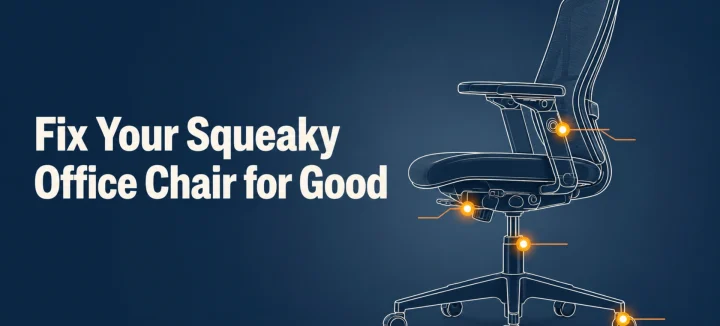
How to Fix a Squeaky Office Chair by Sound and Location
A squeaky office chair makes four different noises, and each one points to a different part. To silence it for good, find the source first: the tilt mechanism, gas cylinder, casters, or armrests. Then tighten what’s loose and lubricate with the right product for that joint. This guide matches each sound to its fix, and […]
Read More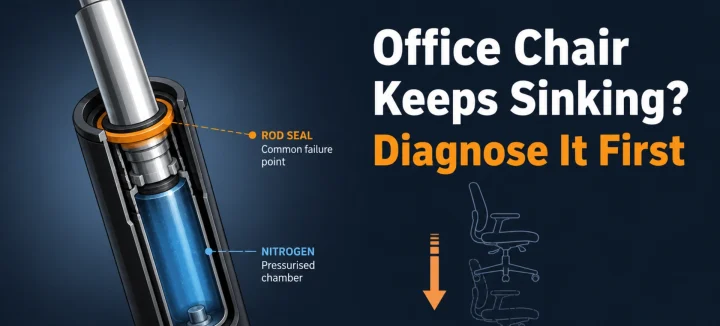
Office Chair Keeps Sinking? Diagnose and Fix It for Good
An office chair that keeps sinking or won’t stay up has one main cause: the gas cylinder under the seat is losing pressure. Worn seals let the nitrogen escape, so the piston stops holding your weight. A hose clamp or PVC pipe locks the height today; a new cylinder fixes it properly in 15 minutes. […]
Read More