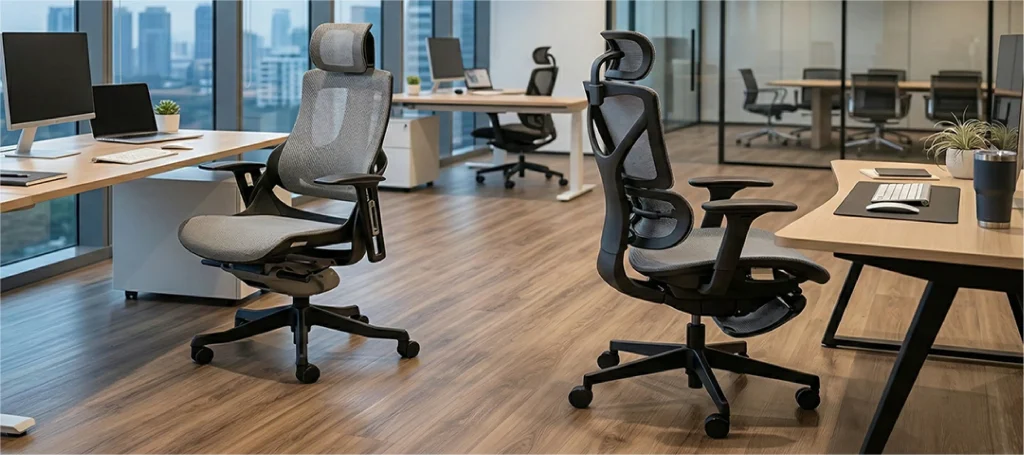
Best Ergonomic Chair for Tall People: A 2026 Fit Guide
A 6’4″ engineer once told us he bought four “big and tall” chairs in two years. None of them fit. The problem wasn’t the chairs. He wasn’t big. He was tall.
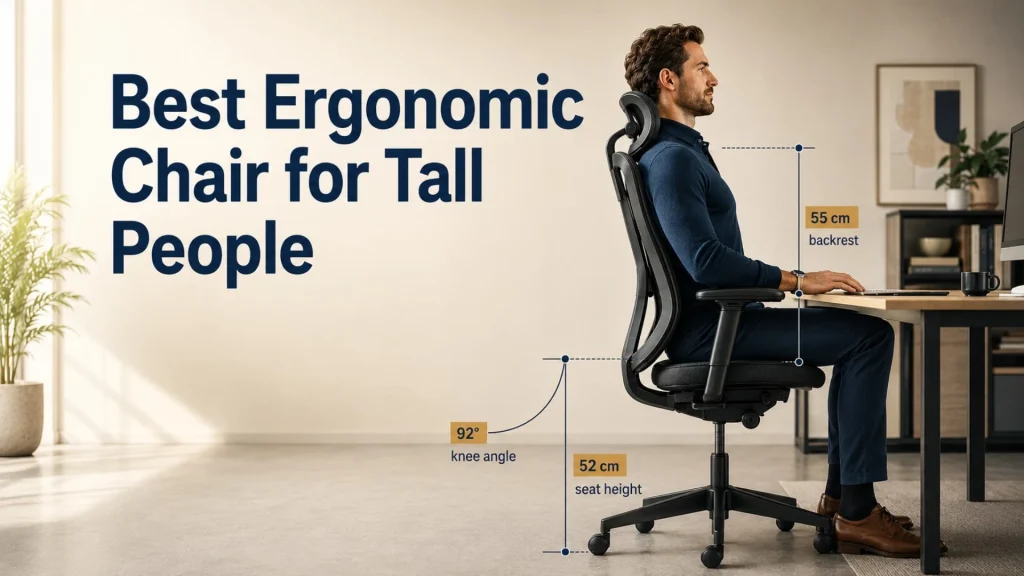
The best ergonomic chair for tall people delivers a seat height above 50 cm, a backrest taller than 55 cm, an adjustable headrest, a deep seat pan, and an extended gas cylinder. For users above 110 kg, add a reinforced base and a Class 4 gas cylinder.
The right chair matches your body type, not a marketing label.
This guide separates tall, big, and big-and-tall as three different buying problems. You’ll get concrete spec thresholds for each, plus chairs that actually fit longer frames.
Key Takeaways
- Tall, big, and big-and-tall are three different body types. The right chair specs are different for each one.
- For users above 185 cm (6’1″), seat height should reach 50–55 cm. Above 195 cm (6’5″), aim for 53–60 cm.
- A backrest under 55 cm leaves the upper back unsupported on anyone over 185 cm tall.
- Buy a chair rated 15–20% above your weight. Buying one rated at your exact weight buys a chair built to fail by year two.
- Class 4 or Class 5 gas cylinders and aluminium alloy bases are the boring specs that decide whether your chair survives long-term.
Why Standard Office Chairs Fail Anyone Above 185 cm
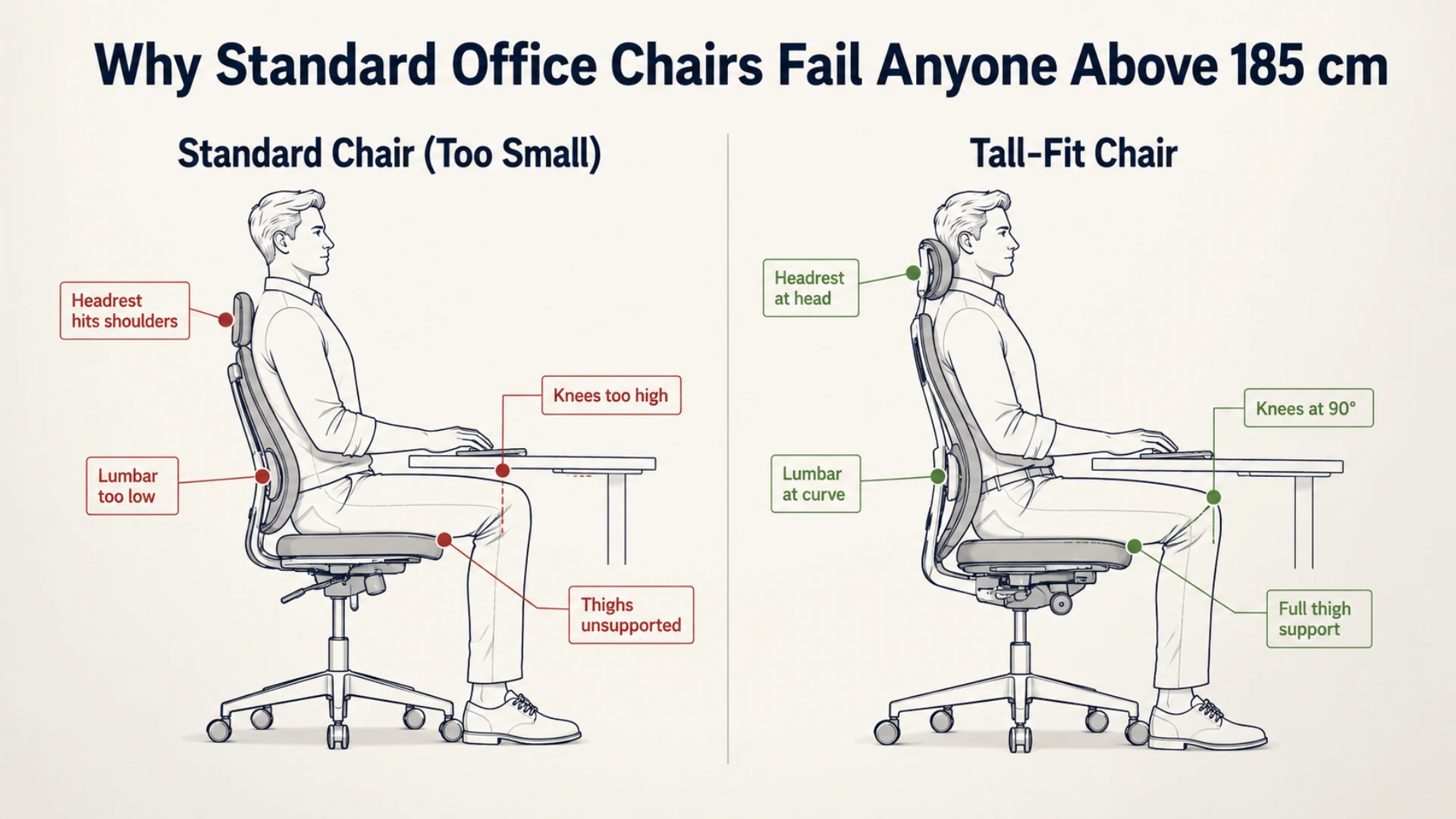
Standard office chairs are designed for the middle of the bell curve. According to the BIFMA G1-2013 Ergonomics Guideline, most chairs adjust between 40 and 53 cm in seat height. That covers people roughly 160–185 cm tall. Above that, the chair runs out of room.
The result is predictable. Your knees rise above your hips, your thighs are unsupported, and your upper back floats above the backrest.
A chair designed for the 95th percentile doesn’t fit anyone in the 99th. The math doesn’t stretch.
Why does my office chair feel too small even at the highest setting?
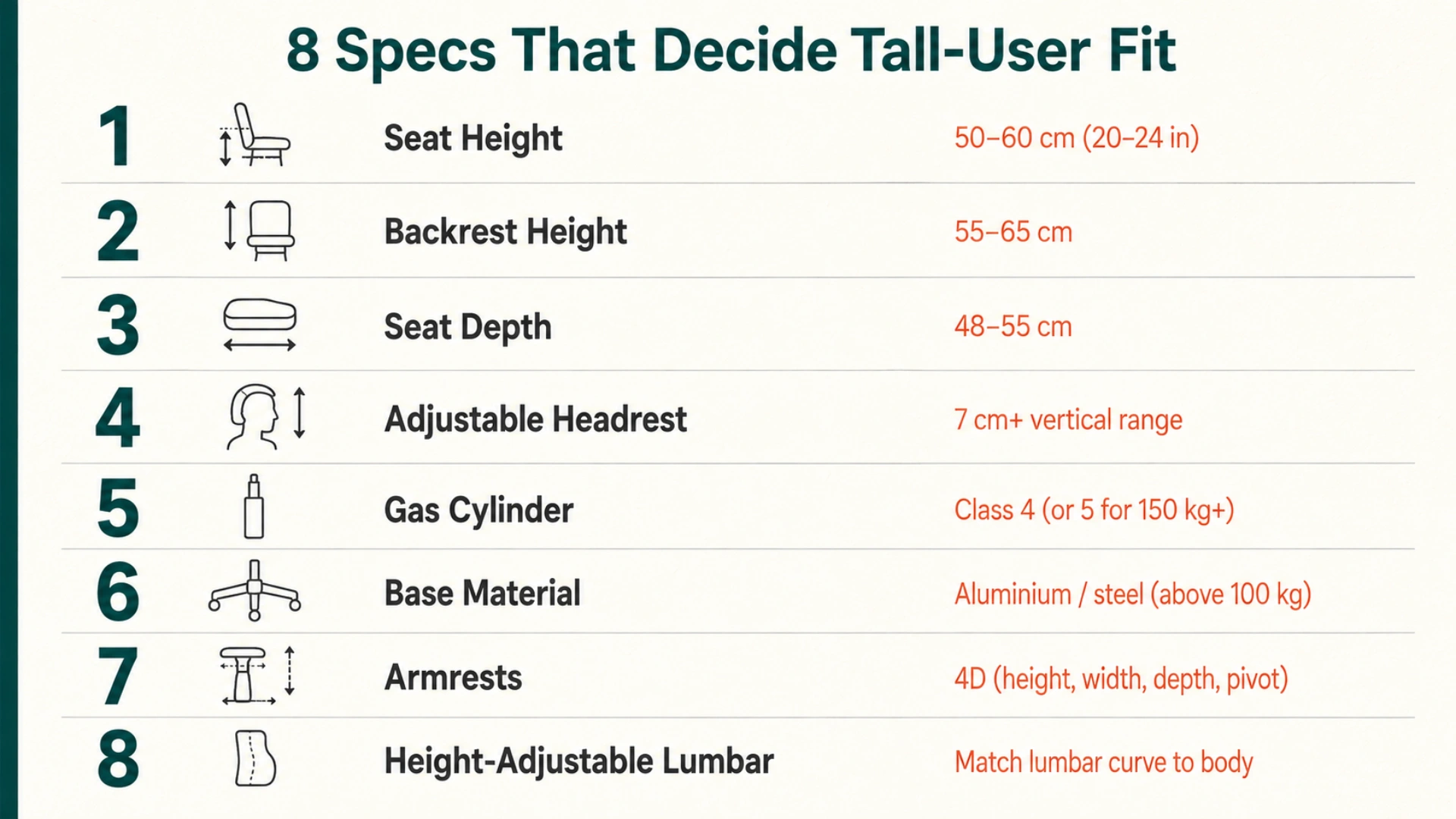
The maximum seat height on a standard chair sits around 53 cm (21 in). A person at 190 cm (6’3″) needs roughly 50–55 cm of seat height to keep knees and hips aligned. At 195 cm and above, that climbs to 53–60 cm. Most chairs simply can’t reach there.
It’s not your imagination. The cylinder runs out.
What height does a standard office chair fit?
Standard chairs fit roughly 60% of the working population. The other 40% sit in chairs that miss them by 5–15 cm somewhere. A 2023 study published in the International Journal of Environmental Research and Public Health noted that older anthropometric datasets often no longer reflect today’s bodies.
People are taller on average. Chairs haven’t caught up.
For the full body-mapping logic behind sizing, see how to size an ergonomic chair for a tall frame.
What happens to your body in a chair that’s too small?
You compensate without noticing. Knees climb. Lower back rounds. Shoulders hunch forward to bring the head closer to the screen, because the headrest sits at your shoulder blades instead of behind your head.
Three hours in, the neck starts. Six hours in, the lumbar.
A headrest that hits your shoulder blades isn’t a headrest. It’s a shoulder rest pretending.
What changes after a year in a too-small chair is the surprise. You stop blaming the chair and start blaming your posture. The chair just trained you to slouch.
Tall, Big, or Big-and-Tall: Diagnose Your Fit Before You Shop
The biggest mistake tall buyers make is treating “big and tall” as one category. It’s three, and the wrong category wastes money on features you don’t need while missing the ones you do.
What’s the difference between a tall chair and a big and tall chair?
A tall chair is built for users with a longer torso, longer femurs, and longer height range. Standard weight capacity. A big chair is built for users above 110 kg who need reinforced steel, wider seats, and high-density foam. Standard height range. A big-and-tall chair combines both.
Choose the wrong one and you pay a premium for the wrong upgrade.
How do I know if I need a big and tall chair or just a tall chair?
Start with your two numbers: height and weight. Then match them against the table below.
| Body type | Height range | Weight range | Spec priority | What to skip |
|---|---|---|---|---|
| Tall (lean or average build) | 185 cm+ (6’1″+) | Under 110 kg (240 lbs) | Extended seat height, taller backrest (55 cm+), adjustable headrest, deep seat pan, Class 3 or 4 cylinder | Reinforced steel base, oversized seat width, high-density foam |
| Big (shorter, heavier) | Under 185 cm | 110 kg+ (240 lbs+) | Reinforced base, wider seat (50 cm+), high-density foam, Class 4 or 5 cylinder, 136+ kg capacity | Extended seat height, oversized backrest |
| Big-and-tall | 185 cm+ | 110 kg+ | All of the above combined; proportionally scaled dimensions | Compromise — both height and weight specs are essential |
Notice the pattern. A tall-and-lean user buying a “big and tall” chair pays for reinforced steel and dense foam they don’t need, while often missing the headrest height adjustment they do.
Most tall users buy chairs engineered for weight they don’t carry. They pay a premium for the wrong upgrade.
What chair should you choose if you’re tall and lean?
If you’re 6’2″–6’7″ and 70–95 kg, you don’t need a big-and-tall chair. You need a tall-friendly standard chair with extended gas cylinder, taller backrest, and adjustable headrest. Look for a height-adjustable backrest, which lets the lumbar pad meet your specific lumbar curve regardless of your torso length.
Skip the heavy-duty steel base. You’ll pay for it and never use it.
(Shorter readers searching for the opposite end of this problem can read the petite-user companion guide for shorter frames.)
The Eight Specs That Decide Whether a Chair Fits a Tall Frame
Here’s where things get specific. These are the eight features that separate a chair that fits from one that almost fits.
What seat height range do I need at my height?
Match your stature to the seat height that lets your feet stay flat with knees roughly at 90 degrees.
| Your height | Target seat height | Minimum gas cylinder |
|---|---|---|
| 185–195 cm (6’1″–6’5″) | 50–55 cm (20–22 in) | Class 3 or 4 |
| 195–205 cm (6’5″–6’9″) | 53–60 cm (21–24 in) | Class 4 |
| Over 205 cm (6’9″+) | 58 cm+ (23 in+) | Class 4 or extended Class 4 |
The rule of thumb: popliteal height (floor to behind your knee while seated) averages about 25% of your standing height. Multiply your height by 0.25 to find your rough seat-height target.
How tall should the backrest be for users over 6 feet?
For users above 185 cm, look for a backrest of at least 55 cm. Above 195 cm, aim for 60 cm or higher. Anything shorter leaves your shoulder blades and upper back unsupported.
A height-adjustable backrest (a ratchet system that lets the back move up the post) is the single most valuable feature for tall buyers. It lets the lumbar curve sit at your lumbar curve, not 5 cm below it.
Does seat depth really matter for tall people?
Seat depth is the spec most tall users skip and the one that quietly causes the most knee pain. Longer femurs need deeper seats. If the seat is under 48 cm deep, your knees will press against the front edge or your back will lose contact with the backrest.
Aim for 48–53 cm at 185–195 cm tall. Above 195 cm, look for 50–55 cm. A seat-depth slider (adjustable depth) is ideal because two people at the same height often have different leg-to-torso ratios.
Backrest height gets the attention. Seat depth quietly causes the knee pain.
What weight capacity should I look for?
Apply the 15–20% buffer rule. If you weigh 100 kg, buy a chair rated for at least 120 kg. According to the Eureka Ergonomic safety guide, maintaining that buffer keeps the foam, cylinder, and tilt mechanism well inside their stress range.
A chair rated exactly at your weight technically works. It also wears out twice as fast.
Why does gas cylinder class matter for taller and heavier users?
The pneumatic cylinder is what holds your chair height stable. There are 5 classes, but we will only look into the latest 3:
- Class 3: standard and fine up to about 90 kg.
- Class 4: the minimum for users above 90 kg
- Class 5: cylinders are rated for 150 kg or more.
A taller chair needs a longer cylinder anyway, but cylinder length and cylinder class are different specs. Check both.
A Class 3 cylinder sagging under 100 kg looks like a chair losing height. It is the chair losing height.
This is also one of the first failure points to watch for when reading the signs your chair is wearing out under your weight.
Should the base material change above 100 kg?
Yes. Standard nylon bases handle up to about 100 kg reliably. Above that, look for aluminium alloy or reinforced steel. The base is the part most likely to crack from cumulative stress, especially during recline.
For big-and-tall users, an aluminium alloy or steel five-prong base isn’t a luxury. It’s the structural floor.
Do I need 4D armrests if I’m tall?
Probably yes. 4D armrests (adjustable in height, width, depth, and pivot angle) accommodate longer arms and wider shoulders that standard 2D armrests can’t reach. A taller user with narrow shoulders will hate 4D arms set wide. A broader user with the same height will need them at maximum width.
Skip 4D if you only ever type at a single desk. Otherwise it’s worth the upgrade.
Why is the headrest the most overlooked detail for tall users?
Most office chairs put the headrest at a fixed height. For someone at 195 cm, that fixed height sits at the shoulder blades. The headrest does nothing for the head, neck, or cervical spine.
Look for a height-adjustable headrest that moves at least 7 cm up the backrest. Better still, a 2D or 3D headrest that tilts to match the back of your head.
Merryfair’s Best Ergonomic Chairs for Tall People in 2026
Merryfair’s range is built around adjustability for tall users up to roughly 195 cm (6’5″). Each chair below targets a different sub-profile within that range. Match the chair to how your body and your workspace actually behave, not to the headline price.
Which Merryfair chair offers the most adjustability for tall users?
For tall users who want every dimension under their control, the Zenit is the strongest pick in the lineup.
The easy-glide ratchet height-adjustable backrest moves through 540–590 mm of range, letting the lumbar pad sit at your actual lumbar curve rather than 5 cm below it. The 4D armrest covers 70 mm of vertical range.
Also, the auto weight-sensing synchronised mechanism removes the tilt-tension dial entirely, as the chair calibrates to your weight.
Seat height runs 445–545 mm (17.5–21.5 inches), and the seat slide adds 50 mm of depth adjustment. The permanent-contact lumbar stays with your back through every recline angle. Best for tall users in the 185–192 cm range who don’t want to keep retuning the chair.
Which Merryfair chair is the strongest all-rounder for tall users?
The Wau reaches higher than any other chair in the Merryfair range. Mesh-back models adjust from 465–565 mm seat height (18.3–22.2 inches), which is the chair’s standout spec for tall buyers.
Both the backrest and headrest are height-adjustable, and the Recline-Glide Motion pivots the back and seat around the hip socket, so the backrest stays in contact with your torso through the whole recline range.
A backrest that loses contact when you lean back isn’t supporting you. It’s just behind you.
Lumbar depth is adjustable. The 5-prong diecast aluminium base handles the structural side. Button-less adjustment keeps the controls intuitive.
Overall, it’s best for tall users in the 185–195 cm range who want a chair that just reaches their height range without fuss.
Which Merryfair chair suits tall users with longer arms or longer torsos?
Tall isn’t a single shape. Two people at 188 cm can have completely different arm and torso lengths.
The Spinelly handles that variation better than the rest of the range.
The armrest covers 100 mm of height adjustment, which is the widest range in the lineup. The seat is depth-adjustable for 50 mm, which matters for longer-femur users who lose lumbar contact in a fixed-depth seat. The lumbar support is height-adjustable for 55 mm. The flexible rib-cage backrest moves with your spine instead of locking it in one curve. Spinelly is BIFMA X5.1 and EN-1335 certified.
Seat height runs 425–520 mm (16.7–20.5 inches). Best for tall users in the 180–188 cm range with arm or torso proportions that standard chairs miss.
Which Merryfair chair suits a tall executive setting?
The Delphi is the executive presence in the lineup — a high-back swivel with a wrap-around backrest, full-leather upholstery option, and polished aluminium backbone supports. The four-point synchronised recline mechanism has a stepless lock, so the chair holds whatever angle you set, not the closest preset.
The headrest is friction-adjustable for height. The base options range from standard nylon to diecast aluminium in polished finish. Seat height runs 425–545 mm (16.7–21.5 inches). Best for tall users in the 180–190 cm range working in executive offices, boardrooms, or client-facing spaces where appearance matters as much as fit.
Which Merryfair chair works for broader-framed tall users?
The Apollo‘s standout is the seat itself. Wide seating surfaces are built into the design specifically to accommodate broader frames, with a seat width of 510 mm and the curvaceous wrap-around armrest profile.
Three mechanism options (knee-tilt with tension knob, knee-tilt with side crank, or spring-head) and three base options (aluminium alloy, polypropylene, or steel cantilever) give you configuration flexibility for different workspaces. Seat height runs 460–535 mm (18.1–21.1 inches) in the high-back configuration. Best for tall users in the 180–188 cm range with broader shoulders or hip width who feel cramped in narrower seats.
What if you’re over 195 cm or above 125 kg?
Merryfair’s range covers tall users up to roughly 195 cm comfortably. Above that height, or for users in the genuine big-and-tall category needing very high weight capacity, the right move is to contact Merryfair directly.
The team can advise on current configurations, BIFMA test reports for specific load ratings, and custom options that won’t appear in a standard catalogue.
A chair sold off-the-shelf is the right answer for most tall buyers. For the edges of the population, the right answer is a conversation.
How to Set Up Your Chair Once You’ve Got the Right Size
Buying right is half the work. Setting up right is the other half. Tall users have a few specific calibration moves that differ from the average user.
Where should the lumbar support sit if you’re 6 feet tall?
Position the lumbar pad at the inward curve of your lower back, not the middle of your spine. For someone at 185 cm, that’s typically around 25–28 cm above the seat pan. For someone at 195 cm, closer to 28–32 cm. If your chair has a height-adjustable lumbar (and as a tall user, it should), this is the most important adjustment after seat height.
A lumbar pad sitting in the middle of your back isn’t lumbar support. It’s mid-back pressure.
How do you adjust an office chair for a tall person specifically?
Follow the Merryfair 6-Point Chair Calibration order: seat height, then seat depth, then lumbar position, then armrests, then tilt tension, then backrest angle. The order matters more for tall users because every adjustment downstream depends on the seat height being right first.
The full step-by-step is in how to adjust an office chair step by step for a tall body.
What can you do if your desk is too low for your new chair?
Common problem. You finally get a chair tall enough for your legs, and now your desk is too low. The fix isn’t lowering the chair (you’ve solved one problem to recreate another). The fix is raising the desk.
A keyboard tray that mounts above the desk surface, or an adjustable-height standing desk, costs less than buying a new chair. Most tall users underestimate how much workstation height matters.
Get the Sizing Right Before the Brand Right
If you remember one thing from this guide, make it this. Tall users get sold brand names. What they actually need is a spec sheet that matches their body. An expensive chair in the wrong size fits worse than a moderately priced chair in the right size.
So bring your numbers, not your brand preferences, which includes your height, weight, and popliteal measurement. Then match them to seat height, seat depth, backrest height, headrest position, weight cap, and cylinder class.
When you’re ready to do that match, explore Merryfair’s full range of ergonomic chairs built for adjustability chairs designed around height-adjustable backrests, adjustable headrests, and aluminium alloy bases. For a wider feature primer that covers every adjustability category, the post on what makes a chair genuinely ergonomic across feature categories gives the broader context.
The chair industry sells frame size. Tall buyers should buy by spec sheet.
A chair you stop noticing is a chair that finally fits.
Frequently Asked Questions
What is the best ergonomic chair for someone over 6’5″?
For users over 196 cm, the chair needs a seat height reaching at least 55 cm, a backrest of 60 cm or more, an adjustable headrest, and a robust gas cylinder. In Merryfair’s range, the Wau has the highest seat reach (up to 56.5 cm in mesh) and the Zenit has the most adjustable backrest. Both suit tall users up to around 195 cm. Above 200 cm, contacting a specialist directly is the right next step.
What seat height should a 6 foot person use?
A 183 cm user typically needs a seat height of 47–51 cm (about 18.5–20 inches). Your popliteal height (floor to the back of your knee while seated) is the precise target. Multiply your standing height by 0.25 for a rough estimate, then adjust to keep feet flat and knees roughly 90 degrees.
What’s the difference between a big and tall chair and a tall chair?
A tall chair is built for users over 185 cm with standard weight capacity, prioritising extended seat height, taller backrest, and headrest adjustability. A big and tall chair adds reinforced base, wider seat, Class 4 or 5 cylinder, and weight capacity above 136 kg. Choose by your specific body type, not the category label.
How much weight capacity do I need in an office chair?
Buy a chair rated 15–20% above your current weight. A 100 kg user should pick a chair rated for at least 120 kg. This buffer keeps the foam, gas cylinder, and tilt mechanism well below their stress limits, which typically doubles the chair’s usable lifespan compared to picking one rated at your exact weight.
Are gaming chairs good for tall people?
Some extra-tall gaming chairs work for very tall users because their backrests are built taller than typical office chairs. The downside is that most gaming chairs lack a height-adjustable lumbar pad and use a removable pillow that drifts out of position during long sessions. Office chairs with height-adjustable backrests, like the Wau or Zenit, hold the lumbar in place where you need it.
Do tall people need a headrest on their office chair?
For users above 185 cm, an adjustable headrest is functionally necessary. A fixed headrest typically sits at the shoulder blades on taller frames, providing no neck or cervical-spine support. Look for a height-adjustable headrest with at least 7 cm of vertical range, or a 2D headrest that tilts to match the back of the head.
MORE BLOGS
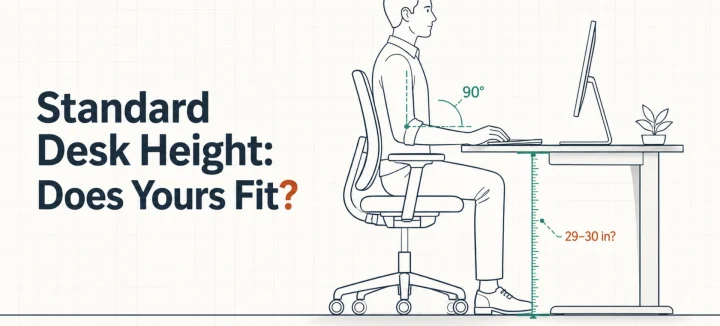
Standard Desk Height: Is 29 Inches Right for Your Body?
Standard desk height is 29 to 30 inches (73 to 76 cm). That number fits far fewer people than you’d think. A desktop that tall matches the seated elbow height of someone around 6’2″. The average American man stands 5’9″, and the average woman 5’3.5″. So this guide does two jobs. It shows you how […]
Read More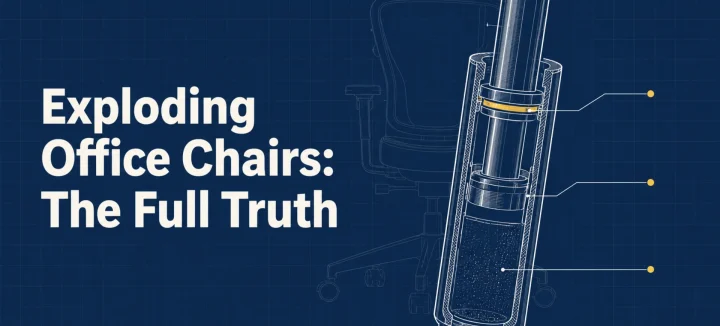
Exploding Office Chairs: The Full Truth From a Chair Maker
The exploding office chair story resurfaces every few years, same grainy photos attached. So can a chair really burst? A handful have, and every documented case involved an uncertified gas cylinder (the pressurized tube that raises and lowers your seat). Chairs built to recognized safety standards fail differently: seals leak, the seat sinks, nothing bursts. […]
Read More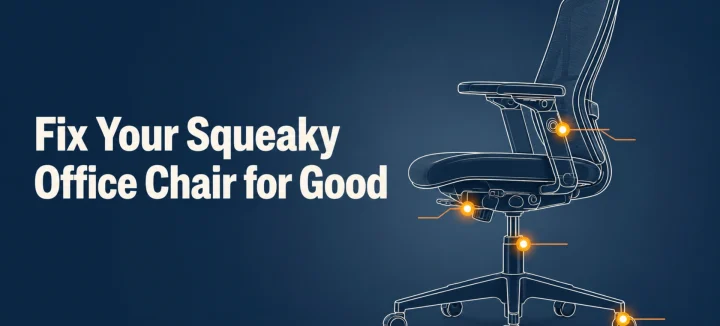
How to Fix a Squeaky Office Chair by Sound and Location
A squeaky office chair makes four different noises, and each one points to a different part. To silence it for good, find the source first: the tilt mechanism, gas cylinder, casters, or armrests. Then tighten what’s loose and lubricate with the right product for that joint. This guide matches each sound to its fix, and […]
Read More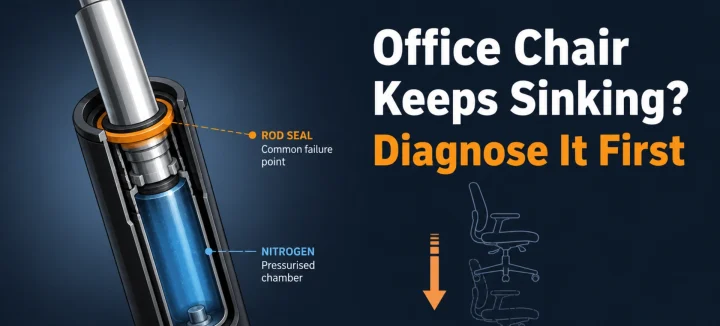
Office Chair Keeps Sinking? Diagnose and Fix It for Good
An office chair keeps sinking for one main reason: the gas cylinder under the seat is losing pressure. Worn seals let the nitrogen escape, so the piston stops holding your weight. A hose clamp or PVC pipe locks the height today; a new cylinder fixes it properly in 15 minutes. Diagnose first, and you’ll only […]
Read More