Lumbar Cushion vs Built-In Lumbar Support: What Really Works
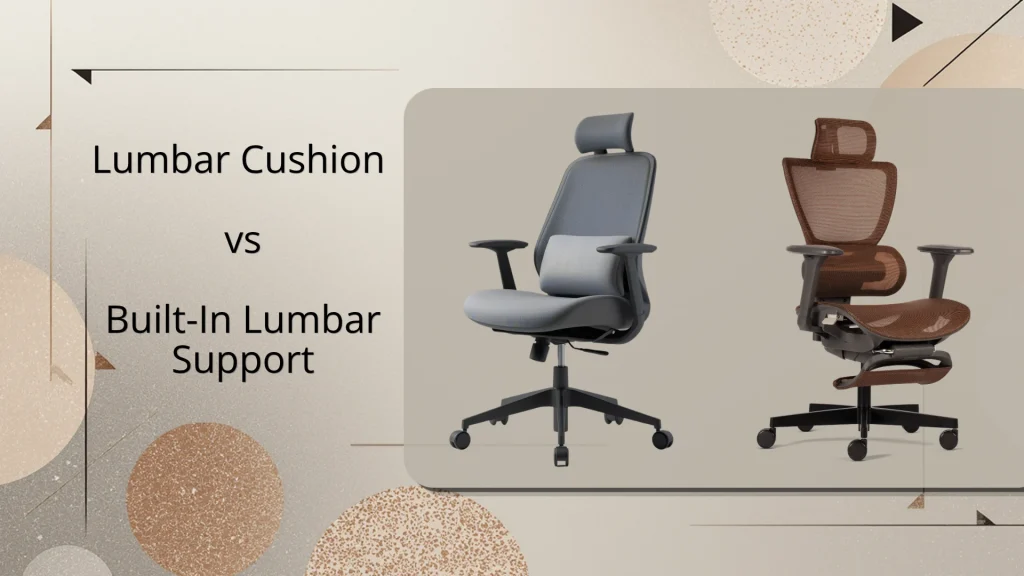
The lumbar cushion vs built-in lumbar support debate usually ends with “it depends.” That’s useless. Built-in support moves with your body as you shift. A cushion stays in one spot while you move around it. Either can work, or fail, based on three conditions. Your chair’s existing back shape, your lumbar curve depth, and how still you sit. Here’s exactly how to tell which yours needs.
Key Takeaways
- Built-in lumbar support moves with you; a lumbar cushion does not. The difference shows up at hour five, not hour one.
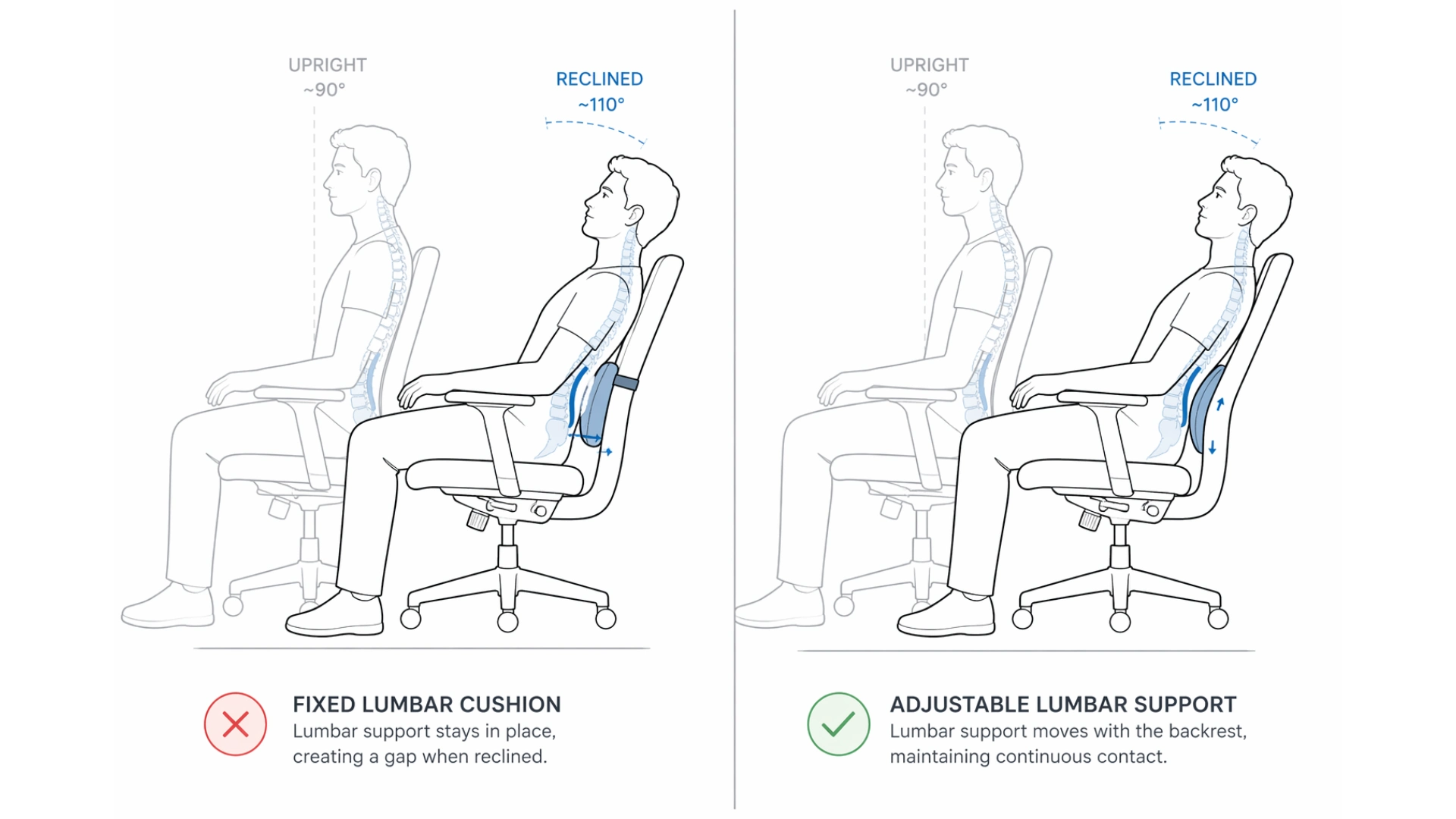
- Use the Cushion-Ready Test: all three conditions must hold. A genuinely flat chair back, a cushion curve matching your lumbar depth, and a still posture across long sessions.
- Lumbar lordosis varies widely between people, from roughly −13° to −69°. One fixed cushion shape cannot fit every spine.
- The real divide is not cushion versus built-in. It’s fit versus no-fit. A well-fitted cushion beats a badly-fitted expensive chair.
What Lumbar Support Actually Does to Your Spine
Most people picture lumbar support as something that “cushions” the lower back. It doesn’t.
Your lower back doesn’t need cushioning. It needs a surface that fills the inward curve (lordosis) of your lumbar spine.
Without that fill, your pelvis rotates backward and flattens the curve.
When the curve stays intact, disc pressure spreads evenly. Your erector spinae muscles get to rest.
A lumbar cushion does not add support to your spine. It simply fills a gap.
That single point reframes the whole comparison.
Both products do the same physical job. They fill the gap between your lumbar curve and the backrest.
The question is never “which adds more support?” It’s “which one stays where your spine needs it across hours of sitting?”
How does a lumbar cushion actually work?
A lumbar cushion is a separate piece of foam or mesh. You strap it (or wedge it) to your chair’s backrest to create a contoured surface.
The goal is simple: the cushion’s curve contacts your lower back. Your pelvis stays tilted forward, and your lumbar spine holds its shape.
A 2013 study in Chiropractic & Manual Therapies tested exactly this. Grondin and colleagues found the lumbar pillow shifted seated posture 2.88 degrees closer to neutral.
Meaningful biomechanically. But participants reported no subjective change in comfort after 30 minutes.
That last detail matters.
A cushion can correct posture without the user feeling different. People throw out working cushions and cling to failing ones.
How does built-in lumbar support work?
Built-in lumbar support is the curve engineered into the chair’s backrest itself. The support is structurally part of the chair.
On a basic chair, it’s fixed. A mid-range chair makes it height-adjustable.
An ergonomic chair adds depth control. You decide how far it pushes into your back.
Premium chairs go dynamic. The system auto-adjusts as you shift postures.
When you recline, lean forward, or shift sideways, built-in support tracks with you. That’s why it outperforms at hour five.
A fuller breakdown of how built-in lumbar support works covers the fixed, adjustable, and dynamic systems in detail.
What is the real difference between a cushion and built-in support?
The difference isn’t the material. It isn’t the firmness either. What matters is whether support stays where your spine needs it.
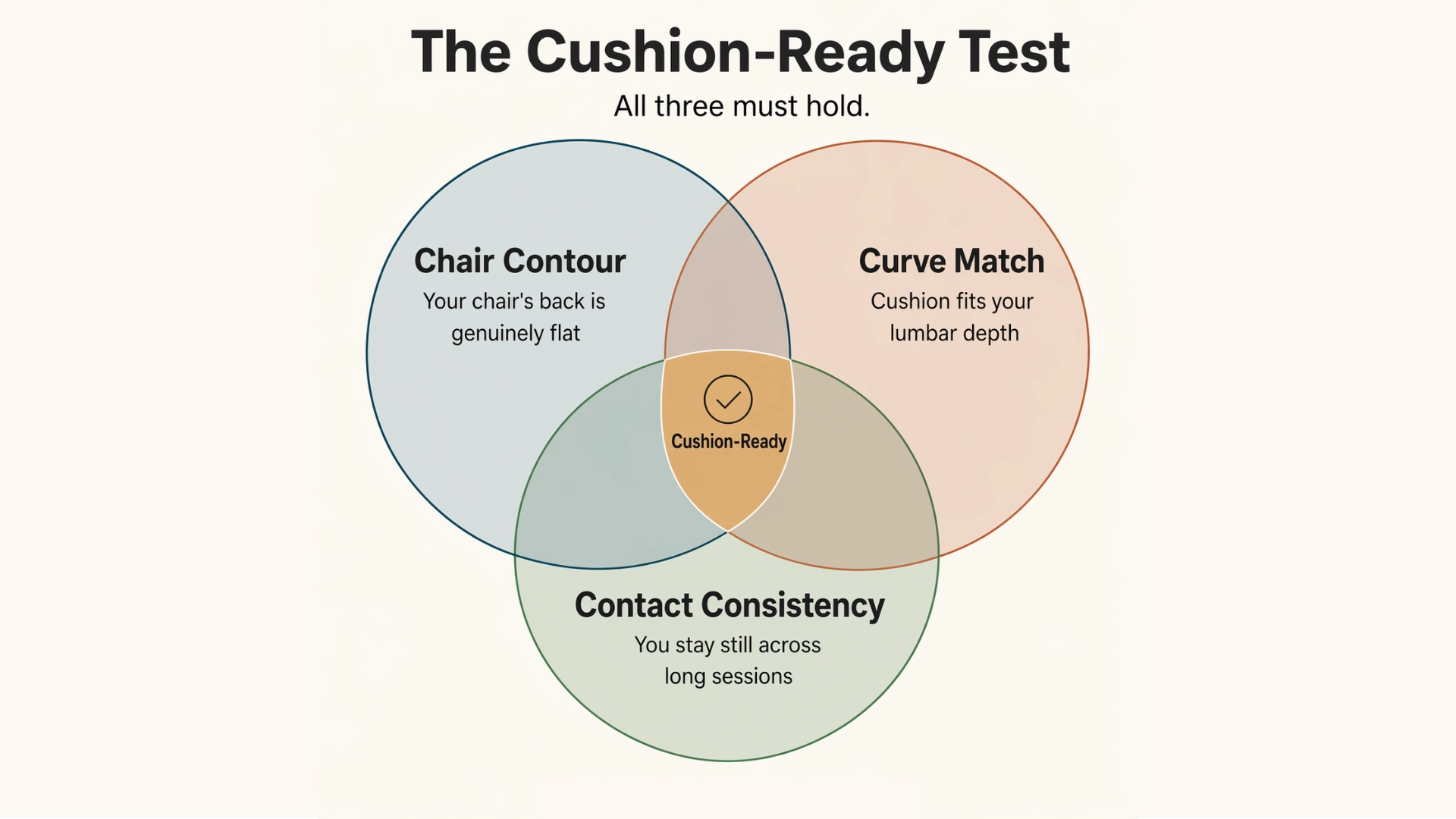
When you shift from upright to reclined, a cushion stays at belt height. Your lumbar spine does not. The support misses.
A built-in system with proper recline keeps the support and your spine in contact.
That’s why built-in performs better at hour five than hour one.
The user has shifted positions twenty times by then. Each shift tests whether the support moved with them.
| Mechanical aspect | Lumbar cushion | Built-in lumbar (adjustable) |
|---|---|---|
| Position during recline | Stays at belt height; loses contact | Tracks spine as backrest reclines |
| Depth calibration | Fixed curve shape | Adjustable pressure depth |
| Height calibration | Manual reposition needed | Slide to match your L3–L5 |
| Stability across session | Tends to shift down or sideways | Structurally anchored |
| Portability | High | None |
For wider context on how ergonomic seating design reduces back pain risk, research on ergonomic interventions supports the broader case.
The Cushion-Ready Test: Three Conditions That Decide Which You Need
Here’s where the cushion-vs-built-in debate gets a cleaner answer than “it depends.”
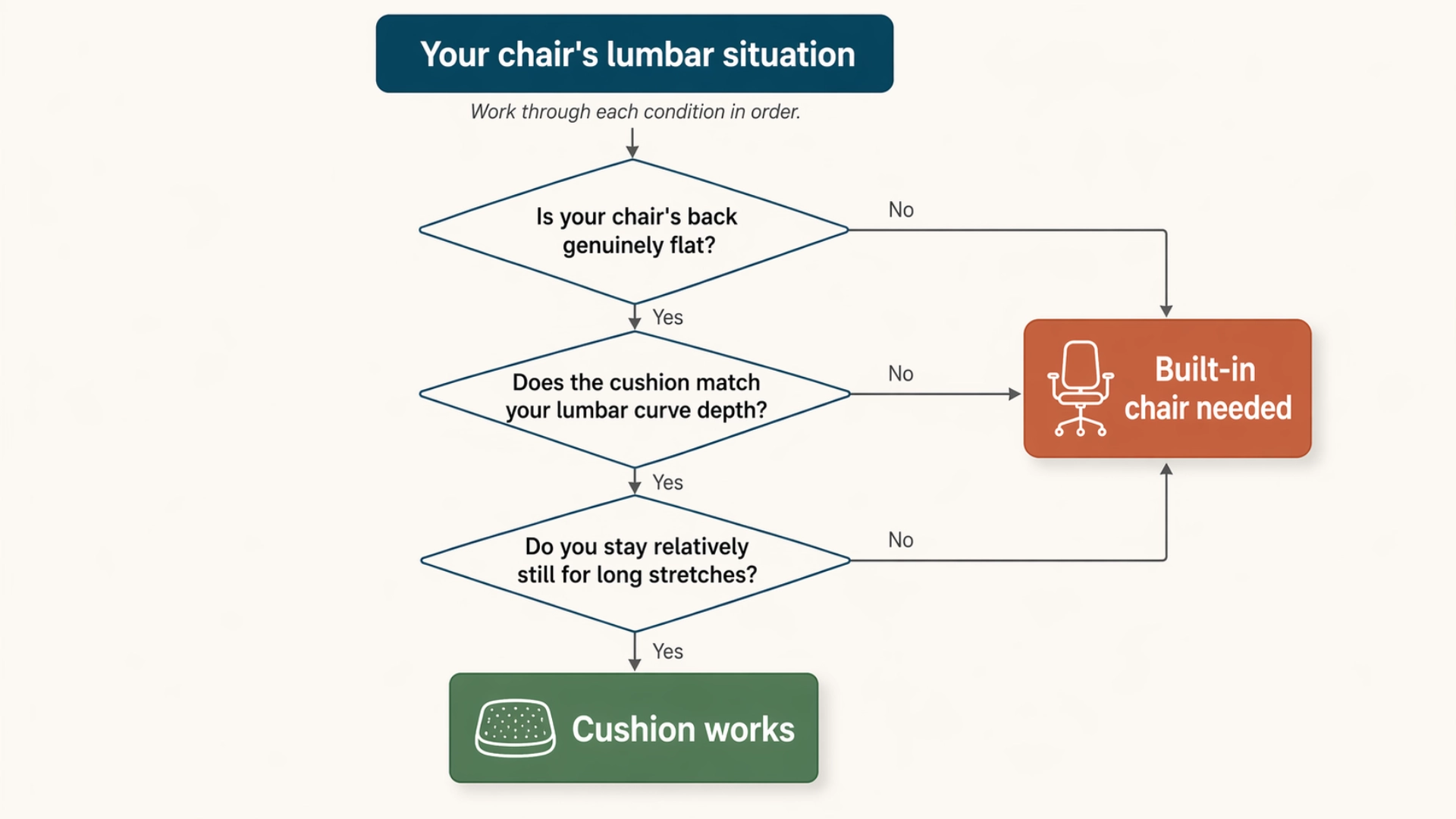
Three conditions. All must hold for a cushion to substitute for built-in support. If any one fails, the cushion will underperform no matter how much you spend.
These are the Cushion-Ready Test: Chair Contour, Curve Match, and Contact Consistency. Check them in order. The test takes five minutes.
Condition 1: Is your chair’s back genuinely flat?
Most office chairs are not actually flat-backed. They have a slight lumbar bulge moulded into the foam. Or a rear tension that pushes the backrest forward at lumbar height.
Add a cushion on top and you’re stacking two curves at different heights. The cushion pushes you too far forward. Or the chair’s built-in bulge catches your mid-back instead of your lumbar region.
Test it. Sit in your chair without a cushion, lower back against the backrest. Slide your hand behind your lumbar spine.
Does the chair already contact your lumbar curve? If yes, a cushion will create double-pressure or force you out of alignment.
If the back feels uniformly flat against your whole spine, you’ve passed Condition 1.
Fixed built-in lumbar support that doesn’t fit your body is worse than a good cushion on a flat-back chair.
Condition 2: Does the cushion match your lumbar curve depth?
Your lumbar curve is a fingerprint.
A PLOS One study measuring lordosis across 158 individuals reported curve angles ranging from -69° to -13.6°. That spread is wide enough that one cushion shape cannot fit every spine.
Norton et al. also found women’s lordosis averages about 13 degrees deeper than men’s.
This is the failure point most comparison articles skip.
A mass-produced lumbar cushion is designed around an average curve. If your curve is shallower, the cushion pushes you too far forward. If deeper, the cushion underfills the gap and does essentially nothing.
Test it by sitting with the cushion for at least 30 minutes. Are you leaning away from it? Still slouching into it? Either response signals a curve mismatch.
This is also why depth-adjustable lumbar support on an ergonomic chair outperforms a cushion in most cases. You calibrate the push to your specific lumbar depth, not the statistical average.
Condition 3: Do you stay relatively still for long stretches?
A cushion only works when you stay still. Built-in works because it moves with you.
Sit in one static posture for an hour (deep focus, reading, detailed design) and a cushion holds position well enough to do its job.
Shift constantly (phone calls where you recline, leaning forward to type, twisting to a second monitor) and the cushion slips. Each shift misaligns it another few millimetres.
By hour three, the cushion is at your mid-back or sliding toward the seat pan. You’re sitting unsupported and you don’t realise it.
Be honest with yourself. Count how many times in an hour you adjust how you’re sitting. More than six or seven? You’re a dynamic sitter.
And a fixed cushion was never going to work for you.
How do I know if I need a lumbar cushion or a new chair?
Run the Cushion-Ready Test. Three yeses means a good cushion is a rational choice. Any no means the cushion is masking a chair problem, and built-in adjustable lumbar is the only real fix.
Which built-in features actually help depends on where your pain originates and which positions consistently make it worse.
| Condition | What you check | Pass criterion |
|---|---|---|
| Chair Contour | Your chair’s back is genuinely flat, no built-in bulge | Hand slides freely behind lumbar |
| Curve Match | The cushion fits your lumbar depth after 30 mins | No forward push, no residual slouch |
| Contact Consistency | You stay relatively still for 45+ minute stretches | ≤6 posture shifts per hour |
All three pass: proceed with cushion. One or more fail: cushion will underperform.
When to Stick With a Cushion and When to Upgrade the Chair
Cost is why this question gets asked in the first place. A decent lumbar cushion costs the equivalent of a mid-range dinner. An ergonomic chair costs what you’d pay for a short holiday.
On that spread, trying the cushion first sounds rational. And for some users, it is.
The question is whether the cost gap translates into an outcome gap.
When is a lumbar cushion actually the right choice?
You passed all three conditions of the Cushion-Ready Test. Your chair’s back is flat. The cushion fits your depth after a few days of use. You’re a static sitter.
In that narrow profile, the cushion is rational. It costs a fraction of a chair. The biomechanical outcome in your specific setup is close enough that the price gap isn’t justified.
You might also reach for a cushion as a short-term bridge. A two-week contract at a client’s office. A travel situation. A temporary workstation.
Built-in support isn’t portable. A cushion is.
When is a built-in chair the only real fix?
You failed any one condition.
Maybe your chair has a pre-curved back fighting the cushion.
Maybe your lordosis sits outside the average depth the cushion was shaped for.
Or, maybe you move a lot across the day.
In any of those cases, no cushion upgrade will solve it.
What you’ll do instead is cycle through cushion after cushion. You’ll blame each one for “not being the right firmness.” The real problem: cushions can’t fix what’s actually broken in your setup.
There’s a point where cost-of-cushion-cycling exceeds cost-of-chair. Three cushions tried and abandoned already puts you there for most mid-range chairs.
The warning signs your chair needs replacing usually show up long before the cost equation tips, if you’re paying attention.
And before you test any chair in a showroom, know how to test lumbar contact in the showroom. Don’t take the salesperson’s word for it.
Can I combine a cushion with a chair that has built-in support?
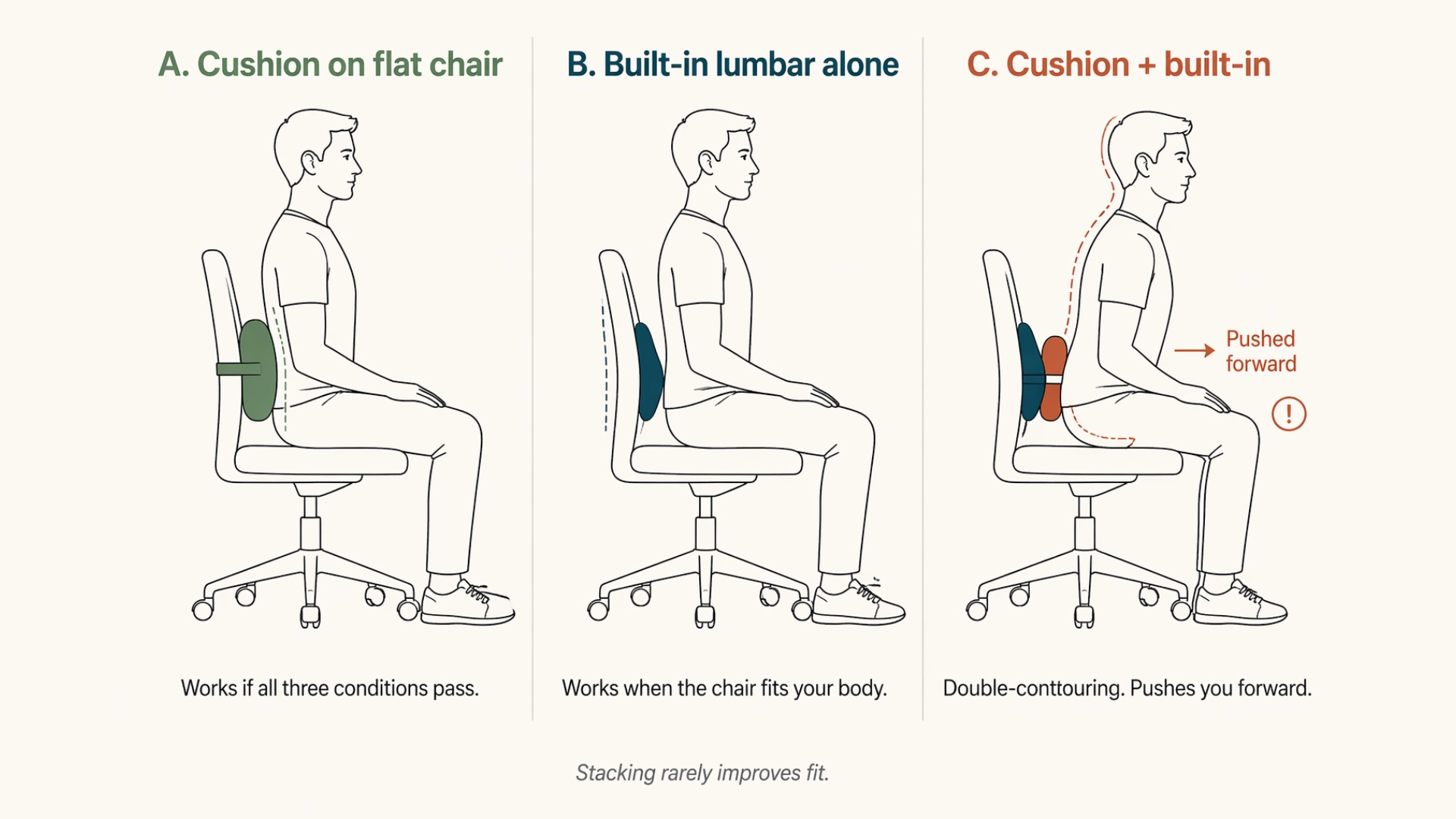
Usually no. This is a silent mistake a lot of people make.
If your chair has built-in lumbar (adjustable or not), adding a cushion on top creates double-contouring. The cushion sits in front of the built-in bulge and pushes you too far forward. Or it lands off-centre from the built-in support and creates a pressure point neither was designed to handle.
The exception: your built-in system is too shallow for your lordosis, and the cushion fills the residual gap without double-contouring. Rare, but possible.
More often, if built-in isn’t deep enough for you, the answer is a chair with deeper depth adjustment. Not a chair plus a cushion.
Fit Is the Only Variable That Matters
Spend enough time in ergonomics and you notice most “what’s better” product debates are fit questions wearing a product disguise. Cushion vs built-in is one of them.
A cushion that fits your chair and your spine will outperform a built-in system that doesn’t.
A built-in system that fits will outperform any cushion ever made.
The real divide is not cushion versus built-in. It’s fit versus no-fit.
Run the Cushion-Ready Test. Three yeses: a cushion is rational and you can stop reading comparison articles. Any no: don’t spend another year cycling through cushions.
The best ergonomic office chairs for every budget in Malaysia offer adjustable lumbar above RM1,000 and a cushion add-on below.
Your back isn’t waiting for you to finish the cost-benefit math. It’s compensating right now. Every week of compensation is a week it remembers.
Sciatica changes the priority order: a chair setup built around sciatic nerve geometry gets seat depth right before worrying about lumbar.
This content is for informational purposes only. If you have existing back pain or a diagnosed disc condition, consult a qualified healthcare professional before changing your seating setup.
Common Questions About Lumbar Cushions and Built-In Support
Is it good to have lumbar support for an office chair?
Yes, if you sit more than three hours a day. Lumbar support maintains the inward curve of your lower back while seated. That reduces disc pressure and prevents your back muscles from overworking. The real question isn’t whether you need it. It’s whether your current setup actually delivers it, which the Cushion-Ready Test is built to answer.
Is a lumbar pillow good for scoliosis?
Possibly, but not automatically. Scoliosis involves asymmetrical lateral curvature, not just the front-to-back curve that standard lumbar cushions address. A symmetric cushion may feel neutral in a mild case or worsen the asymmetry in a pronounced one. Scoliosis seating decisions should be made with a qualified physiotherapist or spine specialist, not from a product comparison article.
What is the best lumbar support cushion for an office chair?
There isn’t one. “Best” depends on your chair’s back shape, your specific lumbar depth, and how statically you sit. A cushion that works for a short-torso static sitter on a flat-back chair will fail for a long-torso dynamic sitter on a pre-contoured chair. Run the Cushion-Ready Test first to see if any cushion will work in your setup.
Can a lumbar cushion make back pain worse?
Yes. If the cushion’s curve is too deep for your lordosis, it pushes you into excessive extension. Your opposing muscles then strain to compensate. If too shallow or placed too high, it forces you to arch your upper back. A cushion that doesn’t fit is actively worse than no cushion at all. It introduces novel strain patterns your body hasn’t adapted to.
How long does it take to feel results from a lumbar cushion?
Two to three weeks of consistent use, assuming the cushion fits correctly. The 2013 study in Chiropractic & Manual Therapies found measurable posture change within 30 minutes but no subjective comfort shift. That gap between measurable and felt benefit is normal. If nothing has changed after three weeks, the cushion probably isn’t fitting your anatomy.
MORE BLOGS
Standard Desk Height: Is 29 Inches Right for Your Body?
Standard desk height is 29 to 30 inches (73 to 76 cm). That number fits far fewer people than you’d think. A desktop that tall matches the seated elbow height of someone around 6’2″. The average American man stands 5’9″, and the average woman 5’3.5″. So this guide does two jobs. It shows you how […]
Read More
Exploding Office Chairs: The Full Truth From a Chair Maker
The exploding office chair story resurfaces every few years, same grainy photos attached. So can a chair really burst? A handful have, and every documented case involved an uncertified gas cylinder (the pressurized tube that raises and lowers your seat). Chairs built to recognized safety standards fail differently: seals leak, the seat sinks, nothing bursts. […]
Read More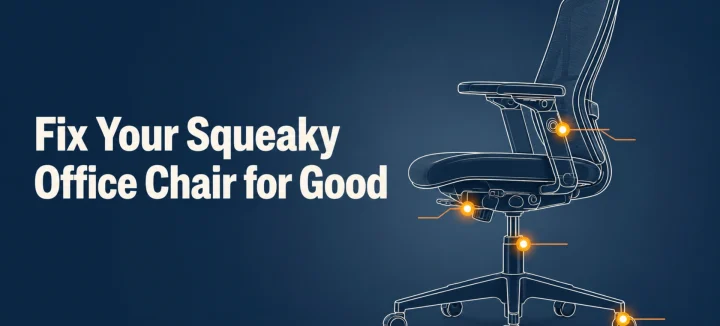
How to Fix a Squeaky Office Chair by Sound and Location
A squeaky office chair makes four different noises, and each one points to a different part. To silence it for good, find the source first: the tilt mechanism, gas cylinder, casters, or armrests. Then tighten what’s loose and lubricate with the right product for that joint. This guide matches each sound to its fix, and […]
Read More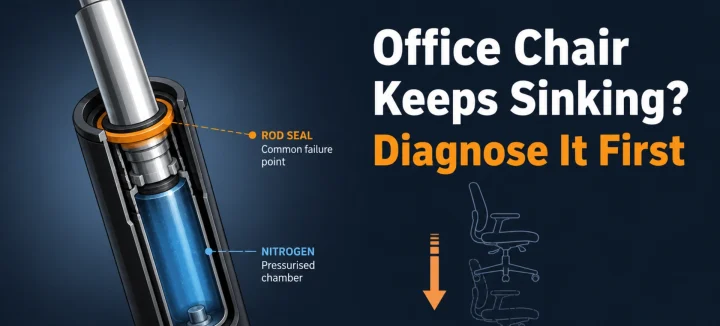
Office Chair Keeps Sinking? Diagnose and Fix It for Good
An office chair keeps sinking for one main reason: the gas cylinder under the seat is losing pressure. Worn seals let the nitrogen escape, so the piston stops holding your weight. A hose clamp or PVC pipe locks the height today; a new cylinder fixes it properly in 15 minutes. Diagnose first, and you’ll only […]
Read More