Under-Desk Footrest for Office Chairs: Who Needs One and Which Type
Most people buy an under-desk footrest because their feet ache. The fix often isn’t the footrest at all.
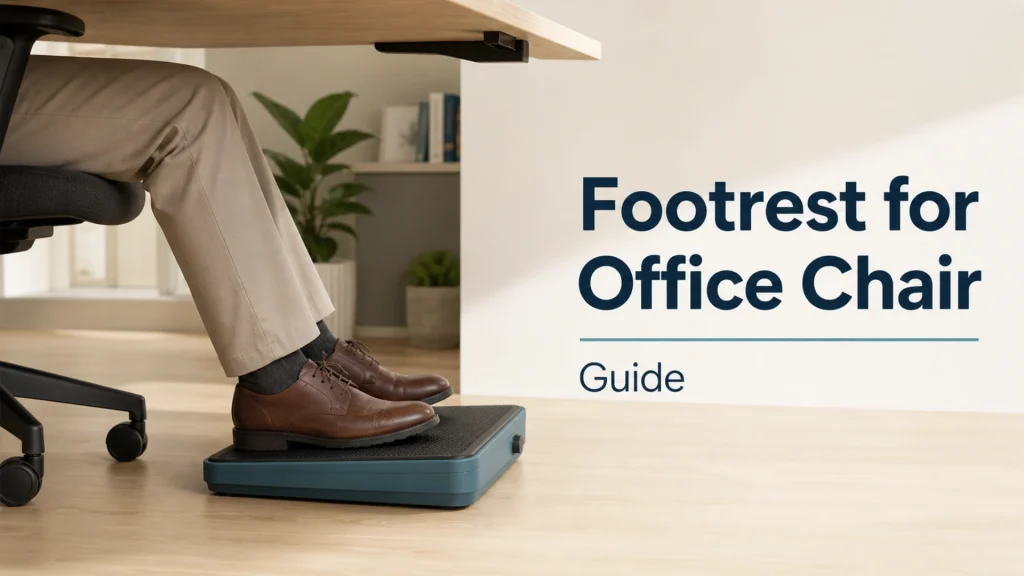
An under-desk footrest (also sold as an ergonomic foot rest) is a height-raising support for your feet. It places them flat when your desk won’t lower and your chair can’t drop without leaving them hanging.
The footrest earns its place only when raising your chair leaves your feet dangling and your thighs pressed against the seat edge.
This guide walks you through the diagnostic, the three footrest types, and how to set yours up so it actually solves the problem.
Key Takeaways
- A footrest for office chair is a second-line fix for a desk that won’t lower. Adjust your chair height first.
- A simple 4-question check tells you if you need one: dangling feet, thigh-edge pressure, fixed-height desk, or lower-leg fatigue. Two or more yeses means yes.
- Three types serve three needs: flat (passive support), tilted (calf stretch), and rocker (active circulation).
- The correct height matches your popliteal distance (floor to behind your knee) when seated correctly.
- A footrest under 25 cm wide or without a grippy surface rarely earns its place, no matter the price tag.
When a Footrest Actually Solves Your Problem
A footrest doesn’t fix tired feet. It fixes a specific geometric mismatch between your chair, your desk, and your body.
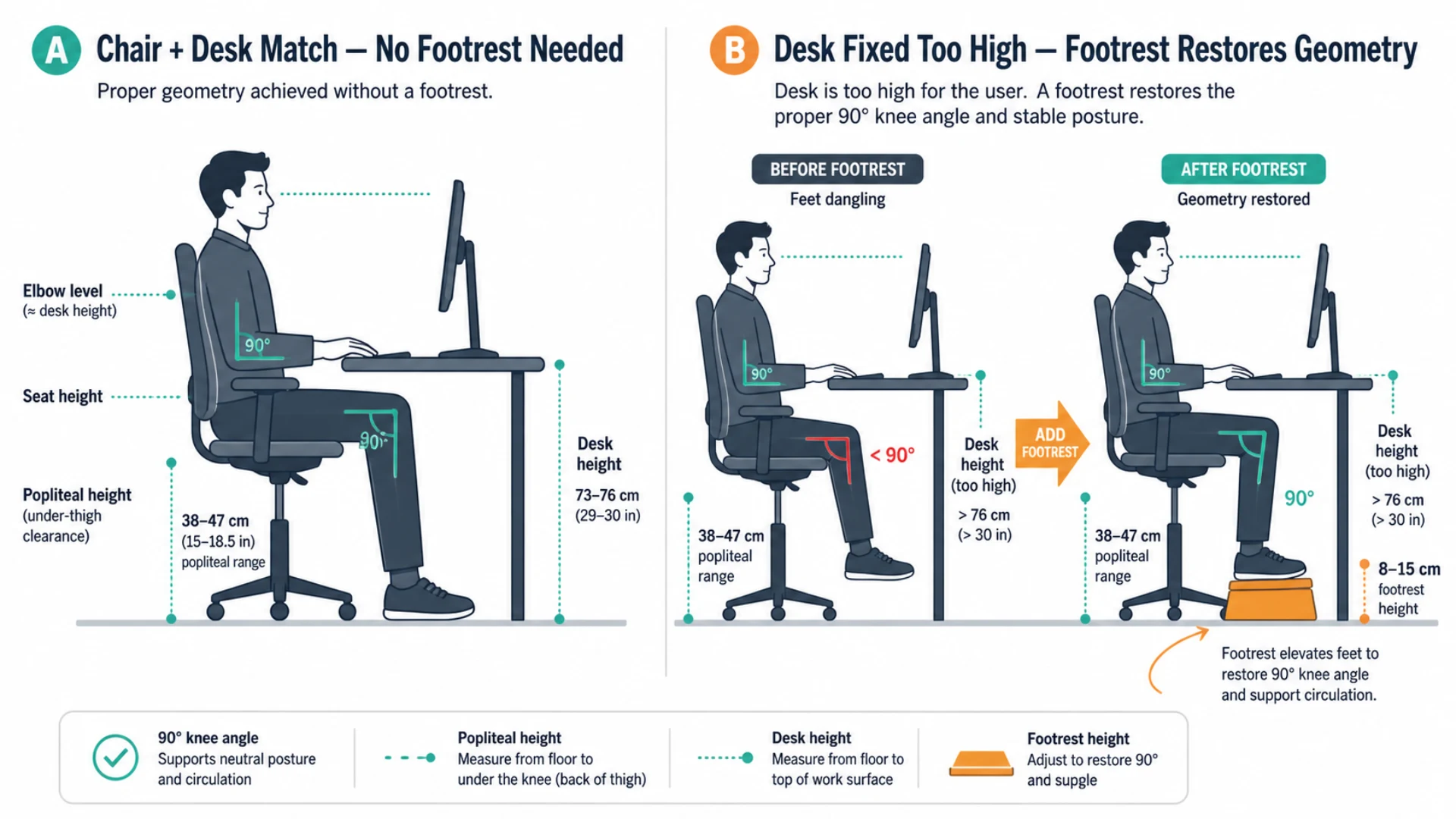
Here’s the chain. Your seat height should match your popliteal distance, the gap from the floor to the back of your knee when seated. When it does, your feet rest flat and your thighs sit parallel to the floor. When the desk above is too tall for that seat height, you raise the chair to keep your elbows level. Now your feet hang. That’s when a footrest enters the picture.
A footrest is the second-best fix for a too-high desk. Raising the chair is the first.
If both your chair and desk adjust, you almost never need one.
What does a footrest do for an office chair?
A footrest raises the floor under your feet so your knees can sit at 90 degrees while your chair is set higher than your popliteal height. It transfers weight off the back of your thighs, restores circulation to your lower legs, and keeps your pelvis level rather than tilted.
It’s not a comfort accessory. It’s a geometric correction.
Who actually needs a footrest? (the height and desk threshold)
You need a footrest when the wrong chair size leaves you with the foot-dangling problem and a chair raised above your popliteal height because the desk above can’t lower to match.
Three setups create this gap most often:
| Setup | Why feet dangle | Footrest helps? |
|---|---|---|
| User under 163 cm with a fixed 73–76 cm desk | Chair must be raised so elbows reach desk; popliteal height is 38–42 cm but seat sits at 45+ cm | Yes |
| Standing desk left at standing height with seated user | Desk is at 95+ cm; chair can’t reach it without losing floor contact | Yes |
| Average-height user with adjustable desk and chair | Both can match; feet sit flat naturally | No |
If your desk adjusts, lower it before buying anything.
Can a footrest replace adjusting your office chair height?
No. A footrest compensates for a chair that’s already correctly raised to meet a fixed desk. It doesn’t replace seat-height adjustment. If your chair has a working gas cylinder and the desk is height-adjustable, the right move is matching them to your body, not adding accessories.
If your knees sit higher than your hips, you don’t need a footrest. You need a different chair.
A 4-Question Check: Do You Actually Need a Footrest?
So how do you know if you actually need one? Run through this quick check.
Two or more “yes” answers and a footrest is likely worth it. One or fewer and your problem is somewhere else, usually the chair height or the desk surface above it.
How do I know if I really need a footrest at my desk?
Sit at your desk in your normal working posture and run through these four questions:
- Do your feet dangle or rest only on tip-toes? If your heels can’t reach the floor, that’s the primary signal.
- Is there pressure on the back of your thighs at the seat edge? Press a finger between your thigh and the seat. If it won’t fit, your weight is loading the wrong tissue.
- Is your desk fixed-height or stuck above 73 cm? Standing-desk-converters left in standing mode count as fixed for this question.
- Do your lower legs feel heavy, numb, or fatigued after two hours of sitting? That’s reduced circulation from compression at the popliteal fossa, the soft area behind your knee.
Two yeses or more, you need a footrest. One or fewer, your fix is elsewhere.
What does it feel like to sit without proper foot support?
In real use, you’ll notice it as a low-grade ache rather than acute pain. Your calves feel heavy by mid-afternoon. Your hamstrings tighten. You shift your legs constantly without realising why. Some people develop slight ankle swelling by 5pm. Others find their lower back tightens because the pelvis tilts to compensate.
Most of the small accessories that quietly fix big ergonomic problems in compact setups work the same way. You don’t notice the relief until you use them.
Is your problem the footrest or the chair itself?
Here’s the test most guides skip. If your feet rest flat at the lowest chair setting, but you’ve raised the seat anyway because your desk is too high, your problem is geometry. Buy the footrest.
But if your feet dangle even at your chair’s lowest setting, the chair is too tall for you. No footrest will fix that. You need a chair with a lower minimum seat height.
Seat height minimums across ergonomic chairs in Malaysia span a wider range than the price tiers suggest.
The 3-layer body fit test that confirms whether a chair actually matches your body walks you through how to check before you buy.
The wrong footrest does nothing. The right one quietly solves a problem you stopped noticing.
The 3 Types of Under-Desk Footrest and Who Each One Fits
Most footrest pages list types like product specs. That misses the point. Each type serves a different posture style and a different user.
Flat platform footrests: passive support for everyday users
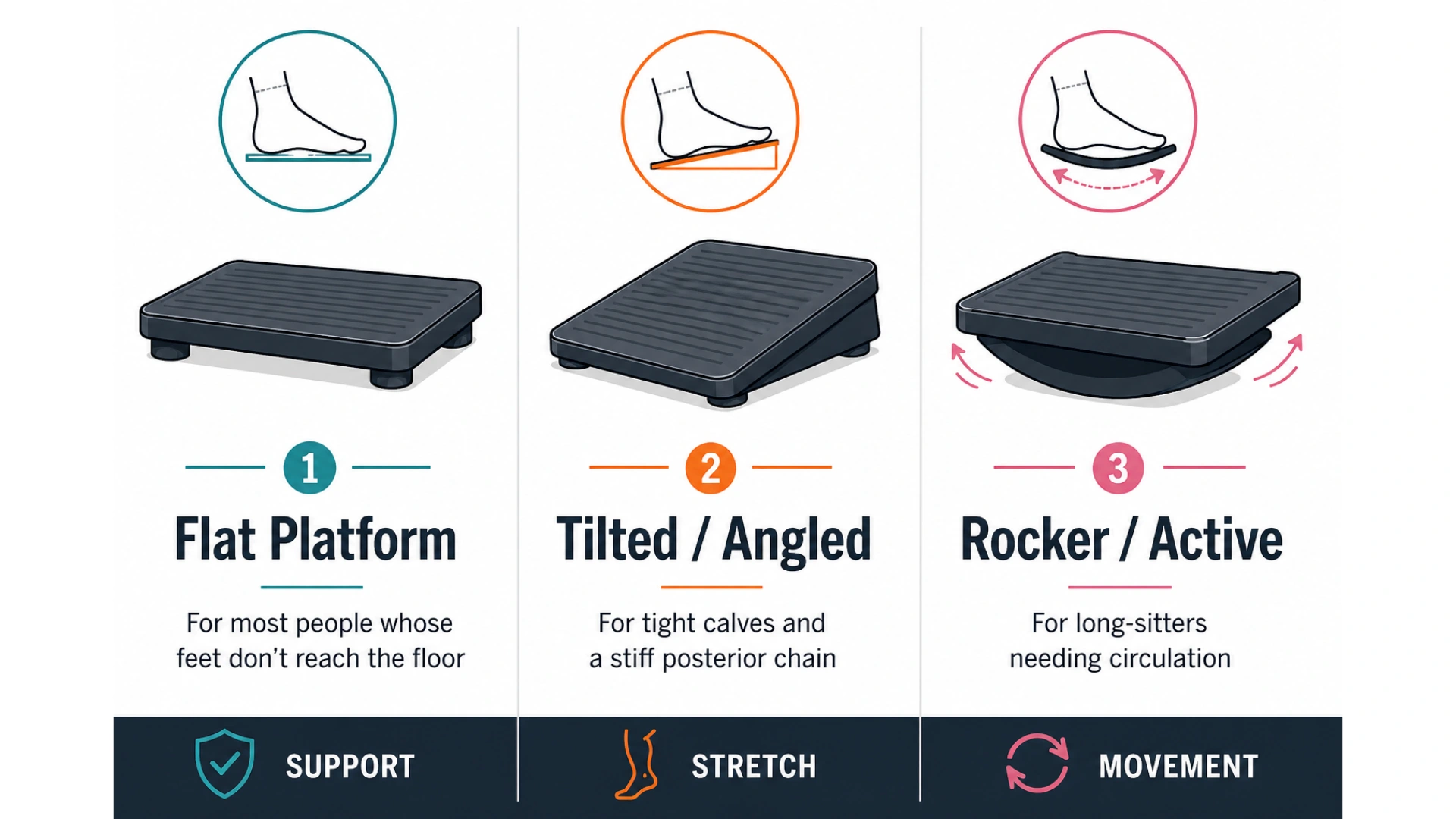
A flat platform sits like a low step under your desk. Your feet rest at the same angle they’d take on the floor. No tilt, no movement, just height adjustment.
This is the default choice for most readers. If your only problem is “my feet don’t reach the floor,” flat is what you want. Look for a height range of 8–15 cm and a surface at least 30 cm wide so both feet sit comfortably without crossing.
Tilted and angled footrests: for tight calves and posterior chain stretch
A tilted footrest sits at an angle, usually 10 to 30 degrees, so your toes are higher than your heels. That position lengthens the calf muscles and the posterior chain, the band of tissue running from your heels through your hamstrings to your lower back.
If you sit for long stretches and notice tight calves or stiff hamstrings when you stand, this type earns its place. Adjustable-tilt models let you change the angle through the day, which works better than a fixed wedge.
Rocker and active footrests: for long-sitters who need circulation
A rocker has a curved bottom. Your feet move forward and back as you press down, like a tiny pedal. The motion drives the calf-muscle pump, the system that moves blood out of your lower legs.
For users sitting six or more hours daily who notice ankle swelling or restless legs, this type does what flat and tilted can’t. The downside is concentration cost. Some people find the constant motion distracting during deep-focus work.
What’s the difference between a flat, tilted, and rocking footrest?
Here’s the comparison, side by side:
| Type | Movement | Best for | Watch out for |
|---|---|---|---|
| Flat platform | None | Anyone whose feet don’t reach the floor | Surface too narrow for both feet |
| Tilted/angled | Static angle | Tight calves, stiff posterior chain | Fixed angle that can’t change |
| Rocker/active | Continuous | Long-sitters, circulation issues, swollen ankles | Distraction during focused tasks |
A flat footrest supports. A tilted one stretches. A rocker keeps you moving. Choose your need first, the product second.
How to Choose the Right Footrest for Your Setup
The hard part isn’t picking a type. It’s knowing what features actually matter and which ones are sales fluff.
What height and tilt should a footrest under desk have?
The footrest height should equal the gap between your seat (when correctly set for desk height) and the floor under your feet. For most users, that’s 8–15 cm. Adjustable models cover this range with a few clicks. Fixed-height models lock you into one position, which is fine if you measured first.
Tilt range, where present, should adjust between 0 and 30 degrees. Anything beyond 30 degrees pushes your toes too high and shortens the gastrocnemius (the main calf muscle) into a cramp.
What features actually matter (and which are marketing fluff)?
Features that earn their price:
– Adjustable height (covers user variation)
– Non-slip grip surface (prevents foot slide on long days)
– Wide platform (at least 30 cm; both feet should fit without crossing)
– Sturdy base (won’t tip when you press one side)
Features marketed but rarely worth extra money:
– Massage rollers (novelty, not ergonomic)
– Heating elements (comfort, not posture)
– Branded cushioning unless paired with a flat or tilted base
Pair a good footrest with the must-have features in an ergonomic chair that adjusts to your body and you’ve fixed two-thirds of the typical seated-discomfort chain.
How does a footrest help with varicose veins and circulation?
A footrest improves lower-leg circulation in two ways. First, it stops the pressure point at the seat edge that compresses the popliteal vein. Second, when it’s a rocker, the motion engages the calf-muscle pump, which physically pushes venous blood back toward the heart.
For users prone to varicose veins or mild edema, a rocker offers the most circulatory benefit. According to CCOHS guidance on seated work and posture, regular leg movement during seated work is critical for preventing fluid pooling. A rocker turns that movement into a passive habit.
This isn’t medical treatment. If you have diagnosed venous insufficiency or persistent swelling, talk to a clinician.
Which Under-Desk Footrest Should You Buy? Picks by Use Case
Buy by use case, not by price. Match the footrest type to the need your four-question check surfaced: flat for everyday support, tilted for tight calves, rocker for circulation. Then hold whatever model you find to the spec profile below. Any footrest that meets the profile will do the job, at RM40 or RM400.
One thing to know first. Merryfair builds chairs, not footrests, and we don’t take affiliate commissions. So these picks are spec profiles, not sponsored models. \
That’s deliberate: brands change their catalogues every year, but the specs that make a footrest work haven’t moved in a decade.
| Your situation | Buy this | Spec profile to match | Typical price (MY, 2026) |
|---|---|---|---|
| Fixed-height desk, everyday support | Height-adjustable flat platform | 10–17 cm height range, platform at least 40 × 30 cm, textured surface | RM40–RM120 |
| Tight calves or hamstrings | Tilted platform | Tilt locks anywhere from 0–30°, non-slip ramp face | RM80–RM180 |
| Swollen ankles or 8-hour sitting days | Rocker (active) footrest | Free-pivot arc, wide rocking rails, textured deck | RM100–RM250 |
| Under 160 cm at a 74 cm+ desk | Tall-range flat platform | Reaches 17 cm or higher without wobble at full extension | RM90–RM200 |
| Sit-stand desk | A simple prop, not a platform | See the standing desk section of this guide | RM0–RM100 |
What specs should you check before buying a footrest?
Five checks separate a footrest that earns its place from desk clutter. Run them in order. A model that fails the first two isn’t worth the shipping fee.
- Width: 25 cm is the floor, 40 cm is comfortable. You reposition your feet dozens of times an hour, and a narrow platform punishes every shift.
- Height range: it must bracket your popliteal gap, the floor-to-knee-crease distance at your working seat height. Measure before you shop.
- Surface grip: rubber texture or moulded ridges. Smooth plastic lets socked feet slide off within minutes.
- Stability: the platform shouldn’t rock unless it’s designed to. Look for rubber feet and a listed weight above 1 kg.
- Lockable settings: tilt and height must hold under pressure. A platform that creeps flat under your heels is a returned platform.
Rollers, massage bumps, and heating elements? Marketing fluff. None of them fix the geometric mismatch a footrest exists to correct.
And if you skipped the four-question check, run it before spending anything. The best footrest at the wrong height is still the wrong fix.
Setting Up Your Footrest So It Actually Works
A footrest set up wrong is just clutter under your desk. The setup matters as much as the buy.
How high should a footrest be under your desk?
Your knees should sit at roughly 90 degrees with your feet flat on the rest. The simplest method:
- Sit at your desk with your chair set for proper elbow height (90-degree elbow bend at the keyboard).
- Note where your feet sit. If they dangle, measure the gap from heel to floor.
- That gap is your footrest height.
- Adjust the rest until your feet sit flat without your thighs lifting off the seat.
If your feet press too hard into the rest, lower it. If your knees rise above your hips, lower it more.
Common footrest mistakes that cancel out the benefit
Most people don’t get value from a footrest because they introduce one of three errors:
- Too high a setting. Pushes your knees above your hips, which tilts the pelvis backward and flattens the lumbar curve. Worse than no footrest.
- Too narrow a surface. Forces one foot to rest off the edge or at an angle. Creates ankle strain on one side.
- Slippery surface with no grip. Your feet slide forward through the day, slowly migrating you out of position.
A correct setup feels invisible. You forget it’s there.
Is an office chair with a footrest worth it compared to a separate one?
Built-in footrests on office chairs are usually an afterthought. They’re often fixed in position, made from cheap plastic, and lack the adjustability of a standalone unit. The exception is gaming and reclining chairs, where the footrest is part of the recline geometry rather than a posture aid.
For seated working posture, a separate footrest almost always outperforms the built-in version. Spend the same money on a quality standalone, not a chair-attached one.
For the broader picture, the full home office setup guide covering elbow, eye, and foot placements covers every adjustment in sequence.
Should you use a footrest with a standing desk?
Yes, but its job flips. Seated, a footrest raises the floor to fix your knee angle. Standing, it works as a prop: resting one foot on a 10–15 cm platform shifts your hips, unloads your lower back, and breaks up static standing. Bars figured this out a century ago with the brass foot rail.
CCOHS guidance on standing work recommends a footrest or rail for exactly this reason: shifting weight between legs reduces the strain of prolonged standing.
Alternate the propped foot every ten minutes or so. And when you sit back down, reset the platform to your popliteal height, or it stops doing its seated job.
A footrest doesn’t replace an anti-fatigue mat, either. The mat cushions both soles during static standing. The prop breaks symmetry. Long sit-stand days benefit from both.
What Are the Health Benefits of an Under-Desk Footrest?
A footrest looks like a comfort accessory. Set correctly, it changes six measurable things about a seated workday, from blood flow to pelvic position.
- Flat foot support at a fixed desk. An under-desk footrest restores flat foot contact when a fixed desk pushes your seat above popliteal height. Knees return to roughly 90 degrees. OSHA’s computer-workstation guidance gives feet exactly two acceptable states: fully supported by the floor, or resting on a footrest.
- Less pressure behind the thighs. Supported feet lift your weight off the seat edge. That eases compression of the popliteal fossa, the soft channel behind the knee where the leg’s main superficial vein runs.
- Better blood flow out of the lower legs. A rocker footrest keeps the calf-muscle pump firing while you sit. That pump, not the heart alone, moves venous blood up and out of the lower legs.
- Less end-of-day fatigue and swelling. In real use, the benefit shows up as absence. Calves that don’t feel heavy by mid-afternoon, ankles that haven’t puffed by 5pm.
- A level pelvis and a working lumbar curve. Feet resting flat keep the pelvis level instead of rolling backward. Merryfair’s chair-fitting experience points to unsupported feet as a common reason a well-adjusted backrest still fails its user.
- Movement without leaving the chair. Rocking, repositioning, and propping one foot at a standing desk all add low-grade movement to otherwise static hours.
Cornell University’s ergonomic guide folds this into one seated check: feet flat on the floor, or on a footrest.
A footrest corrects geometry, not pathology. For diagnosed circulation problems, no ergonomic chair, regardless of how expensive and premium it may be, will fix it for you.
What Most Footrest Guides Get Wrong
Footrest guides love to start with the product. They miss the bigger truth.
A footrest is a patch. It corrects a chair-desk mismatch you couldn’t fix any other way. It’s never the foundation.
If your feet dangle because your chair sits too high for your body, the chair is wrong. No accessory cures a poor foundation. The four-question check catches this: if your problem is the chair, the test gives you one or fewer yeses, and you walk away from the footrest aisle smarter.
Most people pick a footrest by price. The right way is by posture style.
If your check came back with two or more yeses and your chair already fits, find a footrest type matched to your need: flat for support, tilted for stretch, rocker for circulation. Set it to your popliteal gap. Use a grippy, wide platform. Forget the rollers and heating elements.
If the check pointed you toward your chair instead, the best ergonomic chairs across every budget tier is where to start. The accessory comes after the foundation, not before.
Frequently Asked Questions About Footrests for Office Chairs
Do you really need a footrest with your office chair?
Only if your chair is correctly adjusted but your feet still dangle because the desk above is fixed too high. If your chair adjusts low enough for your feet to rest flat, you don’t need one. Run the four-question check before buying anything.
Does a footrest help with circulation and swollen feet?
Yes, particularly rocker-style footrests. The constant micromovement engages the calf-muscle pump, which moves venous blood out of your lower legs. For users prone to ankle swelling or restless legs after long sitting, a rocker delivers more circulatory benefit than flat or tilted models.
What is a footrest for a chair called?
A footrest goes by several names: footrest, foot stool, ottoman, and ergonomic footrest. In ergonomic contexts, “footrest” usually means the under-desk support, while “ottoman” or “foot stool” refers to a separate seated-comfort piece. Rocker-style footrests are sometimes called foot rockers or active footrests.
Is a footstool good for sciatica?
A correctly sized footrest can reduce sciatic discomfort by relieving pressure at the back of your thighs and keeping your pelvis level. It’s not a cure. If your sciatica comes from disc compression or piriformis tightness, a footrest won’t address the root cause. Speak to a clinician for diagnosed sciatica.
How long should I use a footrest each day?
Use it whenever you’re seated at the desk with your feet that would otherwise dangle. There’s no upper limit if your setup is correct. The bigger habit is movement: stand and walk every 30 minutes regardless of footrest use, since no seated position, however well supported, replaces standing.
Can I use a stack of books or a box as a footrest?
Short term, yes. A stable, non-slip stack at the right height works as a temporary fix. Long term, books shift, boxes compress, and neither offers the grippy surface or angle adjustability of a real footrest. If you’re using one daily, buy a real one.
MORE BLOGS
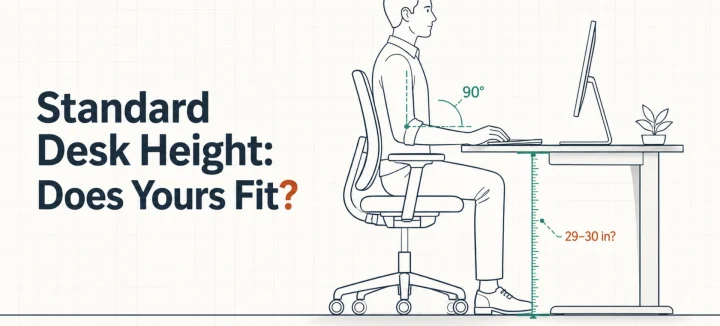
Standard Desk Height: Is 29 Inches Right for Your Body?
Standard desk height is 29 to 30 inches (73 to 76 cm). That number fits far fewer people than you’d think. A desktop that tall matches the seated elbow height of someone around 6’2″. The average American man stands 5’9″, and the average woman 5’3.5″. So this guide does two jobs. It shows you how […]
Read More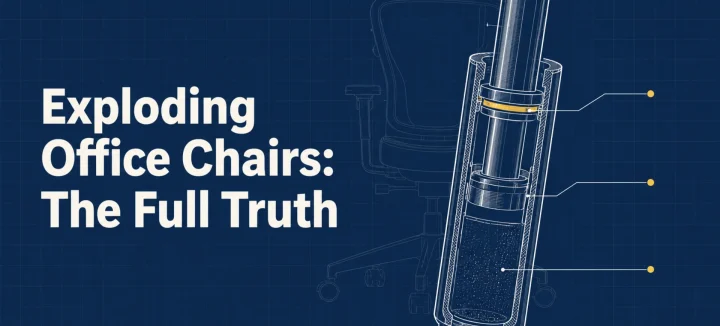
Exploding Office Chairs: The Full Truth From a Chair Maker
The exploding office chair story resurfaces every few years, same grainy photos attached. So can a chair really burst? A handful have, and every documented case involved an uncertified gas cylinder (the pressurized tube that raises and lowers your seat). Chairs built to recognized safety standards fail differently: seals leak, the seat sinks, nothing bursts. […]
Read More
How to Fix a Squeaky Office Chair by Sound and Location
A squeaky office chair makes four different noises, and each one points to a different part. To silence it for good, find the source first: the tilt mechanism, gas cylinder, casters, or armrests. Then tighten what’s loose and lubricate with the right product for that joint. This guide matches each sound to its fix, and […]
Read More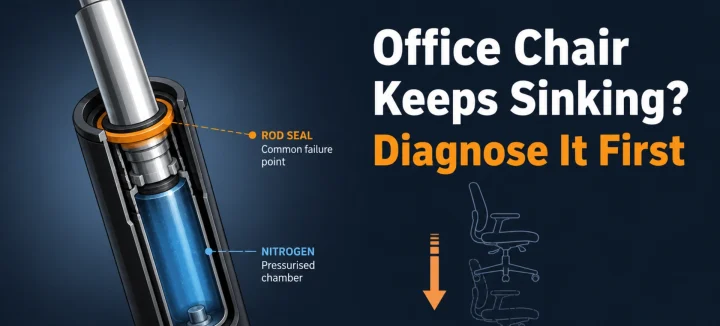
Office Chair Keeps Sinking? Diagnose and Fix It for Good
An office chair that keeps sinking or won’t stay up has one main cause: the gas cylinder under the seat is losing pressure. Worn seals let the nitrogen escape, so the piston stops holding your weight. A hose clamp or PVC pipe locks the height today; a new cylinder fixes it properly in 15 minutes. […]
Read More