How to Clean and Maintain Your Office Chair in Malaysia
9th April, 2026
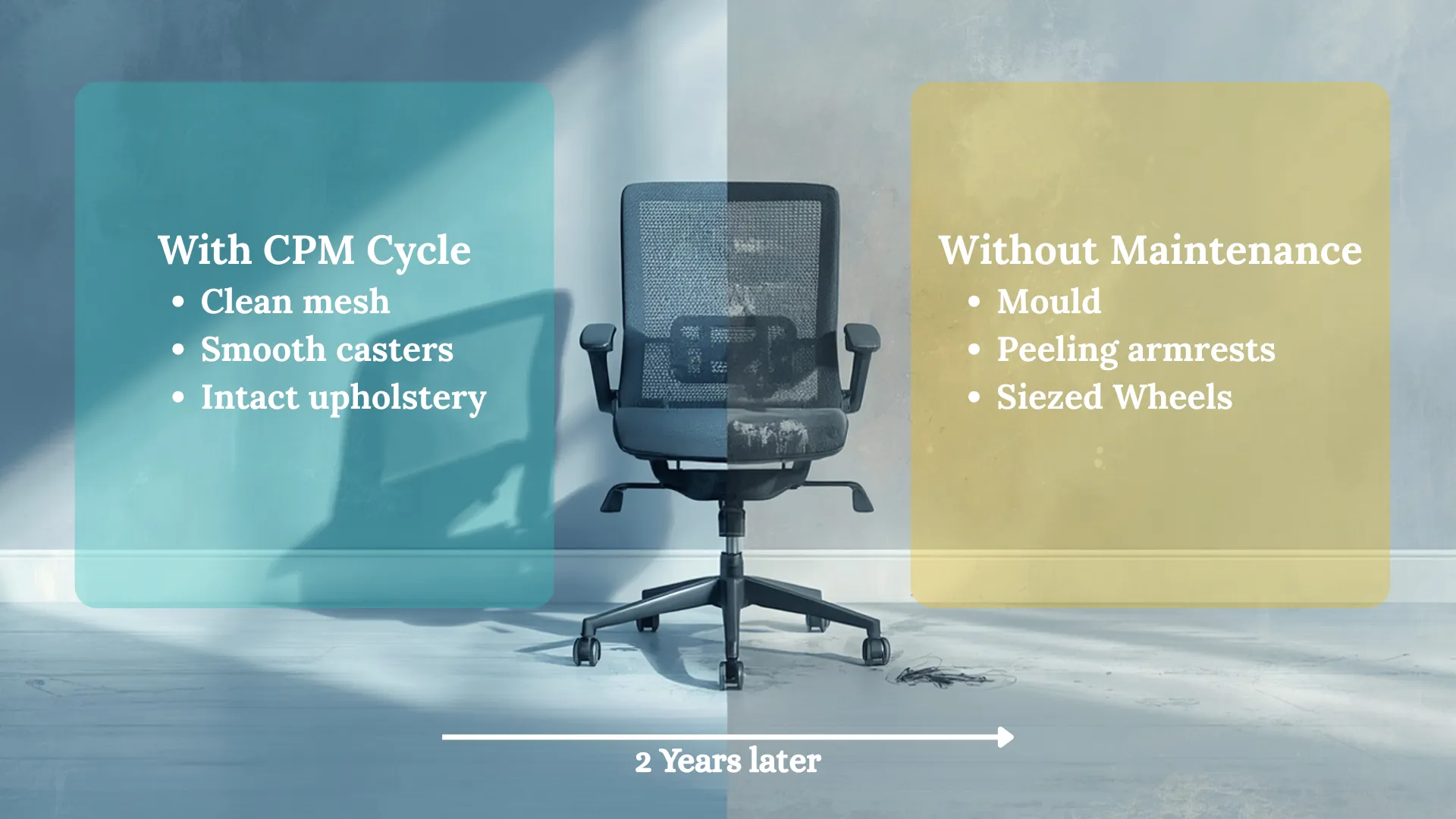
How to clean an office chair correctly can mean the difference between five years of comfort and two years of peeling armrests in Malaysia’s tropical humidity. The short answer: match your cleaning method to your chair’s material, use the right products for each surface, and follow a simple recurring maintenance routine that accounts for 80% average humidity.
Most online guides skip that last part. They’ll tell you how to scrub out a coffee stain but say nothing about the mould growing inside your caster housings six months later.
This guide covers cleaning methods for mesh, fabric, and leather chairs, then goes further with a preventive system designed for Malaysia’s climate. You’ll finish with a maintenance routine that takes 15 minutes a week and adds years to your chair’s life.
Key Takeaways
- Your chair’s cleaning code (W, S, W/S, or X) determines which products are safe to use and whether using the wrong one voids your warranty.
- Malaysia’s 74–86% year-round humidity accelerates mould growth, odour buildup, and material degradation in office chairs that aren’t regularly maintained.
- The Clean-Protect-Monitor (CPM) cycle turns one-off cleaning into an ongoing system that prevents damage before it becomes visible.
- Mesh chairs dry fastest and resist humidity best; leather needs conditioning every 6–12 months to avoid cracking in tropical air.
- A 15-minute weekly wipe-down routine is the single most effective habit for extending any office chair’s lifespan.
Why Malaysia’s Humidity Changes How You Should Clean Your Office Chair
A chair that lasts a decade in London might deteriorate in half that time in Kuala Lumpur. The reason isn’t quality. It’s physics.
According to the Malaysian Meteorological Department, Malaysia’s average relative humidity ranges from 74% to 86% throughout the year. KL alone averages 80% humidity across all twelve months. That constant moisture doesn’t just make surfaces feel sticky. It actively breaks down chair materials from the inside out.
Moisture weakens adhesive bonds in bonded leather, causing peeling. It feeds microbial colonies in fabric fibres. And it corrodes metal components in casters and gas lifts if left unchecked. Your air conditioning helps, but the moment you leave the office over a weekend or holiday, humidity rushes back in.
A chair that looks fine on Monday could be growing mould by Friday if it spent the weekend in a poorly ventilated room.
An office chair in Malaysia fights humidity every single day, whether you’re sitting in it or not.
Understanding how mesh, fabric, and leather respond to cleaning is your starting point, because the wrong cleaning product on the wrong material does more damage than no cleaning at all.
How to check your chair’s cleaning code before you start
Before you touch any cleaning product, flip your chair over. Look for a small tag on the underside of the seat. That tag contains a cleaning code that tells you exactly what your chair can handle.
Here’s what each code means:
- W — water-based cleaners are safe. This is the most common code.
- S — solvent-based cleaners only. Water will damage this fabric.
- W/S — either water-based or solvent-based products work.
- X — vacuum or brush only. No liquid cleaners of any kind.
Skip this step and you risk discolouration, fabric damage, or a voided warranty. Most textile manufacturers won’t honour claims on chairs cleaned with unapproved chemicals.
If your chair has no tag, check the owner’s manual or contact the manufacturer directly. Don’t guess.
How to Clean Every Type of Office Chair Material
Every material needs a different approach. Using a leather conditioner on mesh accomplishes nothing. Soaking a solvent-only fabric with water creates a stain worse than the one you’re trying to remove.
Here’s the method for each material type, step by step.
How do you clean a mesh office chair without damaging it?
Mesh is the easiest material to maintain in Malaysia’s climate because it dries fast and resists moisture retention. That breathability advantage works in your favour during cleaning too.
- Vacuum first. Use an upholstery brush attachment on low suction. Work across the seat, backrest, and any mesh armrest surfaces. Get into seams where dust collects.
- Wipe with mild soap and water. Mix a few drops of dish soap into warm water. Dampen (don’t soak) a microfiber cloth and wipe down all mesh surfaces. For stubborn spots, use a cotton swab dipped in the solution for precision cleaning.
- Rinse residue. Wipe again with a clean damp cloth to remove soap traces. Leftover detergent attracts dust faster.
- Air dry completely. Place the chair in a ventilated area or near a fan. Never use the chair while the mesh is still damp. Trapped moisture in Malaysia’s humidity creates mildew within 24 hours.
So here’s the thing most people miss: over-saturating mesh is the biggest mistake you can make. Too much water gets trapped in the weave and takes hours to dry. Use a damp cloth, not a wet one.
You can browse Merryfair’s full range of mesh and fabric material options to see how different mesh weave densities affect both breathability and cleaning ease.
How to clean fabric office chair upholstery
Fabric chairs need more care than mesh because the fibres absorb moisture, stains, and odour. Always check your cleaning code first (see above).
- Vacuum thoroughly. Fabric traps particles deeper than mesh does. Use a brush attachment and work slowly across every surface.
- Spot-clean stains. For W-coded chairs, mix mild dish soap with warm water. Apply with a cloth using a dabbing motion. Never scrub. Scrubbing drives stains deeper and damages fibre structure.
- For S-coded chairs, use a solvent-based upholstery cleaner applied to a cloth first, never directly on the chair.
- Deodorise. Sprinkle baking soda across the seat and backrest. Leave it for 30 minutes, then vacuum it off. Baking soda absorbs odours without chemicals.
- Dry thoroughly. Fabric takes longer to dry than mesh. In Malaysia’s humidity, point a fan directly at the chair and give it at least 3–4 hours before sitting.
A quick test before full cleaning: dab your cleaning solution on a hidden area (the underside of the seat works well). Wait 10 minutes. If there’s no discolouration, proceed.
What cleaning products are safe for leather office chairs?
Leather looks impressive but demands the most careful maintenance, especially in tropical conditions. Humidity above 55% can saturate leather with excess moisture, while dry air-conditioned offices can crack it. Malaysian offices swing between both extremes daily.
- Dust weekly. A dry microfiber cloth removes surface dust and prevents scratches from grit.
- Clean with appropriate solutions. For genuine leather, a 50/50 mix of white vinegar and water works well. For synthetic leather (PU/PVC), warm water with mild dish soap is sufficient.
- Never use alcohol-based cleaners. Rubbing alcohol, bleach, and harsh chemicals strip protective coatings and dry out leather.
- Condition every 6–12 months. Apply a leather conditioner with a soft cloth to prevent cracking. This step is non-negotiable in Malaysia’s climate. (Think of it as sunscreen for your chair.)
- Dry immediately. Wipe off excess moisture with a dry cloth after every cleaning session.
Leather conditioner in Malaysia isn’t a nice-to-have; it’s the barrier between your chair and the humidity trying to destroy it.
How do you clean office chair wheels that won’t roll?
Wheels are the most neglected part of any office chair. Hair, dust, threads, and carpet fibres wrap around the axle until the casters seize up. In humid offices, this debris also holds moisture against the metal components, accelerating corrosion.
- Flip the chair upside down on a stable surface.
- Remove the wheels. Most pop out with a firm pull. Some need a flathead screwdriver.
- Clear visible debris with tweezers or a butter knife.
- Wash the wheels in warm soapy water. Scrub the housing with an old toothbrush.
- Dry completely before reattaching. Any moisture left inside the housing invites rust.
- Apply a small drop of silicone lubricant to each axle for smooth rolling.
Do this every three months. Your chair will roll like it did on day one.
| Material | Cleaning Method | Supplies Needed | Drying Time (MY climate) |
|---|---|---|---|
| Mesh | Damp cloth + mild soap | Microfiber cloth, dish soap, vacuum | 1–2 hours |
| Fabric (W code) | Spot-clean + deodorise | Cloth, dish soap, baking soda, vacuum | 3–4 hours |
| Fabric (S code) | Solvent-based cleaner | Upholstery solvent, cloth, vacuum | 2–3 hours |
| Leather (genuine) | Vinegar solution + condition | Microfiber cloth, vinegar, leather conditioner | 30 minutes |
| Leather (synthetic) | Soap and water + wipe | Microfiber cloth, dish soap | 30 minutes |
| Wheels/casters | Disassemble + wash + lube | Tweezers, toothbrush, silicone lubricant | 1 hour |
How to Stop Chair Damage Before It Starts
Cleaning fixes problems that already exist. But the real gains come from preventing those problems in the first place. And in Malaysia, prevention means fighting humidity, UV exposure, and daily wear patterns simultaneously.
How often should you clean your office chair in a humid climate?
Most global guides recommend cleaning your chair “every few months.” That schedule doesn’t survive contact with Malaysian humidity.
Here’s a more realistic frequency for our climate:
| Task | Frequency | Time Needed |
|---|---|---|
| Wipe down with dry microfiber cloth | Daily (end of day) | 2 minutes |
| Vacuum upholstery and crevices | Weekly | 10 minutes |
| Spot-clean stains | As needed (immediately) | 5–10 minutes |
| Deep clean (full soap/solvent treatment) | Monthly | 30–45 minutes |
| Condition leather | Every 6 months | 15 minutes |
| Clean and lubricate casters | Quarterly | 20 minutes |
| Full inspection (see Monitor section below) | Quarterly | 15 minutes |
That daily wipe-down is the single highest-return habit on this list. Two minutes at the end of each workday prevents 80% of buildup problems.
How do you stop an office chair from smelling?
Odour in office chairs comes from two sources: bacterial growth in trapped moisture and absorbed body oils in the fabric. Malaysia’s humidity supercharges both.
Baking soda is your first defence. Sprinkle it on fabric seats, leave for 30 minutes, vacuum off. For persistent odours, a fabric freshener spray designed for upholstery (not air freshener, which just masks the smell) can help.
But the real fix? Don’t let moisture accumulate. A daily wipe-down and weekly vacuuming starve bacteria of the environment they need to produce odour. If your office lacks continuous air conditioning over weekends, consider placing silica gel packets near stored chairs to absorb ambient moisture.
Odour isn’t a cleaning problem. It’s a moisture problem wearing a disguise.
Three habits that protect your chair from Malaysia’s climate
- Eat and drink away from your chair. Spills are the number one cause of stubborn stains. A five-metre walk to a pantry table saves hours of cleaning.
- Keep your chair out of direct sunlight. UV exposure fades fabric and dries out leather. If your desk sits near a window, reposition or use blinds during peak sun hours.
- Respect the weight limit. Every ergonomic chair has one. Exceeding it stresses the gas lift, the base, and the upholstery simultaneously. Check your chair’s specifications and take them seriously.
When you’re choosing the right ergonomic chair for Malaysia’s climate, picking a material that naturally resists humidity cuts your maintenance effort in half before you even sit down.
The Clean-Protect-Monitor Cycle for Office Chair Care
Most guides stop after teaching you how to clean. That’s like teaching someone to brush their teeth but never mentioning flossing or dental checkups. Cleaning is one-third of the system.
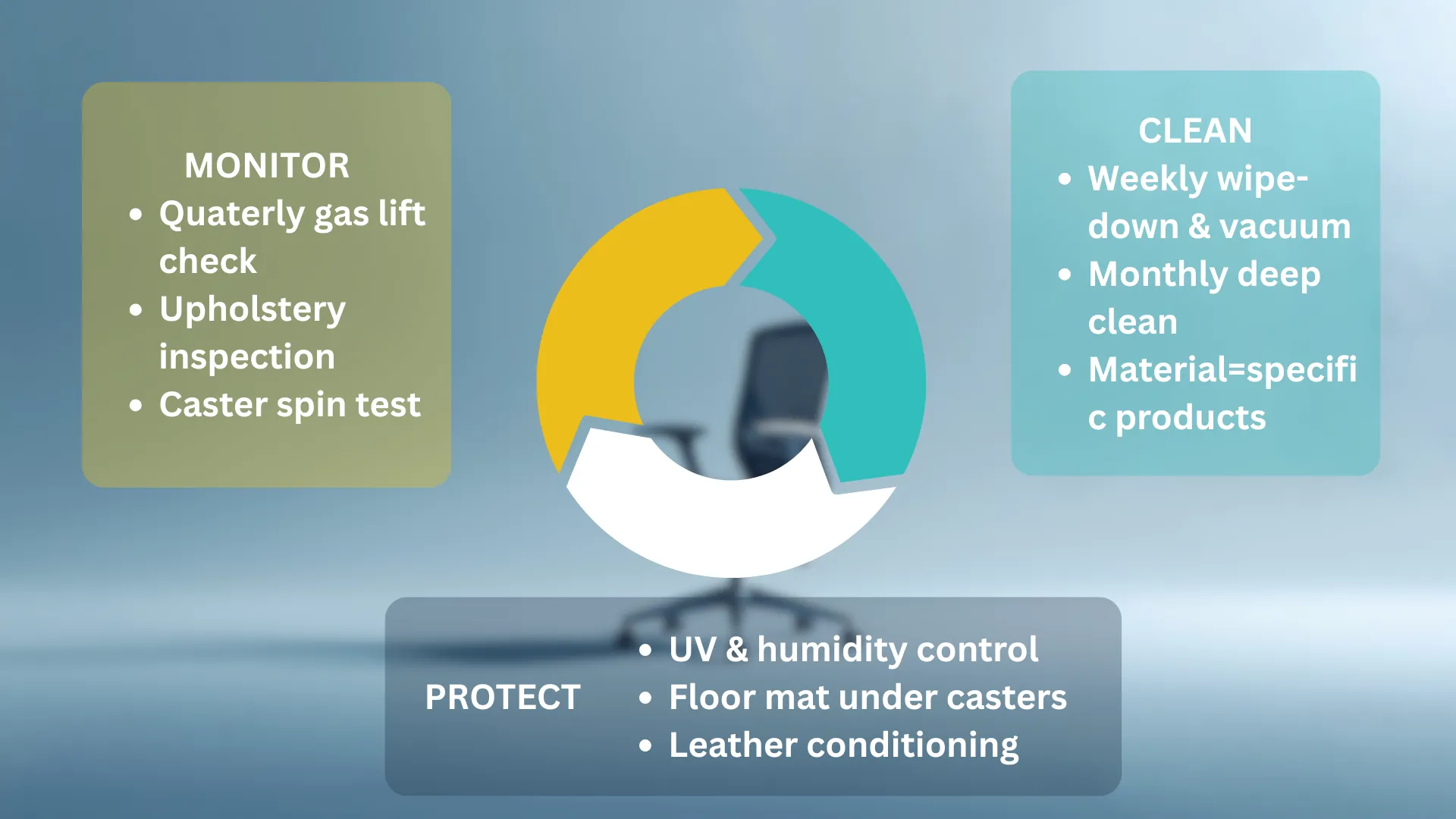
Merryfair’s Clean-Protect-Monitor (CPM) Cycle identifies three stages of ongoing chair care that work together to extend your chair’s functional lifespan well beyond its warranty period.
Cleaning removes damage that already happened. The CPM Cycle prevents it from happening again.
Clean: your weekly and quarterly routine
You already know the material-specific methods from the section above. The key is consistency, not intensity.
Weekly (15 minutes total): Dry-wipe all surfaces. Vacuum the seat and backrest. Check for new stains and spot-clean immediately.
Quarterly (45 minutes): Full deep clean of upholstery. Caster removal, cleaning, and lubrication. Wipe down all hard surfaces (armrests, base, frame) with a damp cloth and mild cleaner.
Protect: shielding your chair from humidity, UV, and daily wear
Protection is the step everyone skips. These are passive measures that run in the background:
- Position your chair away from windows and direct sunlight when not in use.
- Use a floor mat under your casters. Mats prevent debris from embedding in wheels and protect both your flooring and your chair’s base.
- Condition leather surfaces on the schedule above. This is protection, not cleaning. The conditioner creates a moisture barrier.
- If your office air conditioning shuts off overnight or on weekends, ensure ventilation stays adequate. Stagnant humid air is the silent killer of office furniture.
- Assemble your chair correctly from day one. A misaligned gas lift or improperly seated backrest creates stress points that weaken components faster.
Monitor: the quarterly inspection that catches problems early
Every quarter, spend 15 minutes checking your chair for early warning signs. Catch these early and you fix them cheaply. Miss them and you’re shopping for a replacement.
Quarterly check:
- Gas lift: does the chair hold its height when you sit down? Any sinking means the gas lift is starting to fail.
- Tilt mechanism: does it lock and unlock smoothly? Grinding or resistance means debris or wear.
- Armrests: are they wobbly or cracked? Loose bolts are a five-minute fix if caught early.
- Upholstery: any pilling, peeling, cracking, or persistent stains that won’t come out?
- Casters: do all five wheels spin freely?
- Base: any visible cracks in the star base? (This is a safety issue. Replace immediately if cracked.)
If your quarterly check reveals problems that cleaning and tightening can’t solve, it may be time to evaluate whether your chair has reached its end of life. Here’s how to recognise signs your chair is beyond what cleaning can fix.
A 15-minute quarterly inspection costs you one lunch break. Ignoring it costs you a chair.
Your Chair Is an Investment Worth Protecting
A well-maintained ergonomic chair should last seven to ten years in a Malaysian office. A neglected one might give you three before the gas lift fails, the leather peels, or the mesh loses its tension.
The CPM Cycle isn’t complicated. It’s a daily wipe, a weekly vacuum, a quarterly inspection. The hardest part is starting. Once the habit sticks, it runs on autopilot.
And if you’re reading this because your current chair is already past saving, that’s useful information too. It means your next chair deserves better care from day one. Start by understanding what to look for in a replacement ergonomic chair that’s built for Malaysia’s conditions, then apply the CPM Cycle from the moment you unbox it.
The cheapest ergonomic chair is the one you already own and maintain properly.
Your chair works for you eight hours a day. Fifteen minutes of care a week is a fair trade.
FAQ
Can you use Clorox wipes on office chairs?
Avoid using Clorox or bleach-based wipes on office chair upholstery. These products contain harsh chemicals that can discolour fabric, dry out leather, and degrade mesh fibres over time. They may also void your chair’s textile warranty. For disinfecting, use a mild antibacterial soap solution instead, and always rinse the surface afterward with a clean damp cloth.
How do you remove coffee stains from an office chair?
Act immediately. Blot (never rub) the spill with a dry cloth to absorb as much liquid as possible. Then mix a few drops of mild dish soap with cold water, dab the stain gently, and blot dry. For stubborn marks, a small amount of white vinegar can help break down the stain. Always test on a hidden area first and let the chair dry completely before sitting.
Does sitting on a dirty office chair affect your health?
Yes. Dust, allergens, and bacteria accumulate in office chair upholstery over time. In humid environments like Malaysia, this buildup accelerates and can trigger allergies, skin irritation, and respiratory discomfort. Regular vacuuming and cleaning reduce allergen concentration significantly. Think of chair hygiene as part of your overall workspace health, not just aesthetics.
How long should an ergonomic office chair last with proper care?
A quality ergonomic chair with regular maintenance should last seven to ten years in normal office use. Some premium chairs carry warranties of ten years or more. The biggest factors affecting lifespan are cleaning consistency, humidity management, weight limit compliance, and whether you follow the manufacturer’s care instructions. Neglect can halve that lifespan.
MORE BLOGS
How to Adjust Your Office Chair for All-Day Comfort
Most people who own an adjustable office chair never actually adjust it. A field study published in Applied Ergonomics found that the majority of office workers used two or fewer of their chair’s available adjustment functions, despite having access to five or more. Here’s how to adjust your office chair properly: start with seat height, […]
Read More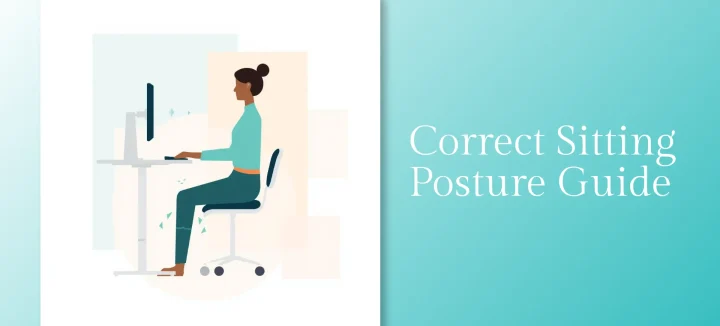
Correct Sitting Posture: Step-by-Step Office Chair Guide
Correct sitting posture breaks down within 20 minutes for most people. That’s the finding from Cornell University’s ergonomics research. Your body starts slouching before you notice it. And by mid-afternoon, most desk workers are sitting in a shape their spine was never designed to hold. So what does correct posture look like? It starts at […]
Read More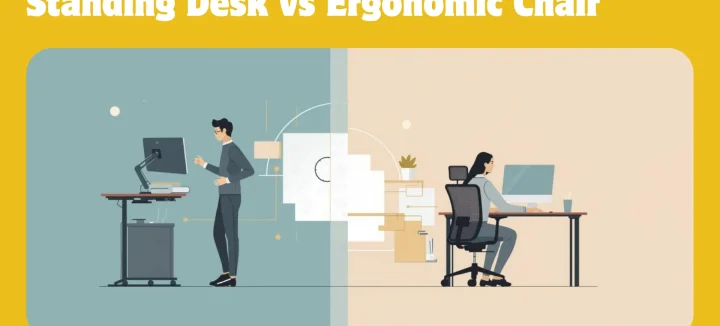
Standing Desk vs Ergonomic Chair: How to Pick the Right One
Standing desk vs ergonomic chair is the wrong question. Here’s why. Even standing desk owners still sit for 75 to 80 percent of their workday. That data comes from ProtoArc’s workplace wellness research. Your body doesn’t need you to pick sides. It needs support when you sit and movement when you’ve sat too long. This […]
Read More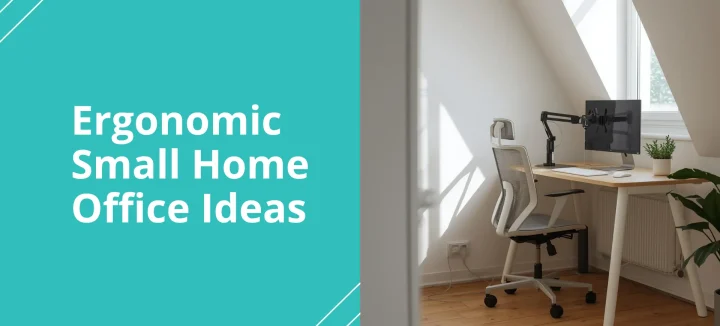
Small Home Office Ideas That Protect Your Back and Save Space
Small home office ideas don’t need to start with Pinterest boards and paint swatches. They need to start with your spine. A PMC study found that 61.2% of home workers reported musculoskeletal discomfort while working remotely, and over half were working from dining tables or bedrooms. The fix isn’t a bigger room. It’s a smarter […]
Read More