Best Study Chairs: A Parent’s Guide to Ergonomic Student Seating
19th March, 2026
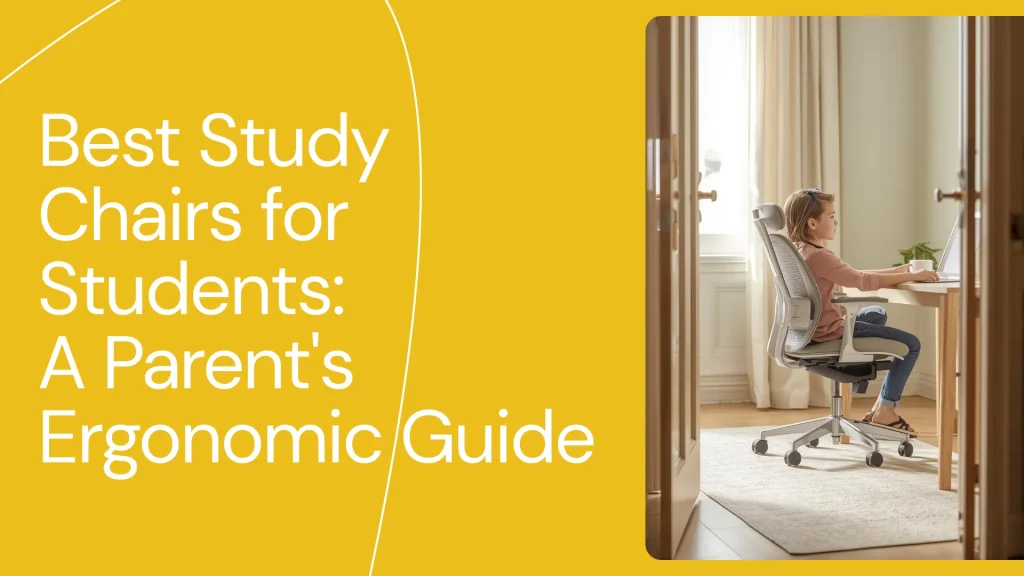
A study chair that fits your child’s body can prevent years of posture damage most parents never see coming. Over 83% of school children sit in chair-desk combinations that don’t match their body height, according to research compiled by Smith System.
The best kind of study chair, such as Rookee, has the adjustable height, proper lumbar support, and correct seat depth, protecting your child’s developing spine and sharpens their ability to concentrate during homework and study sessions.
This guide covers what actually makes a study chair ergonomic, how to size one for any age group, and the features worth paying for.
Why Your Child’s Study Chair Is a Health Decision, Not a Furniture One
Most parents pick a study chair based on price or looks. That’s like choosing shoes by colour alone. The chair your child sits in for 4 to 8 hours a day is actively shaping their skeletal development.
And growing bodies are especially vulnerable.
How does poor seating affect a child’s spine during growth?
A child’s spine is still forming cartilage into bone throughout their school years.
Prolonged sitting in a poorly fitted chair forces the lumbar region into unnatural flexion, placing chronic strain on developing discs and muscles. According to a 2024 systematic review published in Heliyon, prolonged use of non-anthropometric furniture directly impacts spinal posture and physical development during the growth period.
Children spend roughly 80% of classroom time sitting, per ergonomics research. Add homework, screen time, and reading at home, and you’re looking at a child who sits 6 to 10 hours daily. That’s more sedentary time than most office workers.
The chair isn’t optional equipment. It’s load-bearing infrastructure for a body still under construction.
Your child’s posture habits aren’t forming in their twenties. They’re forming now.
What happens when kids sit in chairs that don’t fit?
When a seat is too high, a child’s feet dangle. Blood circulation behind the knees decreases. They fidget. When a seat is too deep, their back loses contact with the backrest and they slouch forward.
Research by Saarni et al. found that schoolchildren sat with their backs flexed more than 20 degrees for 56% of lesson time when furniture didn’t fit. That kind of sustained flexion compresses spinal discs and trains muscles into patterns the child carries into adulthood.
What you’ll actually notice at home: your child leaning forward over their desk, sitting cross-legged on the chair, or constantly shifting positions. Those aren’t signs of restlessness. They’re signs the chair doesn’t fit, and how ergonomic chair features protect your back during long hours explains why each adjustment point matters.
The Surprising Link Between Seating Comfort and Study Performance
Here’s where it gets practical. A child fighting their chair can’t fight through a maths problem.
A child fighting their chair can’t focus on their homework.
Does an ergonomic chair actually help students focus better?
Physical discomfort is a concentration thief. A 2023 cross-sectional study published in Cureus found that 94% of medical students reported low back pain, with prolonged sitting identified as the most common aggravating factor. Students who sat for more than 8 hours were 5.6 times more likely to report pain. And 43% said that pain directly affected their academic grades.
These were adults. Children, whose pain tolerance and self-awareness are lower, feel the effects sooner but complain less specifically. They just stop concentrating.
Ergonomic seating doesn’t magically boost grades. But it removes a physical barrier that competes with mental focus. When a child’s body is supported, their mind can work without distraction. That’s not a sales pitch. It’s biomechanics.
You can find the right ergonomic chair across every price range without spending a fortune.
How long can a student sit comfortably in the wrong chair?
Most children can manage about 20 to 30 minutes in a poorly fitted chair before they start shifting, slouching, or standing up. That’s barely enough time to finish one homework assignment.
In the right chair? Study sessions of 45 to 60 minutes become achievable without discomfort (still with regular movement breaks, which are always recommended).
The difference isn’t willpower. It’s engineering.
Later in this guide, you’ll learn a 3-step method to check whether your child’s current chair actually fits them.
Five Features That Separate a Real Study Chair from a Decoration
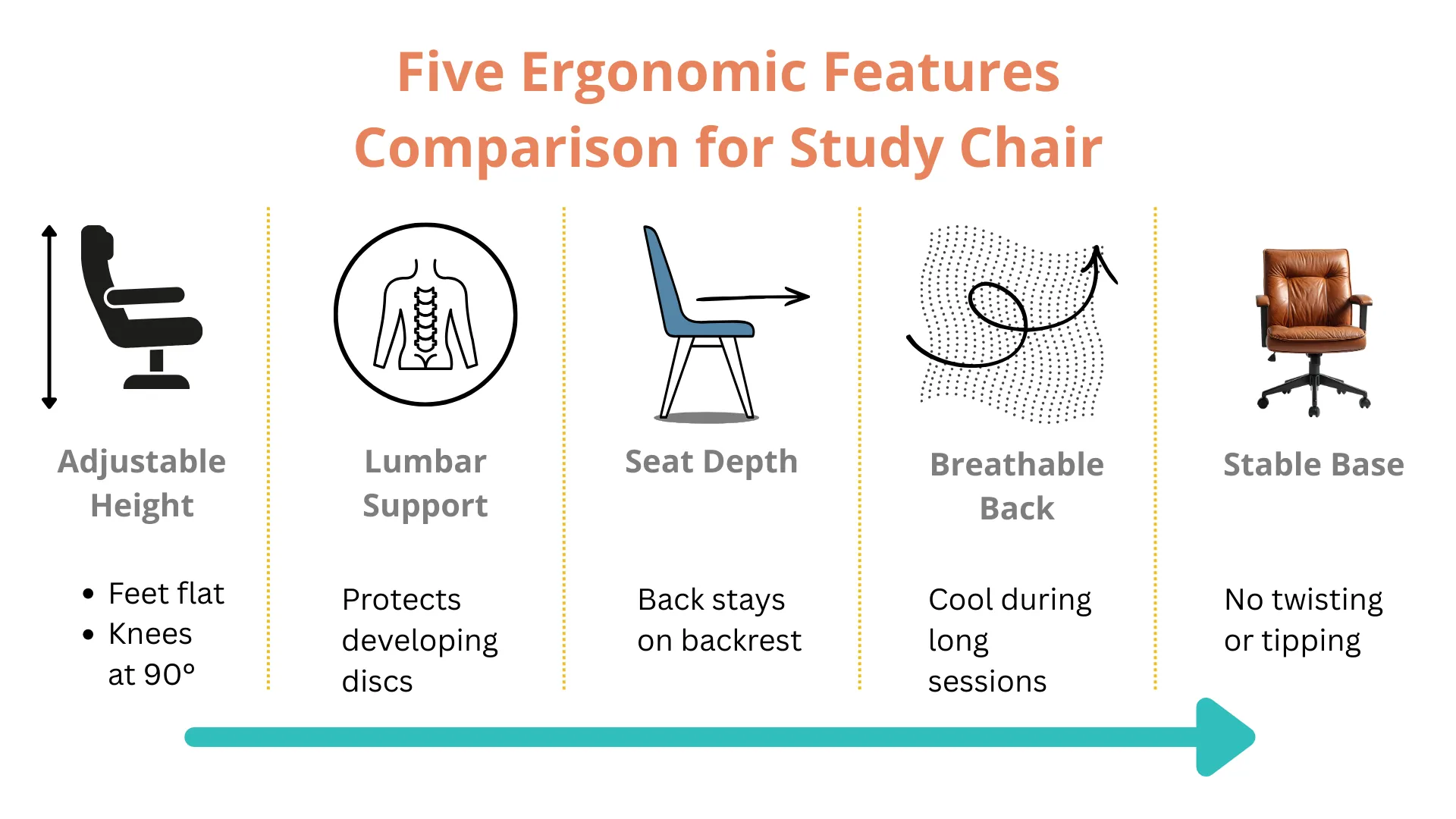
Not every chair labelled “ergonomic” earns the title. These five features are what separate a study chair that protects your child from one that just fills a room.
What is the most important feature in a student’s study chair?
Adjustable seat height is the single most critical feature in any study chair for students. If the height is wrong, everything downstream fails. Feet should rest flat on the floor (or a footrest) with knees bent at roughly 90 degrees. A gas-lift mechanism provides smooth height changes and accommodates growth spurts without replacing the chair.
Here’s what each feature does and why it matters for students specifically:
| Feature | What It Does | Why Students Need It |
|---|---|---|
| Adjustable seat height | Sets feet flat on floor, knees at 90 degrees | Prevents circulation problems, reduces fidgeting |
| Lumbar support | Maintains the natural curve of the lower back | Protects developing spinal discs from chronic flexion |
| Adjustable seat depth | Keeps back in contact with backrest | Stops slouching while allowing proper leg positioning |
| Breathable backrest (mesh) | Allows airflow through the material | Prevents heat buildup during long study sessions |
| Stable base with casters | Distributes weight, allows easy repositioning | Reduces twisting and reaching that strains the back |
Notice what’s missing from this list: flashy colours, cup holders, LED lighting. Those sell chairs. They don’t support spines.
The best study chair is the one that adjusts to fit your child today and still fits them two years from now.
Are gaming chairs good for studying?
Gaming chairs prioritise a reclined, leaned-back position designed for holding a controller. Studying requires a more upright posture, typically 95 to 105 degrees of backrest angle, with arms positioned for writing or typing.
Some gaming chairs offer decent lumbar pillows and height adjustment. But most use a bucket seat design borrowed from racing, which restricts hip movement and doesn’t accommodate the wide range of body sizes children cycle through.
For younger children especially, gaming chairs are typically oversized. A chair built for a 180cm adult gamer won’t support a 130cm ten-year-old correctly, regardless of how many adjustment knobs it has.
If your child already owns a gaming chair, check the 3-Point Growth Fit Test below. It works for any chair type.
Does my child need armrests on their study chair?
Armrests reduce shoulder and neck tension during writing and typing by supporting forearm weight. But only if they’re set at the right height.
Armrests that are too high push shoulders upward. Too low, and they’re useless. Adjustable armrests solve this, but for younger children (under age 10), armrests sometimes get in the way of pulling the chair close to the desk. Choosing the right office chair material for breathability and comfort matters as much as the frame design, since kids spend years in contact with these surfaces.
For primary school children: optional armrests that slide under the desk or adjust out of the way are ideal. For secondary school and older: height-adjustable armrests become increasingly valuable.
How to Size a Study Chair for Any Age (The 3-Point Growth Fit Test)
Forget the age labels on the box. A “kids’ chair” that doesn’t fit your kid is just a small chair.
The 3-Point Growth Fit Test, developed here, gives parents a quick way to check chair fit at any stage. Run it every 6 months as your child grows.
Merryfair’s approach to chair sizing identifies three body contact points that determine whether a chair actually supports the person sitting in it.
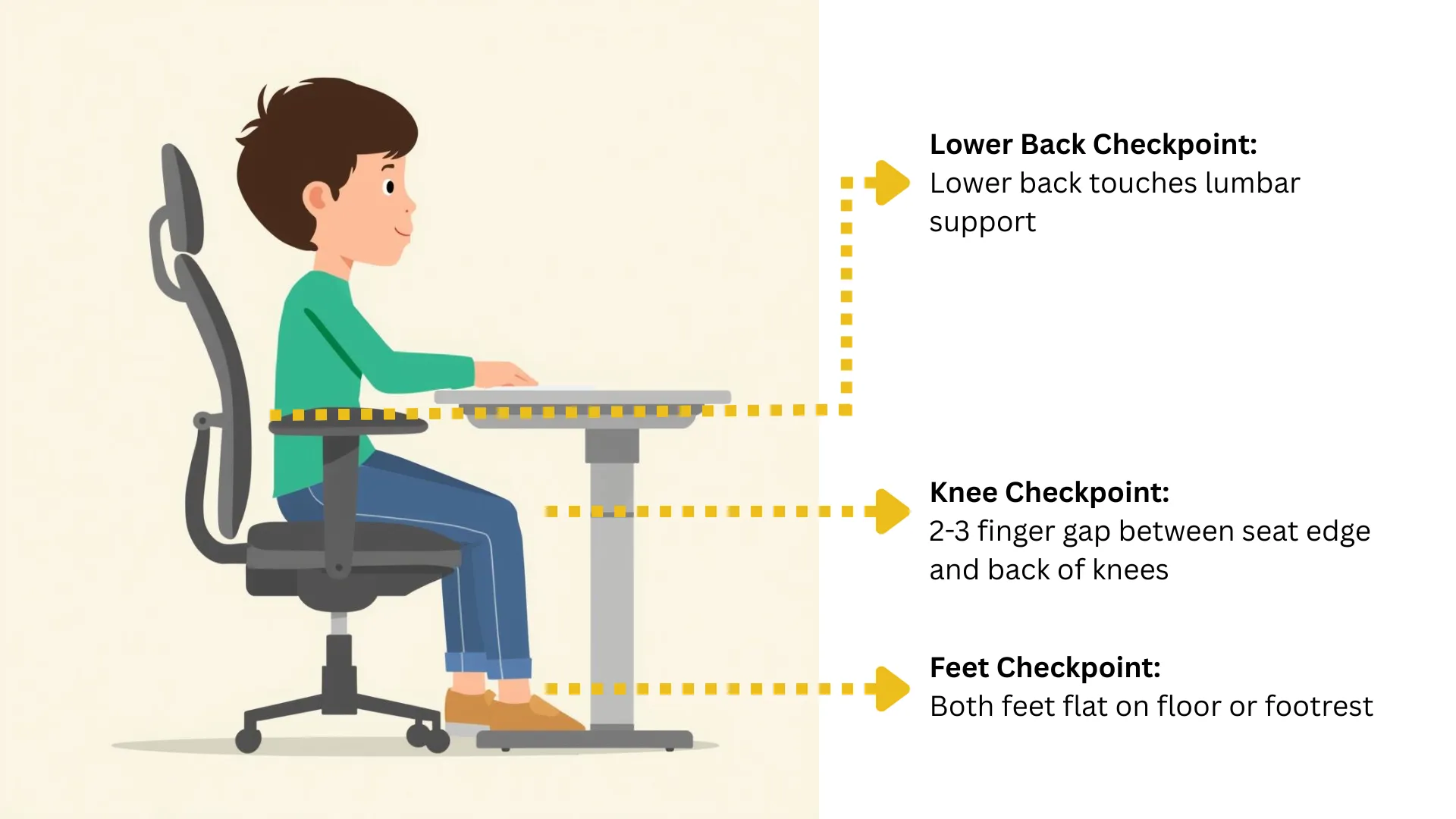
- Feet checkpoint. Both feet should rest flat on the floor or on a footrest. If they dangle, the seat is too high. Dangling feet cause pressure behind the knees and trigger fidgeting.
- Knee checkpoint. There should be a 2 to 3 finger gap between the front edge of the seat and the back of the knees. If the seat edge presses into the back of the knees, the seat is too deep. If there’s a fist-sized gap, the seat is too shallow.
- Lower back checkpoint. The child’s lower back should touch the lumbar support area of the backrest. If there’s a gap between their lower back and the chair, the backrest isn’t reaching them. They’ll compensate by slouching forward.
What is the right chair height for a student desk?
Standard desk heights range from 55cm for young children to 75cm for adults. The chair seat should position the child’s elbows at roughly the same height as the desk surface when their arms hang relaxed.
A common mistake: setting the desk right but ignoring the chair. Or buying a height-adjustable desk but pairing it with a fixed-height chair. Both need to work together.
Do kids need a different chair than adults?
Yes. And not just a smaller one. Children’s proportions differ from adults.
- Their torso-to-leg ratio is different
- The centre of gravity sits higher
- Weight distribution changes rapidly across growth phases.
A properly designed children’s study chair accounts for these proportions.
Merryfair’s Rookee ergonomic study chair for ages 4 to 14, for instance, adjusts backrest height and seat depth simultaneously across 7 positions. As the back moves higher, the seat extends deeper, tracking the proportional changes a growing body goes through.
That’s the difference between a chair that’s kid-sized and one that’s kid-designed.
A small chair isn’t an ergonomic chair. A chair designed for how children’s bodies actually grow is.
One Chair That Grows with Your Child (and Your Budget)
Here’s what most parents don’t consider: children outgrow fixed chairs roughly every 2 to 3 years. That’s 3 to 5 chair replacements across a school career. The cost adds up. So does the waste.
Adjustable study chairs with wide height ranges, sliding seat depth, and repositionable footrests can serve a child from age 4 through age 14 or beyond. One chair. One purchase.
What should parents look for in a chair that lasts multiple years?
Three things: range of adjustability, build quality, and replaceability of soft parts.
Range of adjustability means height, seat depth, and backrest position all move enough to cover multiple growth stages. Build quality means the mechanism survives years of daily use by a child (look for BIFMA or equivalent testing certification). Replaceability means seat covers and pads can be swapped when they wear out or get stained, without replacing the entire chair.
One adjustable study chair costs less than three fixed ones over a child’s school years.
You can explore affordable ergonomic chairs that fit a student’s budget and explore the full Merryfair Lifestyle Collection for home to find chairs designed for exactly this kind of long-term use.
The best investment you’ll make for your child’s study space isn’t the desk, the lamp, or the tablet. It’s the chair they sit in for 10,000 hours before they leave home.
Safety certifications matter, too. Look for BIFMA testing (strength and durability standards), GREENGUARD Gold (low chemical emissions, important for a child’s room), and EN 1729 compliance for educational furniture sizing. These aren’t marketing badges. They’re independent proof that the chair was tested to perform safely.
Set It Right from Day One
The study chair your child sits in today is shaping the spine they’ll carry for decades. That sounds dramatic because it is. Posture patterns established during school years don’t reset at graduation.
You now know what to look for: adjustable height, lumbar support, correct seat depth, and a design that tracks your child’s growth. You know how to test the fit with three checkpoints. And you know that the real cost of a “cheap” chair is measured in replacement cycles and physiotherapy visits, not price tags.
So run the 3-Point Growth Fit Test on whatever chair your child is using right now. If it fails even one checkpoint, it’s time to upgrade. Visit a Merryfair showroom to test the fit in person, or start online at merryfair.com.
Your child’s back won’t tell you it’s hurting until the damage is already forming. The chair is your first line of defence.
Common Questions Parents Ask About Study Chairs
What kind of chair is best for studying?
The best study chair for students offers adjustable seat height, lumbar support, and correct seat depth for the user’s body size. For children, chairs designed with growth adjustability (rather than fixed dimensions) outperform standard task chairs. Mesh backrests add breathability during long sessions. Prioritise fit over appearance.
How does sitting posture affect academic performance?
Poor sitting posture causes discomfort that competes with concentration. Research shows that students experiencing back pain report shorter study sessions and lower academic satisfaction. When the body is properly supported, mental focus improves because physical distraction is removed. Good posture also supports better breathing and circulation to the brain.
What should I look for in a study chair for my child?
Look for five features: adjustable seat height (gas-lift), lumbar support that contacts the lower back, adjustable seat depth, a breathable backrest material, and a stable base with smooth casters. For children under 10, a footrest is also essential to prevent dangling feet and maintain proper knee angle.
How do I set up my child’s study chair correctly?
Use the 3-Point Growth Fit Test. First, set seat height so feet rest flat on the floor or footrest. Second, check that 2 to 3 fingers fit between the seat edge and the back of the knees. Third, confirm the lower back touches the lumbar support area. Recheck every 6 months as your child grows.
Can one study chair work for different-aged siblings?
Yes, if the chair has sufficient adjustment range. Chairs with multiple backrest positions, sliding seat depth, and wide height adjustment can accommodate children from approximately 110cm to 160cm in height. A repositionable footrest helps younger siblings while folding away for older ones.
MORE BLOGS
How to Adjust Your Office Chair for All-Day Comfort
Most people who own an adjustable office chair never actually adjust it. A field study published in Applied Ergonomics found that the majority of office workers used two or fewer of their chair’s available adjustment functions, despite having access to five or more. Here’s how to adjust your office chair properly: start with seat height, […]
Read More
Correct Sitting Posture: Step-by-Step Office Chair Guide
Correct sitting posture breaks down within 20 minutes for most people. That’s the finding from Cornell University’s ergonomics research. Your body starts slouching before you notice it. And by mid-afternoon, most desk workers are sitting in a shape their spine was never designed to hold. So what does correct posture look like? It starts at […]
Read More
Standing Desk vs Ergonomic Chair: How to Pick the Right One
Standing desk vs ergonomic chair is the wrong question. Here’s why. Even standing desk owners still sit for 75 to 80 percent of their workday. That data comes from ProtoArc’s workplace wellness research. Your body doesn’t need you to pick sides. It needs support when you sit and movement when you’ve sat too long. This […]
Read More
Small Home Office Ideas That Protect Your Back and Save Space
Small home office ideas don’t need to start with Pinterest boards and paint swatches. They need to start with your spine. A PMC study found that 61.2% of home workers reported musculoskeletal discomfort while working remotely, and over half were working from dining tables or bedrooms. The fix isn’t a bigger room. It’s a smarter […]
Read More