
Mesh vs Fabric vs Leather: Best Office Chair Material for Malaysia
9th March, 2026
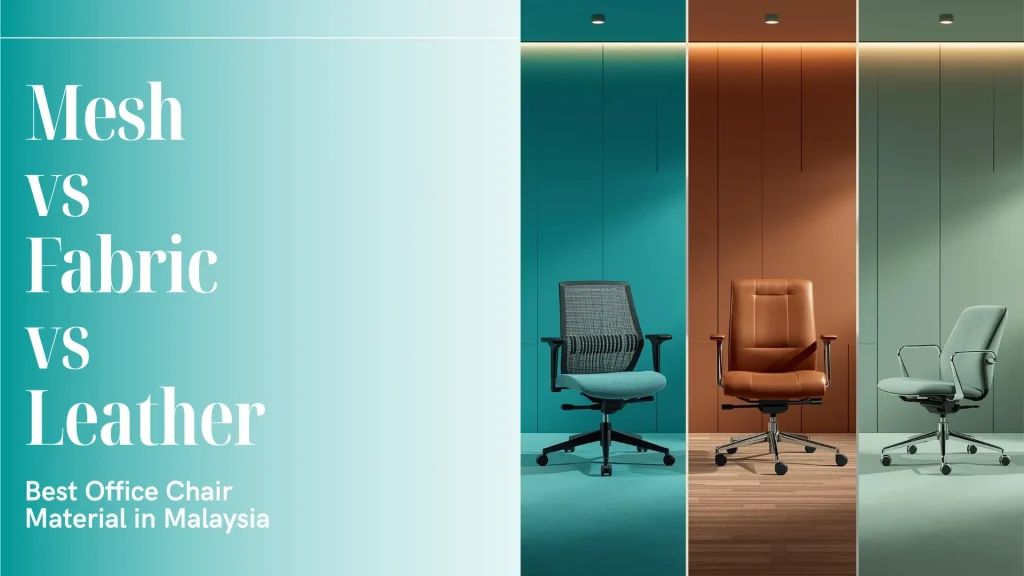
Mesh vs Fabric vs Leather: Best Office Chair Material for Malaysia
Office chair material is the single biggest factor separating a comfortable 8-hour workday from a sticky, frustrating one in Malaysia.
Mesh performs best for most Malaysian workplaces because its open-weave design allows constant airflow in 80% average humidity. But leather and fabric each have their place depending on your workspace, budget, and how you use your chair.
This guide compares all three materials against Malaysia’s specific climate conditions. You’ll walk away knowing exactly which one fits your office.
The same chair material that earns top reviews in Stockholm can fail within two years in Kuala Lumpur.
Why Malaysia’s Climate Rewrites the Office Chair Material Rulebook
Most office chair reviews online come from countries where humidity sits below 50%. Malaysia’s equatorial climate operates on different physics entirely.
According to the Malaysian Meteorological Department, the country’s average relative humidity ranges from 74% to 86% year-round, with temperatures rarely dropping below 27°C in lowland areas. Kuala Lumpur alone averages 80% humidity across all twelve months. That’s not a seasonal issue. It’s a permanent condition.
If you’re choosing the best ergonomic chair in Malaysia, material should be your first filter, not your last.
What does 80% humidity actually do to your office chair?
High humidity accelerates material degradation in three specific ways. Moisture weakens adhesive bonds in bonded leather, causing peeling. It promotes microbial growth in fabric fibers that trap dampness. And it increases skin-to-surface friction, making non-breathable materials uncomfortable within the first hour of sitting.
Breathability isn’t a luxury feature in Malaysia; it’s a baseline requirement for productive seating.
Most Malaysian offices run air conditioning between 23°C and 26°C. That sounds comfortable on paper. But bodies still generate heat, and the moment you step away from direct airflow, humidity takes over.
How does each material handle Malaysia’s equatorial heat?
Here’s what actually happens when each material meets Malaysia’s climate:
| Factor | Mesh | Leather | Fabric |
|---|---|---|---|
| Breathability | Excellent. Air passes through the open weave continuously. | Poor. Traps body heat against the surface. | Moderate. Some airflow, but absorbs moisture. |
| Heat retention | Minimal. No heat soak effect. | High. Creates a sticky, warm contact layer. | Moderate to high. Retains warmth and dampness. |
| Moisture behaviour | Wicks moisture; dries quickly. | Repels surface moisture but traps heat-related sweat. | Absorbs moisture; slow to dry. Risk of odour and microbial growth. |
| Maintenance in humidity | Wipe-down with damp cloth. Low effort. | Requires conditioning every 6-12 months to prevent cracking. | Needs regular vacuuming and occasional deep cleaning. |
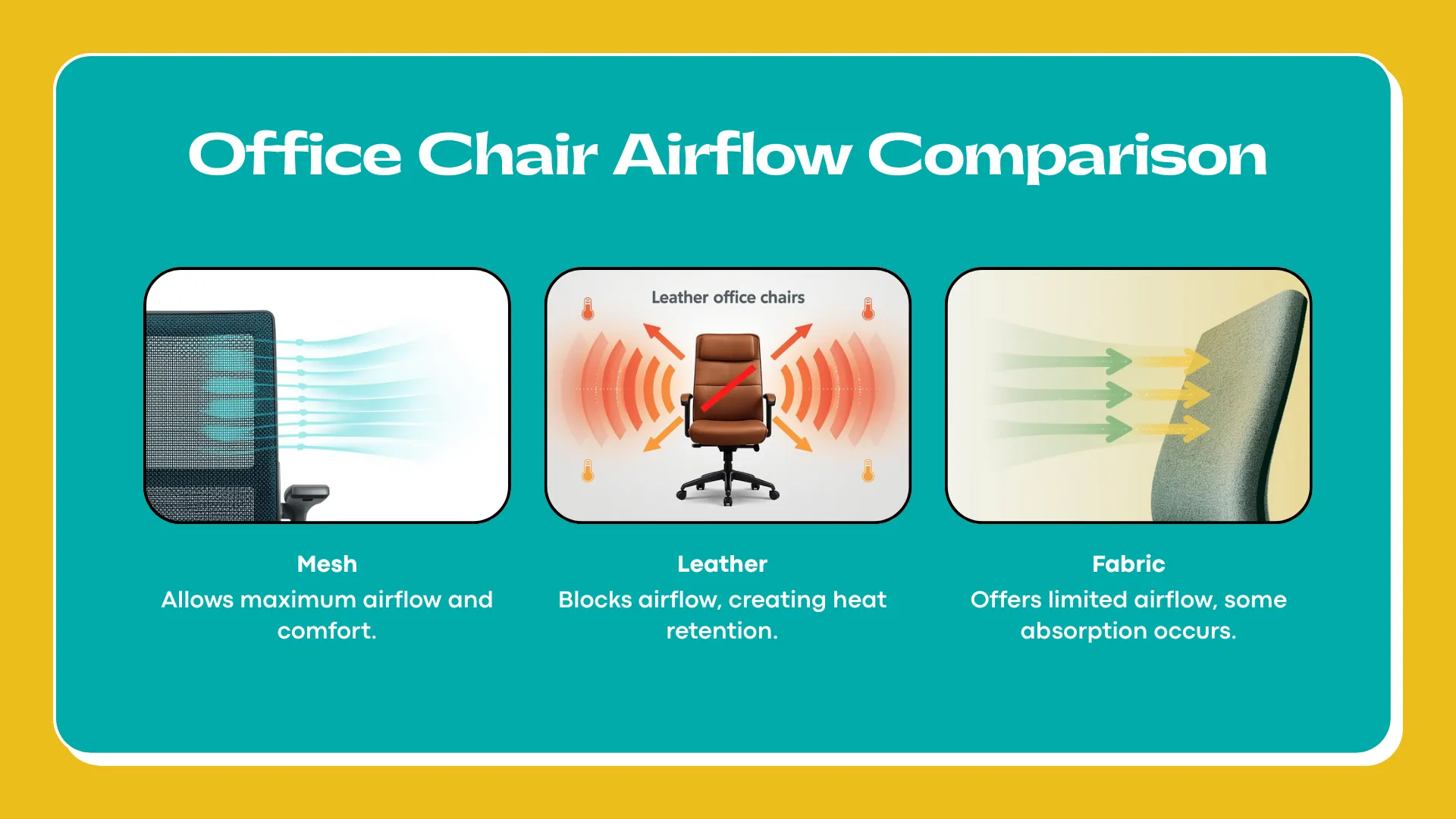
Mesh Office Chairs: The Tropical Performance Standard
Mesh has become the default office chair material in modern Malaysian workplaces for a reason that goes beyond trend. The physics simply work.
High-quality mesh uses synthetic fibers (typically polyester or nylon) woven into an open structure that functions as a suspension system. Industry benchmarks suggest premium mesh can allow up to 6.5 times more airflow than solid materials like leather or dense fabric. That gap matters most in environments where ambient temperature and humidity stay high year-round.
You can explore Merryfair’s full range of mesh, fabric, and material options to see how different weave densities perform across product lines.
Why is mesh the most popular office chair material in hot climates?
Mesh prevents what engineers call the “heat soak” effect. When you sit in a solid-back chair, your body heat has nowhere to go. It builds up between your skin and the chair surface, creating discomfort within 30 to 60 minutes.
Mesh breaks that cycle. Air circulates behind your back continuously. Your body’s natural cooling system actually works instead of fighting the chair.
In practice, this translates to measurable comfort gains. A 2023 study cited by Esplanade Office found that participants in mesh chairs reported 35% less perceived heat discomfort compared to those in non-breathable seating.
A mesh backrest paired with a foam seat cushion often outperforms either material used alone.
And here’s what most guides skip: the best mesh chairs in tropical markets use a hybrid approach. Mesh on the backrest handles breathability. A high-density foam cushion on the seat provides the comfort that pure mesh sometimes lacks. This combination eliminates the “too firm” complaint while keeping you cool.
Do mesh office chairs sag over time?
Yes, but the timeline depends entirely on quality. Budget mesh chairs (under RM300) can start sagging in 1 to 3 years as the fibers lose elastic memory. The seat frame may press against your thighs once tension drops.
Premium mesh holds its shape for 5 to 10 years under daily use. Look for chairs that pass ANSI/BIFMA X5.1 testing, which simulates years of heavy use through drop and cycle tests. Manufacturers offering 5-year or longer warranties on their mesh are signaling confidence in their weave quality.
The real cost of an office chair isn’t the price tag; it’s the replacement cost divided by years of comfortable use.
Leather Office Chairs: Executive Style Meets Tropical Reality
Leather projects authority. There’s no arguing with the visual impact of a well-crafted leather executive chair in a boardroom or corner office. But in Malaysia, leather’s performance story gets complicated fast.
Genuine full-grain leather is a natural material with limited breathability. In poorly ventilated spaces, it creates a sealed contact layer between your body and the chair. The result? Sweat builds up faster, and that “sticky” feeling arrives within the first hour.
For those interested in why executive comfort drives productivity in the modern workplace, material choice is where that conversation starts.
Why do leather office chairs crack and peel in Malaysia?
Humidity is leather’s quiet enemy. In dry climates, leather’s main risk is drying out. In Malaysia, the problem reverses: constant moisture fluctuations cause the material to expand and contract repeatedly, weakening its structural bonds over time.
Bonded leather (reconstituted scraps glued to a fabric backing) fails fastest. It typically lasts only 3 to 5 years before peeling begins, and Malaysia’s humidity accelerates that timeline. Faux PU leather follows a similar pattern, often cracking along flex points where you sit and recline daily.
Genuine full-grain leather holds up far better, but it demands maintenance that most owners skip: conditioning every 6 to 12 months, avoiding direct sunlight, and wiping down weekly. Skip this routine, and even premium leather starts showing stress within three years.
Cheap faux leather doesn’t just crack faster in humid climates; it starts peeling before the warranty expires.
Is PU leather the same as genuine leather on office chairs?
Not even close. Here’s the breakdown:
| Type | What it is | Typical lifespan | Malaysia performance |
|---|---|---|---|
| Genuine full-grain leather | Animal hide, top layer intact. | 7-15 years with care. | Good with consistent maintenance. Sticky without AC. |
| Top-grain leather | Sanded and treated hide. | 5-10 years with care. | Decent. Less breathable than full-grain. |
| PU (polyurethane) leather | Synthetic coating over fabric base. | 3-5 years. | Peels and cracks in high humidity. |
| Bonded leather | Shredded leather scraps glued together. | 2-4 years. | Fails quickly. Avoid for Malaysian offices. |
So when a chair listing says “leather,” check what type. Bonded and PU leather office chairs may cost less upfront, but they’re poor investments in tropical environments.
Fabric Office Chairs: The Comfortable Middle Ground
Fabric chairs offer what mesh and leather sometimes lack: a soft, cushioned feel from the moment you sit down. For people who find mesh too firm and leather too sticky, fabric seems like the obvious compromise.
And for cooler, drier climates, it often is. But Malaysia’s humidity creates a specific challenge for fabric upholstery that most buyers don’t anticipate.
In humid environments (above 60% relative humidity), fabric’s moisture retention becomes a real factor. Practical observations from manufacturers suggest that moisture accumulation can increase skin-to-fabric friction by an estimated 50 to 70%, which affects both comfort and hygiene over time.
If you’re shopping on a budget, check out affordable ergonomic chairs under RM1,000 from Merryfair, which include options in multiple materials for direct comparison.
Are fabric office chairs good for hot weather?
Fabric sits in the middle of the breathability spectrum. It’s better than leather because the woven fibers allow some air circulation. But it’s worse than mesh because those same fibers absorb and hold moisture.
In an air-conditioned Malaysian office kept below 25°C with humidity controlled, fabric performs reasonably well. In offices with weaker AC, shared meeting rooms that heat up during the afternoon, or home offices without climate control, fabric becomes uncomfortable faster than mesh.
Fabric chairs in 80% humidity can increase skin friction by 50 to 70%, accelerating wear on both chair and clothing.
Fabric’s real strength is versatility. It comes in the widest range of colours, patterns, and textures of any chair material. For offices where aesthetic customisation matters (reception areas, design studios, coworking spaces), fabric offers options that mesh and leather simply can’t match.
How do you maintain a fabric chair in a humid office?
Fabric demands the most active maintenance of the three materials. Vacuum the seat and backrest weekly to remove dust and trapped allergens. Address spills immediately with a pH-neutral cleaner; fabric absorbs liquids fast, and stains set quickly in humid conditions.
Every three to six months, consider a deeper clean using a fabric-specific upholstery cleaner. Some offices rotate fabric chairs through a steam-cleaning cycle quarterly. This prevents odour buildup, which is the biggest long-term risk for fabric in tropical environments.
The Climate-Fit Material Matrix: How to Choose Your Office Chair Material
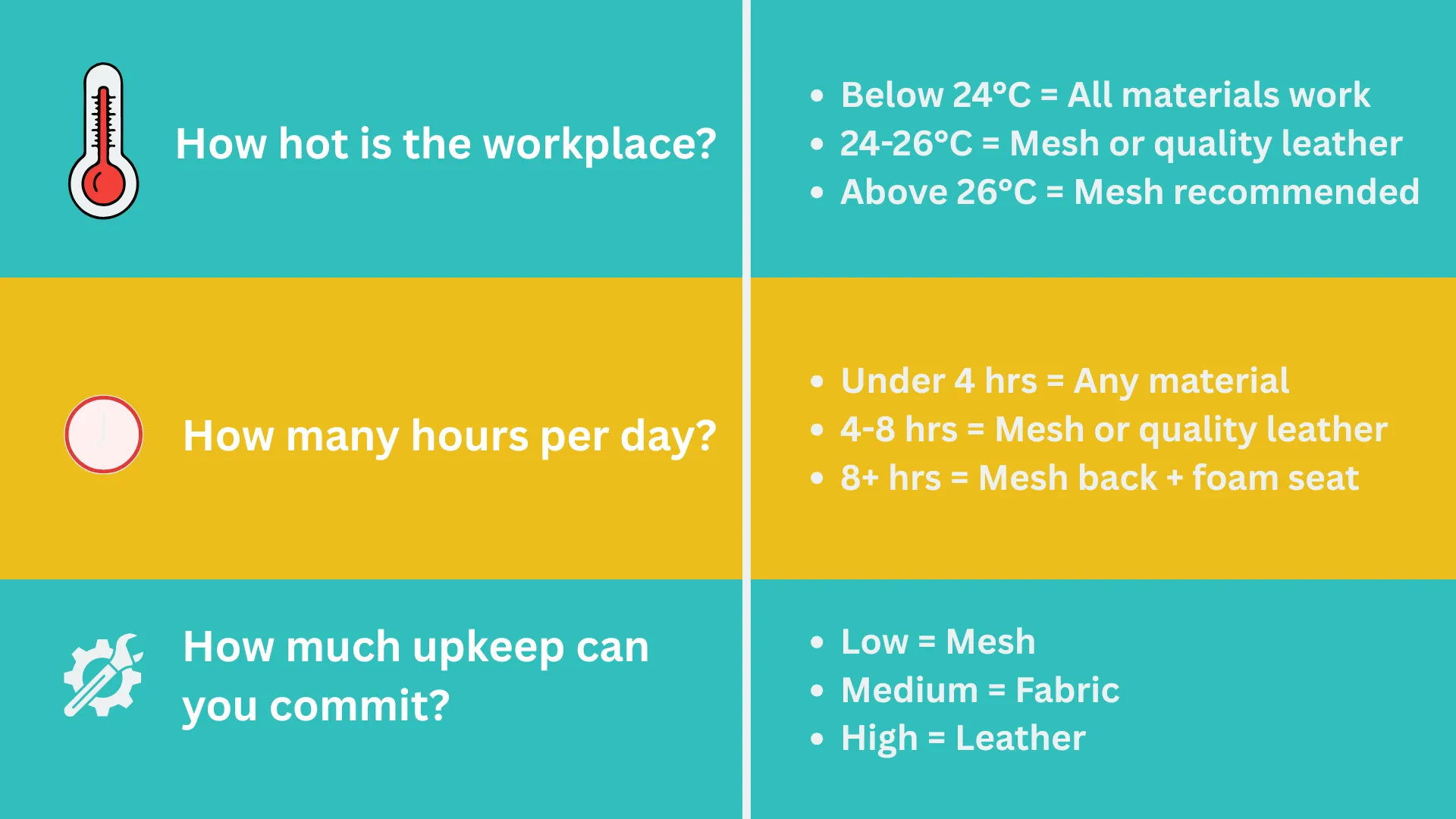
Merryfair’s approach to material selection, developed through five decades of manufacturing office chairs in Malaysia, follows a three-factor evaluation we call the Climate-Fit Material Matrix.
- Thermal load. How hot is your workspace? If your office stays below 24°C with controlled humidity, all three materials work. Above 26°C or in spaces with inconsistent AC, mesh becomes the clear winner.
- Usage intensity. How many hours per day, and how many people per chair? For 8+ hour daily use by a single user, mesh or high-quality genuine leather perform best. For shared desks and hot-desking environments, mesh wins because it doesn’t retain the previous user’s body heat.
- Maintenance capacity. How much upkeep can you realistically commit to? Mesh is lowest effort. Leather requires consistent conditioning. Fabric needs regular cleaning. Be honest about this one. (Most offices overestimate their maintenance discipline.)
Your office chair material matters more than your air conditioning setting for personal thermal comfort.
What is the best office chair for long hours in a tropical climate?
For 6-8 hours of daily sitting in Malaysia’s climate, a mesh-back chair with a high-density foam seat cushion is the strongest general recommendation. You get continuous airflow where heat builds up most (your back) and comfortable cushioning where pressure accumulates most (your seat).
This hybrid construction is why many premium ergonomic chairs in the Malaysian market use mesh backrests even when the seat is upholstered. It’s not compromise; it’s precision.
When comparing gaming chairs vs office chairs for ergonomic performance, material is often the factor that separates all-day comfort from all-day heat.
Which material works best for shared office desks?
Shared and hot-desking setups add hygiene to the equation. Mesh is the clear winner here. It doesn’t absorb sweat or body oils from the previous user. It dries quickly if someone spills their teh tarik. And it’s the easiest to wipe down between users.
Here’s a scenario-based recommendation based on common Malaysian workplace types:
| Workplace scenario | Recommended material | Why |
|---|---|---|
| Executive suite or boardroom | Genuine full-grain leather | Short meeting durations. Professional image priority. AC well-controlled. |
| Open-plan office (8+ hrs/day) | Mesh back with foam seat | Maximum breathability for long sessions. Low maintenance. |
| Home office (variable AC) | Mesh | Most forgiving when climate control isn’t constant. |
| Shared/hot-desking | Mesh | Hygiene, quick dry time, no heat retention between users. |
| Reception or creative studio | Fabric | Aesthetic range matters more; shorter sitting durations. |
| Conference room | Fabric or leather | Comfort for 1-2 hour meetings; visual impact. |
You can explore Merryfair’s ergonomic solutions in the showroom to test how each material feels after 30 minutes of sitting. That test tells you more than any spec sheet.
Your Chair Material Is Only Half the Equation
Material gets you comfortable. Ergonomic design keeps you healthy. The best office chair material in Malaysia won’t fix poor lumbar support, a non-adjustable seat height, or armrests that force your shoulders upward.
Start with material to filter your options. Then evaluate adjustability, build quality, and warranty length. A well-built mesh chair with 4-point adjustability will outperform an expensive leather chair with no lumbar support every time.
Every office in Malaysia should test chair materials for one week before committing to a bulk purchase.
Browse Merryfair’s complete seating product catalogue to compare ergonomic features across mesh, fabric, and leather options built specifically for Malaysian workplaces.
The smartest move? Order samples of two or three chairs. Let your team use them for a week. Collect honest feedback. That one-week trial will save you from years of regret and replacement costs.
Common Questions About Office Chair Materials in Malaysia
Is mesh or leather better for an office chair in Malaysia?
Mesh outperforms leather in most Malaysian office settings because of its superior breathability in high humidity. Malaysia’s average 80% humidity makes leather chairs uncomfortable for extended sitting without strong air conditioning. Leather works best in short-duration settings like meeting rooms where professional appearance matters more than thermal comfort.
What office chair material lasts the longest?
Genuine full-grain leather can last 7 to 15 years with proper conditioning and maintenance. Premium mesh chairs typically last 5 to 10 years. Fabric chairs average 4 to 7 years depending on weave quality and maintenance habits. Bonded or PU leather has the shortest useful life at just 2 to 5 years, especially in humid climates.
How do you clean a mesh office chair?
Vacuum the mesh weekly using an upholstery attachment to remove dust. For stains, apply a mild soap solution with a damp cloth and let it air dry. Mesh dries quickly because of its open weave. Avoid harsh chemical cleaners that can weaken the synthetic fibers and reduce the chair’s lifespan.
Can you use a leather office chair without air conditioning?
You can, but comfort drops significantly. Leather retains body heat and creates a sealed contact layer that promotes sweating. Without air conditioning in Malaysia’s climate, a leather chair becomes uncomfortable within 30 to 60 minutes of sitting. If your workspace lacks reliable AC, mesh is the safer choice.
What is the best budget office chair material?
Mesh offers the best value at lower price points. Budget mesh chairs (RM300 to RM600) provide adequate breathability and ergonomic support for daily use. Budget leather chairs in this range almost always use PU or bonded leather, which degrades quickly in Malaysia’s humidity. Fabric is a strong budget option for offices with good climate control.
MORE BLOGS
Do Posture Correctors Work? Why Your Chair Matters More
Do Posture Correctors Work? Why Your Chair Matters More Do posture correctors work for the millions of desk workers now strapping on braces and hoping for relief? The short answer: they build temporary awareness, but research shows they don’t create lasting change on their own. Overuse can actually weaken the muscles responsible for holding you […]
Read More
Best Ergonomic Office Chairs for Every Budget in 2026
The best ergonomic office chairs don’t need to cost thousands of ringgit to protect your back. A RM900 chair with proper lumbar support and adjustable armrests can outperform a RM3,000 model that doesn’t fit your body. The real question isn’t how much to spend. It’s what your body actually needs for the hours you sit. […]
Read More
What Is Lumbar Support? Why Your Office Chair Needs It
Lumbar support is the single most important feature separating an ergonomic office chair from one that slowly damages your back. Yet a 2025 study in Scientific Reports found that 80.81% of office workers experience musculoskeletal disorders, with lower back pain affecting more than half. The culprit, in most cases, is the chair they sit in […]
Read More
Why Executive Comfort Is the New Productivity
You can’t have productivity without comfort, and the biggest part of comfort while working is ergonomics.
Read More