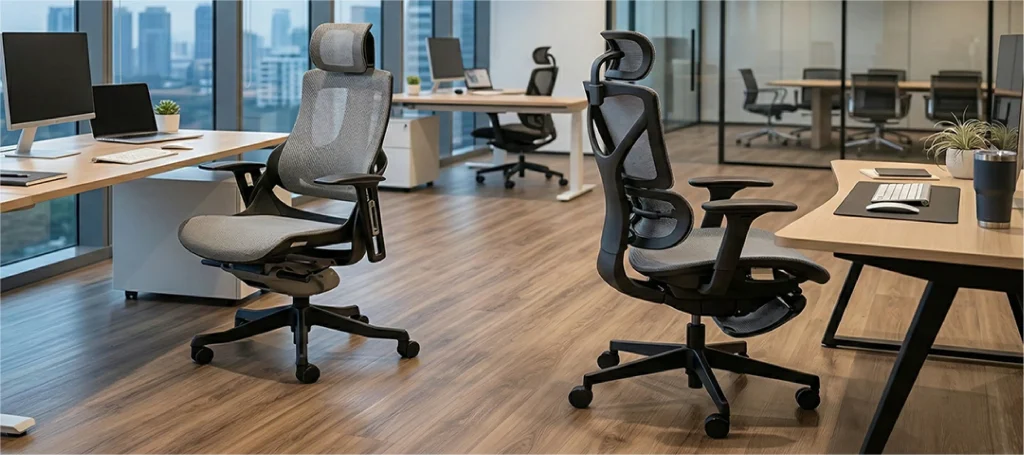
The 3-Layer Fit Test: How to Choose an Office Chair for Your Body
10th March, 2026

Figuring out how to choose an office chair sounds simple until you’re three months into owning one that pinches behind your knees or leaves a gap where your lower back needs support. Nearly 70% of Malaysian office workers report musculoskeletal pain in the neck, shoulders, or lower back, according to a 2018 study by Universiti Putra Malaysia. Most of them never learned how to test a chair before buying it.
The 3-Layer Ergonomic Fit Test is a step-by-step method for evaluating whether an office chair matches your body across three dimensions: static fit, support fit, and dynamic fit. Developed from Merryfair’s 50 years of chair manufacturing experience, it turns guesswork into a repeatable process you can use in any showroom or home trial.
This guide walks you through each layer. By the end, you’ll know exactly what to check, what to measure, and how to tell the difference between a chair that looks right and one that actually fits.
Why Most People Choose Office Chairs Wrong
Here’s the pattern. Someone walks into a showroom, sits in a chair for 20 seconds, bounces a little, says “feels nice,” and swipes their card. Or they buy online based on a review score and a photo.
Both approaches skip the part that actually matters.
A chair that fits your eye isn’t the same as a chair that fits your spine.
And the consequences are slow enough to miss. You don’t feel the mismatch on day one. You feel it at week three, when your lower back starts tightening by 2pm, or when your shoulders creep upward because the armrests sit too low for your desk height.
Why does my office chair hurt after a few hours?
Most chair discomfort builds gradually because of a poor dimensional match between your body and the chair’s adjustments. A seat that’s too deep cuts circulation behind your knees. Lumbar support that sits 5cm too high pushes into your mid-back instead of your lower curve. Armrests set too low force your shoulders to compensate.
The pain isn’t random. It traces back to specific fit failures that a quick sit-test can’t reveal.
A field study on office chair behaviour found that between 24% and 61% of office workers had never adjusted their chair, according to research cited in Applied Ergonomics. A separate study published in Human Factors (Amick et al., 2003) showed that providing workers with an adjustable chair plus training reduced discomfort, but training alone made no difference. The chairs weren’t always the problem. Many workers simply didn’t know how to use them.
If you’ve noticed five warning signs your current chair is failing your body, the issue likely started here.
What most buying guides actually miss about chair fit
Most guides in Malaysia list features: lumbar support, adjustable height, mesh back. That information is useful but incomplete. It tells you what a good chair should have. It doesn’t tell you whether a specific chair works for your specific body.
Two people can sit in the same RM2,000 ergonomic chair and have opposite experiences. One person’s 170cm frame fits perfectly. The other, at 155cm, can’t reach the floor with their feet flat and the lumbar pad sits above their lower back entirely.
Understanding how ergonomic chairs prevent back pain over time is important. But preventing pain starts with choosing a chair that physically fits you first.
That’s what the 3-Layer Fit Test does.
What the 3-Layer Ergonomic Fit Test Checks
The 3-Layer Ergonomic Fit Test, developed from Merryfair’s five decades of designing and manufacturing office chairs, identifies three levels of chair-body compatibility that you need to pass before committing to a purchase.
Static fit takes 30 seconds to check. Skipping it costs you 8 hours of discomfort every day.
Here’s the overview:
- Layer 1 (Static Fit): Do the chair’s physical dimensions match your body measurements? This covers seat height, depth, width, and armrest range.
- Layer 2 (Support Fit): Do the chair’s support systems align with your spine? This covers lumbar positioning, backrest contact, and pressure distribution across your back.
- Layer 3 (Dynamic Fit): Does the chair maintain support when you move? This covers recline behaviour, tilt tension, and whether the backrest tracks with your body through position changes.
Most buyers only check Layer 1 (and usually just the height). Layers 2 and 3 are where long-term comfort lives or dies.
Before you test any chair, you need to know the features that separate real ergonomic chairs from marketing labels.
How does the 3-Layer Fit Test work?
The test works by checking your body against the chair in a specific sequence. You start with measurable dimensions (Layer 1), then assess spinal support alignment (Layer 2), then test movement response (Layer 3). Each layer builds on the last.
If a chair fails at Layer 1, there’s no reason to proceed to Layer 2. A brilliant lumbar system won’t help if the seat height range can’t accommodate your leg length. This sequential approach saves time and prevents you from falling for a chair that feels good in one dimension but fails in another.
What measurements do I need before testing a chair?
You’ll get more from any chair test if you walk in knowing three numbers about your own body. You don’t need special equipment. A measuring tape and a flat-seated surface (like a dining chair) are enough.
| Body measurement | How to measure | What it tells you |
|---|---|---|
| Popliteal height (floor to back of knee while seated) | Sit on a hard flat chair with feet flat on the floor. Measure from the floor to the crease behind your knee. | Whether the chair’s seat height range will let your feet rest flat. |
| Buttock-popliteal length (seat depth needed) | From the back of your buttock to the crease behind your knee while seated. | Whether the seat depth allows 2-3 fingers of space behind your knees. |
| Shoulder width | Across the widest point of your shoulders. | Whether the backrest is wide enough to support your upper back without restriction. |

Layer 1 Static Fit: Does the Chair Match Your Body?
Layer 1 is pure geometry. You’re checking whether the chair’s adjustable range can accommodate your body’s physical dimensions. No subjective feelings yet. Just measurements against ranges.
This is the layer most people skip entirely. And it’s the one that causes the most preventable discomfort.
How do I know if a chair seat height is correct for me?
Sit in the chair with your feet flat on the floor. Your thighs should be roughly parallel to the ground or angled very slightly downward from hip to knee. If your feet dangle, the chair is too high. If your knees rise above your hips, it’s too low.
For context: the average popliteal height for Malaysian adults ranges from approximately 38cm to 47cm, depending on gender and individual proportions. Most quality ergonomic chairs offer a seat height range of roughly 42cm to 52cm from the floor, which covers the majority of users. But if you’re shorter than 155cm or taller than 185cm, this is the first place fit breaks down.
Check the specification sheet. If your popliteal height falls outside the chair’s adjustment range, no amount of lumbar support will fix the fact that your feet aren’t grounded.
What is the right seat depth for my leg length?
Sit with your back firmly against the backrest. Look at the gap between the front edge of the seat and the back of your knees. You need 5-8cm of clearance. About two to three fingers’ width.
If the seat edge presses into the back of your knees, it restricts blood flow to your lower legs. You’ll feel numbness or tingling after an hour. If the seat is too shallow, your thighs aren’t properly supported and your pelvis bears excess load.
Adjustable seat depth is one of the most underrated features on an ergonomic chair. Many budget models fix the seat depth at a single position, which means you’re either a perfect match or you’re not.
How wide should my office chair seat be?
Your hips should rest comfortably within the seat pan with roughly 2-3cm of space on each side. Too narrow and you feel squeezed. Too wide and your arms can’t reach the armrests naturally, which forces your shoulders into an unnatural position.
Seat width rarely appears on buying guides because it’s rarely adjustable. But it’s a critical fit dimension, especially for users who fall outside the average Malaysian frame. If you’re broader, you need a chair designed with a wider seat pan. Forcing yourself into a narrow seat creates lateral pressure on the hips that worsens throughout the day.
Layer 2 Support Fit: Does the Chair Hold Your Spine Right?
Once you’ve confirmed the chair’s dimensions match your body (Layer 1), you test how the support systems interact with your spine. This is where the difference between a good chair and a great one becomes obvious.
Lumbar support in the wrong position is worse than no lumbar support at all.
How should lumbar support feel when it fits properly?
Sit back fully into the chair. The lumbar support should press gently into the inward curve of your lower back, roughly at the level of your belt line (L3-L5 vertebrae). You shouldn’t have to push backward to feel it. It should meet your back naturally.
If the support feels like it’s pressing into your mid-back, it’s too high. If it seems to miss your back entirely and you only feel the flat backrest, it’s too low. Both situations force your muscles to compensate for what the chair isn’t doing.
This is why adjustable lumbar height matters more than the mere presence of lumbar support. Understanding what lumbar support does and why position matters changes how you evaluate every chair you sit in.
The best test: sit in the chair for three minutes without thinking about your posture. Then check. Are you still sitting upright, or have you slouched forward? If you’ve slouched, the lumbar support isn’t doing its job for your body.
Can I test backrest contact without special equipment?
Yes. Use your hand.
While seated normally, slide your hand between your back and the backrest. Run it from your lower back up to your shoulder blades. The backrest should maintain consistent contact along your entire spine. If there are large gaps (where your hand slides through easily), the backrest isn’t contouring to your spinal curve.
Pay extra attention to two zones: the lumbar region (lower back) and the thoracic transition (where your mid-back curves outward). Many chairs support the lower back but leave a gap at the mid-back, which creates a pressure point and makes it harder to maintain contact over long sitting sessions.
If you can’t feel the backrest touching your lower back without pushing into it, the chair doesn’t fit you.

Layer 3 Dynamic Fit: Does the Chair Move With You?
Layer 3 is where your test shifts from sitting still to sitting as you actually work. Your body moves an average of 53 times per hour while seated, according to research cited by Herman Miller. A chair that only works in one position fails you 52 times.
A static fit and a support fit can both be perfect, and the chair can still disappoint you if its recline mechanism fights your movements or the tilt tension snaps you upright every time you lean back.
How long should I sit in a chair before deciding to buy it?
At minimum, 15 minutes. Ideally, 30 minutes or more.
The first five minutes tell you almost nothing useful. Your body hasn’t settled. Your muscles haven’t relaxed into (or against) the chair’s support zones. The real test begins around minute 10, when your posture stops being conscious and becomes automatic.
The best time to test an office chair is late afternoon, when your body has already accumulated the day’s postural fatigue.
If a chair passes the test at 4pm on a Wednesday, it’ll work at 9am on Monday. The reverse isn’t always true.
During your test, do what you’d normally do: type, read your phone, lean back to think. Don’t sit in a perfect demonstration posture. Sit like a human.
What should I check when testing office chair recline?
Lean back slowly. The backrest should follow your movement smoothly, without a jarring click or a sudden release. You should feel supported through the entire range of motion, not just at the endpoints.
Then check tilt tension. When you lean back, does the chair push back with enough resistance to keep you supported? Or does it feel like you’re falling backward? Good tilt tension matches your body weight. Lighter users often need less tension; heavier users need more.
The gold standard is synchro-tilt, where the seat and backrest recline together at a coordinated ratio (typically the back reclines faster than the seat). This keeps your thighs supported and your hips open even as you lean back. Not every chair offers it, but for comparing gaming chairs and office chairs for long sitting sessions, it’s one of the clearest differentiators.
Try returning to upright from a reclined position. The chair should assist you smoothly. If you have to muscle yourself forward or grab the desk, the tilt mechanism isn’t calibrated for your weight.
Where to Test Office Chairs in Malaysia
Knowing the 3-Layer Fit Test is only useful if you can actually apply it. The best place to run a proper test is in person, at a showroom or retail location where you can sit for a meaningful amount of time.
Can I test an ergonomic chair before buying online?
Some online retailers offer trial periods (typically 7-30 days), but policies vary and returns can be logistically painful. The better option, if it’s available to you, is to test first in a physical showroom and buy the specific model you’ve confirmed fits your body.
Merryfair’s showroom in KL (No. 82-84, Jalan 2/23A, Jalan Genting Kelang, 53300 Kuala Lumpur) carries the full range for hands-on testing. If visiting a showroom isn’t practical, look for retailers that offer a meaningful return window and read the policy carefully before ordering.
For those on tighter budgets, it’s still possible to find ergonomic chairs that deliver real support under RM1,000. But even at the budget tier, testing before buying prevents expensive mistakes.
What should I check at an office chair showroom?
Bring your three measurements (popliteal height, buttock-popliteal length, shoulder width) and run each chair through the full 3-Layer Fit Test. Here’s what to prioritise at the showroom:
- Adjust every control before sitting. Set the height, seat depth, lumbar, and armrests to your body first.
- Sit for at least 15 minutes in your top two choices. Don’t rush.
- Test with your actual sitting posture, not a showroom-perfect position.
- Wear the shoes you’d normally wear to work. Shoe heel height affects your popliteal measurement by 2-4cm.
- Ask about the chair’s weight capacity and whether the tilt tension is user-adjustable.
- Check the certification. Look for BIFMA, GREENGUARD, or equivalent international standards.
(A showroom visit also lets you compare materials in person. Mesh breathability and foam density feel different than they look in product photos, especially in Malaysia’s humidity.)
Your Chair Fitting Checklist Starts Now
The 3-Layer Ergonomic Fit Test turns chair shopping from a guessing game into a structured evaluation. Static fit checks whether the chair’s dimensions match your body. Support fit checks whether the chair holds your spine correctly. Dynamic fit checks whether the chair moves with you, not against you.
If a chair passes all three layers, you’ll know before you buy. And that confidence is worth more than any return policy.
The right chair should feel invisible after the first hour. Not exciting, not noticeable. Just gone, because your body isn’t fighting it.
Ready to run the test? Explore the best ergonomic office chairs across every budget tier or visit Merryfair’s showroom to try the 3-Layer Fit Test in person.
Common Questions About Choosing Office Chairs
Does my body type affect which office chair I should buy?
Yes. Your height, weight, hip width, and leg length determine which seat dimensions, weight capacities, and lumbar ranges work for you. Two people at the same height can need different seat depths based on their leg proportions. Always check the chair’s adjustable ranges against your own measurements before buying.
What is the correct seat height for my height?
Measure your popliteal height (floor to the crease behind your knee while seated). The chair’s seat height should adjust to match that number. For most Malaysian adults, this falls between 38cm and 47cm. Your feet should sit flat on the floor with thighs roughly parallel to the ground.
Why do expensive office chairs still feel uncomfortable?
Price doesn’t guarantee fit. An expensive chair designed for a 180cm European frame won’t feel right on a 158cm Malaysian body. The issue is almost always dimensional mismatch, especially in seat depth and lumbar height. Running the 3-Layer Fit Test reveals whether the chair actually fits you regardless of its price.
How do I choose between mesh and foam seat cushions?
Mesh distributes weight across a wider surface and breathes better in warm, humid climates like Malaysia. Foam offers a more cushioned, defined seat feel and works well for users who prefer firmer support. Neither is objectively better. Choose based on your climate, comfort preference, and how many hours you sit daily.
Is it worth visiting a showroom to test chairs in person?
A 15-minute showroom test tells you more than any review. You can check all three layers of the Ergonomic Fit Test and compare models side by side. Showroom testing is especially valuable if you fall outside average body dimensions, since online specs don’t always reveal how a chair feels for your specific frame.
MORE BLOGS
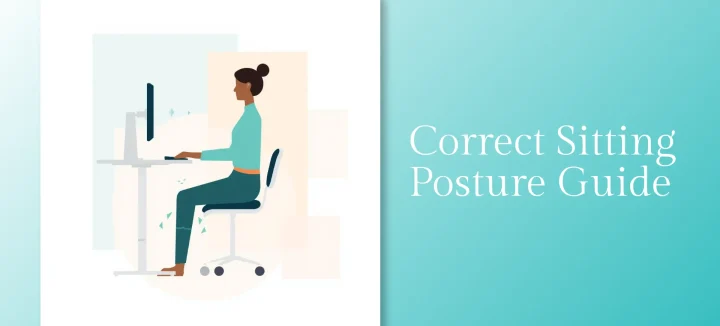
Correct Sitting Posture: Step-by-Step Office Chair Guide
Correct sitting posture breaks down within 20 minutes for most people. That’s the finding from Cornell University’s ergonomics research. Your body starts slouching before you notice it. And by mid-afternoon, most desk workers are sitting in a shape their spine was never designed to hold. So what does correct posture look like? It starts at […]
Read More
Standing Desk vs Ergonomic Chair: How to Pick the Right One
Standing desk vs ergonomic chair is the wrong question. Here’s why. Even standing desk owners still sit for 75 to 80 percent of their workday. That data comes from ProtoArc’s workplace wellness research. Your body doesn’t need you to pick sides. It needs support when you sit and movement when you’ve sat too long. This […]
Read More
Small Home Office Ideas That Protect Your Back and Save Space
Small home office ideas don’t need to start with Pinterest boards and paint swatches. They need to start with your spine. A PMC study found that 61.2% of home workers reported musculoskeletal discomfort while working remotely, and over half were working from dining tables or bedrooms. The fix isn’t a bigger room. It’s a smarter […]
Read More
Ergonomic Home Office Setup: A 5-Zone Guide That Works
Your ergonomic home office setup is probably wrong. A PMC study found that 61.2% of home workers reported musculoskeletal discomfort while working remotely. Nearly half were working from dining tables or bedrooms. An ergonomic home office setup comes down to five zones: chair, desk, screen, peripherals, and environment. Get these five right and you fix […]
Read More