Effects of Poor Sitting Posture: 7 Ways It Damages Your Body (And How Ergonomics Fixes Each One)
18th March, 2026

Poor sitting posture is damaging your spine, lungs, mood, and digestive system every hour you spend at a desk. Most guides stop at back pain. The reality covers seven distinct effects, each with a different mechanism and a specific ergonomic fix. Here’s what’s actually happening in your body, and what stops it.
TL;DR — Poor sitting posture damages your body in 7 ways:
- Chronic back pain and spinal disc compression
- Neck strain, shoulder tension, and tension headaches
- Reduced lung capacity and shallow breathing
- Disrupted sleep and persistent fatigue
- Slowed digestion and acid reflux
- Nerve compression and referred pain
- Lower mood, reduced focus, and impaired mental performance
Each one has a specific ergonomic fix. Read on.
What Is Poor Sitting Posture?
Poor sitting posture is any seated position that forces your spine away from its natural neutral curve. Your lumbar spine has a slight inward curve. Your thoracic spine curves gently outward.
When those curves get distorted by slouching, leaning, or hunching forward, the muscles, discs, and nerves supporting your spine absorb forces they weren’t designed to handle.
It shows up in three main patterns.
Forward Head Posture
This is when your head drifts forward past your shoulders toward your screen. For every 2.5 centimetres it moves forward, the effective load on your cervical spine increases sharply. At 60 degrees of forward tilt — the angle of most people looking down at a phone — your neck handles the equivalent of 27 kilograms of compressive force. A 2014 study in Surgical Technology International confirmed this loading pattern, which is roughly five times the neutral weight of your head.
Rounded Shoulders
Sitting with your arms reaching forward toward a keyboard pulls your shoulder blades apart and rotates the shoulder joint inward. Over months of desk work, your chest muscles tighten and your upper back muscles weaken. The rounded-shoulders look becomes your default, even when you’re not sitting.
Slouching (Thoracic Kyphosis)
Slumping backward into a chair flattens your lumbar curve and pushes your thoracic spine into an exaggerated outward curve. This collapses your core, compresses your abdominal organs, and shifts your centre of gravity forward. Your muscles fight to hold you upright all day. Eventually, they lose. That’s when the pain starts.
How Do You Know If You Have Poor Sitting Posture?
Run through this quick self-check at your desk right now.
- Your chin juts forward past your collarbone
- Your shoulders are visibly rounded or raised toward your ears
- Your lower back is flat against the chair (no natural inward curve)
- Your feet don’t sit flat on the floor
- You feel neck or upper back tightness by mid-afternoon
- Your screen sits noticeably below your eye level
Three or more? You’ve got a posture problem. The seven effects below explain what it’s already costing you.
1. Chronic Back Pain and Spinal Disc Compression
Poor sitting posture places uneven load on the intervertebral discs of your lumbar spine. Sustained pressure on one side of a disc causes it to bulge. The surrounding muscles weaken and tighten unevenly in response. The result is the kind of persistent lower back ache that doesn’t fully go away, even on rest days.
Why does poor posture cause back pain?
Your intervertebral discs act as shock absorbers between each vertebra. In a neutral seated position, pressure on those discs is roughly 40% higher than when you’re standing. Slouch forward and it increases further. Over time, the outer fibres of the disc weaken and the inner gel-like nucleus shifts, pressing against nearby nerves. That’s when a dull ache becomes sharp or shooting pain.
[QUOTABLE] Back pain from poor posture isn’t the result of a single injury. It’s the cumulative damage of thousands of hours of uneven spinal loading.
Muscle imbalance makes it worse. When your hip flexors and lower back muscles are constantly shortened from sitting, they pull your pelvis forward. Meanwhile, your glutes and deep core muscles switch off from disuse. You’re left with a spine that’s structurally unsupported from every direction.
The ergonomic fix for spinal strain
A chair with adjustable lumbar support holds your spine’s natural inward curve in place passively. You don’t have to think about sitting straight. The ergonomic chair does it.
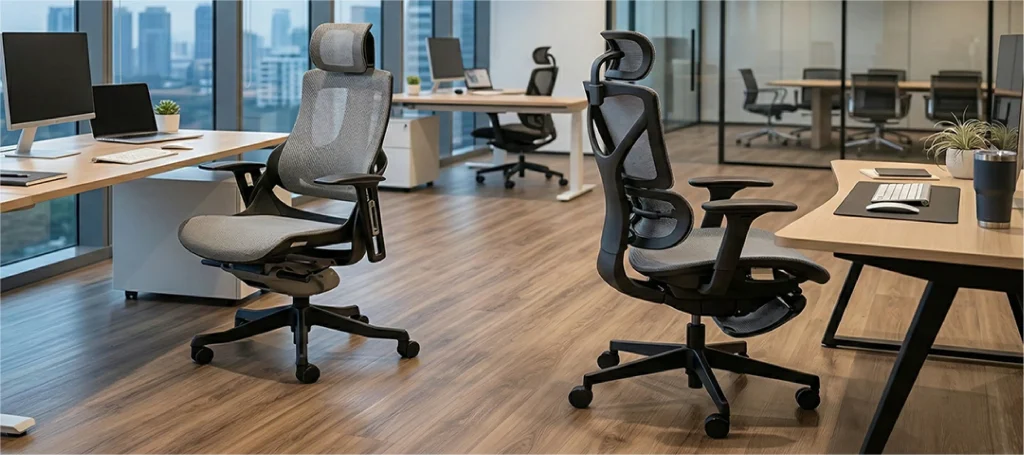
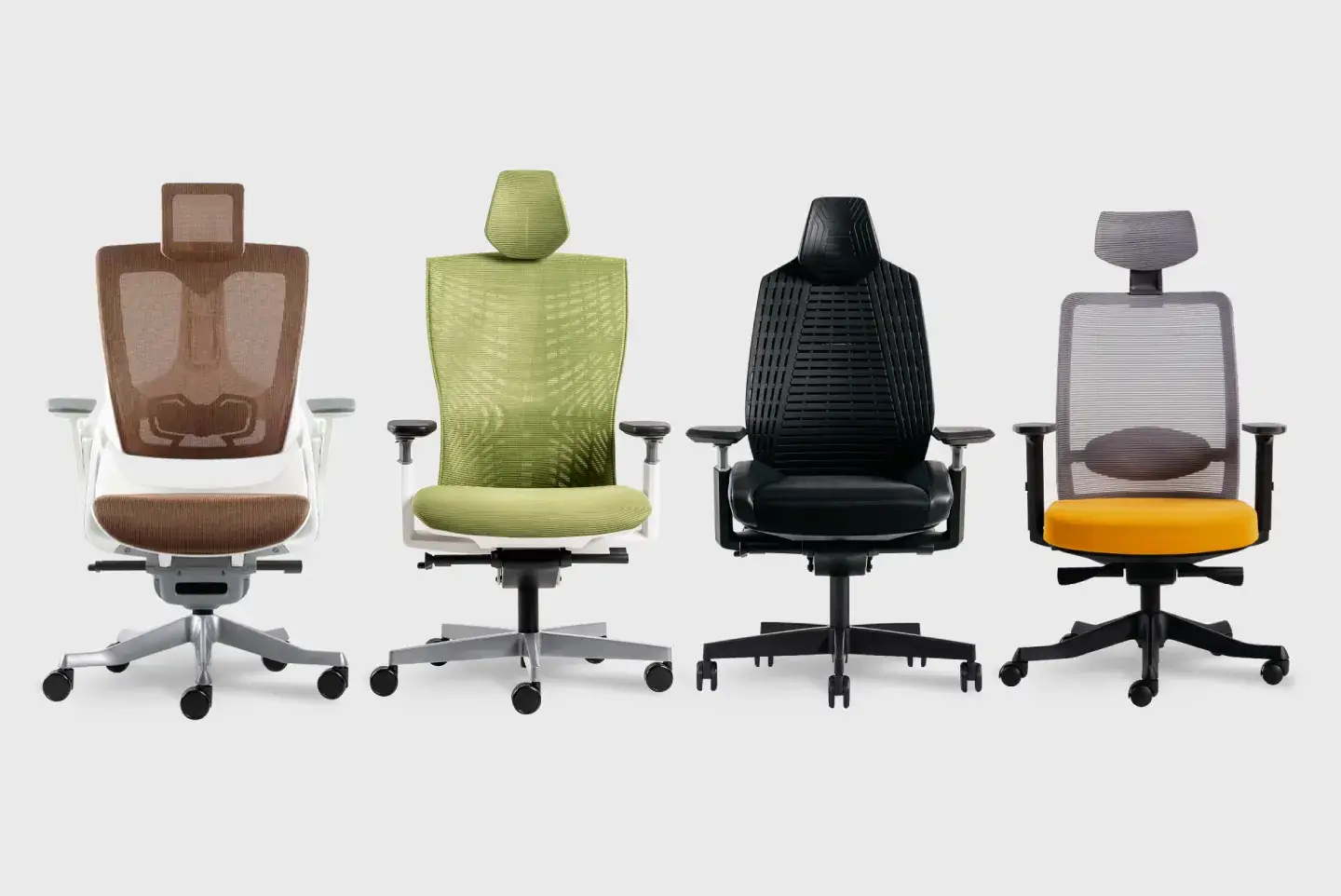
For example, Merryfair’s Reya supports your lumbar curve and distributes seat pressure evenly, so you can hold a productive position for hours without the gradual collapse that causes disc loading.

2. Neck Strain, Shoulder Tension, and Tension Headaches
Hunching toward a screen strains the muscles and connective tissue of your neck and upper back. Those muscles run directly into your scalp. When they’re tight and fatigued, they pull on the tissue covering your skull and trigger the kind of dull, pressing tension headache that builds through the afternoon.
Why does slouching cause tension headaches?
The trapezius and suboccipital muscles at the base of your skull are the first to suffer from forward head posture. They’re working overtime to hold your head against gravity. Sustained tension in these muscles restricts blood flow, builds lactic acid, and refers pain upward across your head.
[QUOTABLE] Most afternoon tension headaches aren’t caused by screen time or dehydration. They’re caused by four to six hours of forward head posture compressing the muscles at the base of your skull.
Rounded shoulders compound the issue by reducing the range of motion in your cervical spine. Your neck loses its neutral position. The surrounding muscles stay in a chronic state of low-grade tension, even on your days off.
The ergonomic fix for neck and shoulder pain
An adjustable headrest keeps your cervical spine in a neutral position, offloading the suboccipital muscles by giving your head something to rest against. Adjustable armrests matter too: when your arms are supported at elbow height, your shoulders drop their raised, tensed position and the trapezius finally relaxes. Merryfair’s Wau combines an adjustable headrest, lumbar support, and a flexible back mechanism that keeps your cervical and thoracic spine supported whether you’re leaning in or reclining.
3. Reduced Lung Capacity and Shallow Breathing
Slouching compresses your thoracic cavity and restricts the downward movement of your diaphragm, the primary muscle responsible for breathing. This forces you to breathe using only the upper portion of your lungs, reducing oxygen intake with every breath cycle throughout the day.
How does slumping affect your breathing?
Your diaphragm needs to move downward freely on each inhale. When you’re slumped, your rib cage compresses and your abdominal organs push upward, limiting how far the diaphragm can descend. The result is shallower breaths and a body running in a low-grade state of oxygen deficit all day.
Less oxygen means reduced alertness, faster mental fatigue, and a tiredness that caffeine doesn’t fix. (That 2pm slump isn’t just about lunch. It’s about six hours of restricted breathing.)
Slumped posture measurably reduces your functional lung capacity, meaning your body operates on less oxygen than it should for most of the working day — and that deficit shows up as brain fog long before it shows up as breathlessness.
The ergonomic fix for restricted breathing
Sitting upright with your hips slightly higher than your knees opens the angle between your torso and thighs, removing compression on your abdominal cavity. A chair with a seat tilt mechanism and proper lumbar support achieves this without any effort from you. Merryfair’s Ronin keeps your torso extended and your diaphragm free to move whether you’re in a long work session or a gaming marathon.
4. Disrupted Sleep and Persistent Fatigue
Poor sitting posture creates chronic muscle tension that doesn’t switch off when you close your laptop. Tight muscles in your back, neck, and hips stay activated and uncomfortable into the evening, making it harder to fall asleep and preventing the deep restorative sleep your body needs to recover and repair.
Why does poor posture interfere with sleep?
Muscle tension activates your sympathetic nervous system — your fight-or-flight response. When that system runs, cortisol levels stay elevated. Elevated cortisol suppresses melatonin production and keeps your brain in a state of low-level alertness that’s incompatible with deep sleep.
It’s a slow feedback loop. Poor posture during the day leads to worse sleep at night. Worse sleep leads to more fatigue and less body awareness the next day. More fatigue leads to worse posture. And so on.
The tension your back carries from eight hours of poor posture doesn’t disappear when you sit down to relax. It follows you to bed and quietly erodes your sleep quality night after night.
The ergonomic fix for postural fatigue
Reducing the muscular effort required to sit throughout the day reduces the accumulated tension your body carries into the evening. Merryfair’s Anggun is built to support a natural upright position with minimal active muscle engagement, so your body isn’t fighting the chair all day. Less tension at 6pm means a cleaner physical transition into rest.
5. Slowed Digestion and Acid Reflux
Slumping forward compresses your abdominal cavity and bends your digestive tract out of its optimal alignment. Food moves more slowly through a compressed gut. The lower oesophageal sphincter can be displaced, allowing stomach acid to reflux upward. The bloating and discomfort you attribute to what you ate could be a direct result of how you sat while eating it.
What does slouching do to your digestive organs?
Your stomach, intestines, and colon depend on consistent peristalsis — the wave-like muscle contractions that move food through. When your abdomen is compressed by hours of forward slouching, those muscles work against physical resistance. Gastric emptying slows. Gas builds up. The discomfort becomes a background hum through your afternoon.
Acid reflux is a specific risk. The angle between your oesophagus and stomach changes when you’re slumped, and the mechanical pressure on your stomach pushes acid upward. If you’re regularly uncomfortable after desk-based meals, your posture is worth examining before your diet.
The ergonomic fix for digestive compression
The fix is straightforward: sit upright, torso fully extended, hips at roughly 90 to 100 degrees. This restores the anatomical alignment your digestive system needs. A chair with seat depth adjustment lets you position correctly regardless of your height, removing the forward compression that makes digestion sluggish and reflux more likely.
6. Nerve Compression and Referred Pain
Sustained poor sitting posture can gradually compress the nerves that exit your spinal column, particularly in the lumbar region. Compressed nerves don’t just cause local pain. They send discomfort to wherever that nerve travels — including your glutes, hamstrings, calves, and feet.
How does poor posture compress nerves?
Your sciatic nerve is the largest in your body. It exits the lumbar spine and runs down through your glutes and the back of each leg. When poor posture causes lumbar muscles to tighten asymmetrically — or causes disc displacement — that nerve gets squeezed. The pain can appear anywhere along its path, which is why some people get back pain, others get hip pain, and others feel it in their calf.
[QUOTABLE] Sciatica that appears from nowhere is frequently the delayed result of months of postural compression on the lumbar spine: damage that accumulated slowly before announcing itself loudly.
Piriformis syndrome is a related issue. Sitting with poor pelvic alignment tightens the piriformis muscle deep in the glute, which can compress the sciatic nerve independently of the spine. You can have perfect disc health and still develop referred nerve pain from postural imbalance alone.
The ergonomic fix for nerve pressure
Seat depth and seat tilt are the key adjustments here. If your seat is too deep, the front edge digs into the back of your thighs, compressing the femoral nerve and restricting circulation. If your pelvis tilts backward in the seat, it increases lumbar flexion and closes the exit channels for spinal nerves. Adjustable seat depth and a dynamic tilt mechanism correct both problems at once.
7. Lower Mood, Reduced Focus, and Impaired Mental Performance
Your posture and your mental state are directly connected — and the relationship runs both ways. Poor sitting posture signals your nervous system that you’re in a low-energy, defeated state. Your body responds with reduced alertness, lower confidence, and elevated stress hormones. This isn’t motivational theory. It’s physiology.
Does bad posture affect your mood?
A randomised trial published in Health Psychology found that participants who maintained upright posture during a stress task reported higher self-esteem, more positive affect, and lower fear compared to those who sat slumped — even when their stress levels were objectively identical. Nair et al. (2015) found that slumped posture is associated with increased negative emotion and reduced energy. The body and brain aren’t as separate as most people assume.
[QUOTABLE] Sitting up straight isn’t just good for your spine. Research shows it directly improves self-esteem, reduces negative emotion, and increases energy compared to slumped sitting — with measurable differences after minutes, not months.
Practically, this matters for your work. Poor posture reduces blood flow to the brain through neck muscle tension and restricted breathing, on top of its direct effect on mood. You’re not just uncomfortable. You’re cognitively impaired.
The ergonomic fix for cognitive impact
Maintaining an upright, supported posture keeps your brain’s blood supply optimal and your nervous system in a calm, alert state. But the chair is only part of the system. Screens positioned below eye level pull your head downward and forward, triggering mood and focus effects regardless of how well your chair is adjusted. Ergonomics is a full setup, not a single product purchase.
How to Correct Poor Sitting Posture: Your Ergonomic Setup Checklist
Getting your posture right isn’t about willpower. It’s about setting up your environment so that the correct position is the easiest position. Here’s what that looks like in practice.
Chair Height and Seat Depth
Adjust your seat height so your feet rest flat on the floor and your knees sit at roughly 90 degrees. For seat depth, there should be two to three finger widths between the front edge of the seat and the back of your knees. No pressure on the back of your thighs. Seat depth adjustment is one of the most overlooked ergonomic features — and one of the most impactful for anyone under 5’7″ or over 6’1″.
Lumbar Support Positioning
Lumbar support should sit in the small of your back, filling the natural inward curve of your lumbar spine. Too high and it pushes your thoracic spine forward. Too low and it tilts your pelvis backward, which is worse than no support at all. If you want to go deeper on this, the guide on how to choose the right ergonomic chair for your body shape and sitting habits covers the exact fit process.
Monitor and Screen Height
Your monitor’s top edge should sit at or just below eye level. This keeps your cervical spine neutral and prevents the forward head posture that drives neck strain and headaches. For laptop users, an external monitor or a laptop stand is non-negotiable. Using a laptop flat on a desk puts your head at a 45-degree forward tilt for every hour of work.
Armrest and Keyboard Alignment
Set armrests so your elbows sit at 90 degrees with your shoulders fully relaxed — not raised, not pulled back. Your keyboard should sit at a height where your forearms are roughly parallel to the floor. Armrests that are too high push your shoulders up. Too low and you lean to one side. Either way, your neck absorbs the difference.
Your Posture Problem Is an Engineering Problem. Solve It Like One.
Poor posture isn’t a character flaw or an inevitability. It’s your body adapting to an environment that wasn’t designed for it. The fix is redesigning the environment.
But there’s a catch. No single product solves all of this on its own. If you’re wondering why posture corrector braces fall short without proper chair support, the answer is in the mechanism: braces create temporary awareness, chairs create structural support. One wears off. The other keeps working.
Merryfair’s range is built around real ergonomic function — adjustable lumbar support, seat depth, headrests, and tilt mechanisms that respond to how you actually move. The World Health Organisation estimates 1.71 billion people globally live with musculoskeletal conditions, many of them desk workers. Most of those conditions are preventable with the right setup. The right chair should make correct posture effortless, not something you remind yourself to do every twenty minutes.
If budget is a factor, read the full breakdown of ergonomic chairs across every budget that address posture-related pain before you decide.
Frequently Asked Questions About Poor Sitting Posture
What are the long-term effects of poor sitting posture?
Long-term poor sitting posture leads to chronic back and neck pain, permanent changes to spinal curvature, reduced lung capacity, digestive problems, nerve compression, and disrupted sleep. The effects compound over time: what starts as occasional stiffness becomes persistent pain, then structural change. The earlier you correct the underlying causes, the more reversible the damage.
Can poor sitting posture be corrected?
Yes. Most posture-related damage is reversible, especially when caught within the first few years. Correcting your workstation setup, strengthening your core and back muscles, and reducing prolonged static sitting are all effective. Structural spinal changes from decades of poor posture take longer to address, but even long-standing habits respond to consistent correction.
How long does it take for poor posture to cause damage?
Noticeable symptoms like neck tension and back stiffness can develop within weeks of adopting a poor seated position. Structural changes to muscles and connective tissue can begin within a few months. Disc and spinal curvature changes are longer-term, typically developing over years. The damage is gradual, which is why most people don’t realise it’s happening until the pain becomes consistent.
Is an ergonomic chair enough to fix poor posture?
An ergonomic chair is the single most impactful change you can make to your sitting environment, but it works best as part of a complete setup. Monitor height, keyboard placement, and regular movement breaks all contribute. A well-adjusted ergonomic chair removes the structural causes of poor posture passively, so you’re not relying on willpower to sit correctly for eight hours straight.
What is the correct sitting posture at a desk?
Correct sitting posture means your feet are flat on the floor, knees at roughly 90 degrees, lumbar spine supported in its natural inward curve, shoulders relaxed and not raised or rounded, and your head directly above your shoulders with your eyes level with the top of your screen. Your elbows should sit at 90 degrees, forearms roughly parallel to the floor.
MORE BLOGS
Standing Desk vs Ergonomic Chair: How to Pick the Right One
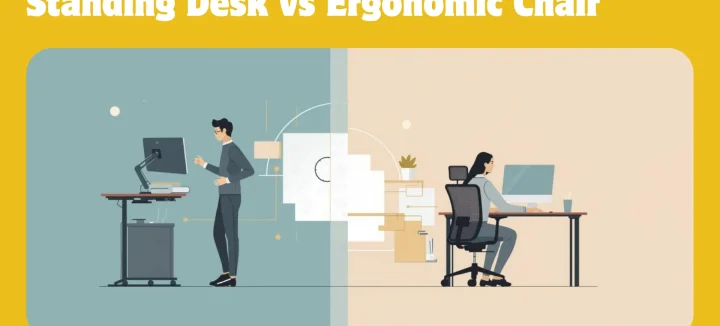
Standing desk vs ergonomic chair is the wrong question. Here’s why. Even standing desk owners still sit for 75 to 80 percent of their workday. That data comes from ProtoArc’s workplace wellness research. Your body doesn’t need you to pick sides. It needs support when you sit and movement when you’ve sat too long. This […]
Read More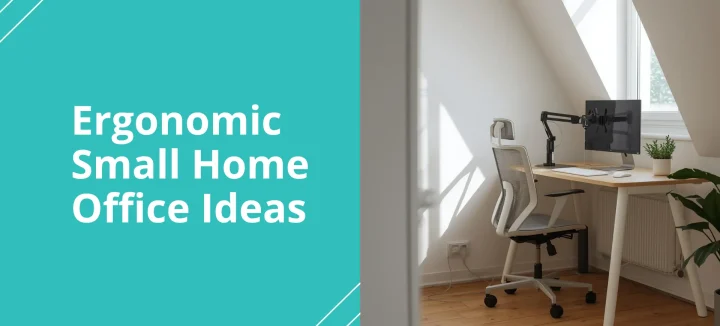
Small Home Office Ideas That Protect Your Back and Save Space
Small home office ideas don’t need to start with Pinterest boards and paint swatches. They need to start with your spine. A PMC study found that 61.2% of home workers reported musculoskeletal discomfort while working remotely, and over half were working from dining tables or bedrooms. The fix isn’t a bigger room. It’s a smarter […]
Read More
Ergonomic Home Office Setup: A 5-Zone Guide That Works
Your ergonomic home office setup is probably wrong. A PMC study found that 61.2% of home workers reported musculoskeletal discomfort while working remotely. Nearly half were working from dining tables or bedrooms. An ergonomic home office setup comes down to five zones: chair, desk, screen, peripherals, and environment. Get these five right and you fix […]
Read More
Your Ergonomic Chair Size Guide for Every Height and Weight
An ergonomic chair size guide should start with your body, not a product page. About 40% of the working population falls outside the “standard” range most chairs target. That means your chair might look ergonomic. It could still miss your body entirely. Your ideal chair size comes down to three numbers. Popliteal height (floor to […]
Read More